Qinghan Yu, Pai Li, Xing Ni, Youyong Li and Lu Wang
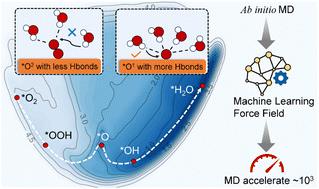
{"title":"Dynamics and kinetics exploration of the oxygen reduction reaction at the Fe–N4/C–water interface accelerated by a machine learning force field†","authors":"Qinghan Yu, Pai Li, Xing Ni, Youyong Li and Lu Wang","doi":"10.1039/D4SC06422D","DOIUrl":null,"url":null,"abstract":"<p >Understanding the oxygen reduction reaction (ORR) mechanism and accurately characterizing the reaction interface are essential for improving fuel cell efficiency. We developed an active learning framework combining machine learning force fields and enhanced sampling to explore the dynamics and kinetics of the ORR on Fe–N<small><sub>4</sub></small>/C using a fully explicit solvent model. Different possible reaction paths have been explored and the O<small><sub>2</sub></small> adsorption process is confirmed as the rate-determining step of the ORR at the Fe–N<small><sub>4</sub></small>/C–water interface, which needs to overcome a free energy barrier of 0.39 eV. By statistical analysis of solvent configurations for proton-coupled electron transfer (PCET) processes, it is revealed that the configurations of interface water remarkably influence the reaction efficiency. More hydrogen bonds and longer lifetimes facilitate the PCET reactions and even make them barrierless. Our theoretical framework highlights the significance of solvent configurations in determining free energy barriers, and offers new insights into the reaction mechanism of the ORR on Fe–N<small><sub>4</sub></small>/C catalysts.</p>","PeriodicalId":9909,"journal":{"name":"Chemical Science","volume":" 8","pages":" 3620-3629"},"PeriodicalIF":7.4000,"publicationDate":"2025-01-20","publicationTypes":"Journal Article","fieldsOfStudy":null,"isOpenAccess":false,"openAccessPdf":"https://pubs.rsc.org/en/content/articlepdf/2025/sc/d4sc06422d?page=search","citationCount":"0","resultStr":null,"platform":"Semanticscholar","paperid":null,"PeriodicalName":"Chemical Science","FirstCategoryId":"92","ListUrlMain":"https://pubs.rsc.org/en/content/articlelanding/2025/sc/d4sc06422d","RegionNum":1,"RegionCategory":"化学","ArticlePicture":[],"TitleCN":null,"AbstractTextCN":null,"PMCID":null,"EPubDate":"","PubModel":"","JCR":"Q1","JCRName":"CHEMISTRY, MULTIDISCIPLINARY","Score":null,"Total":0}
引用次数: 0
Abstract
Understanding the oxygen reduction reaction (ORR) mechanism and accurately characterizing the reaction interface are essential for improving fuel cell efficiency. We developed an active learning framework combining machine learning force fields and enhanced sampling to explore the dynamics and kinetics of the ORR on Fe–N4/C using a fully explicit solvent model. Different possible reaction paths have been explored and the O2 adsorption process is confirmed as the rate-determining step of the ORR at the Fe–N4/C–water interface, which needs to overcome a free energy barrier of 0.39 eV. By statistical analysis of solvent configurations for proton-coupled electron transfer (PCET) processes, it is revealed that the configurations of interface water remarkably influence the reaction efficiency. More hydrogen bonds and longer lifetimes facilitate the PCET reactions and even make them barrierless. Our theoretical framework highlights the significance of solvent configurations in determining free energy barriers, and offers new insights into the reaction mechanism of the ORR on Fe–N4/C catalysts.
了解氧还原反应机理,准确表征反应界面对提高燃料电池效率具有重要意义。我们开发了一个主动学习框架,结合利用机器学习力场和增强采样来探索在完全显式溶剂模型下Fe-N4/C上ORR的动力学和动力学。探索了不同可能的反应路径,并确定O2吸附过程是Fe-N4/ c -水界面上ORR的速率决定步骤,该过程需要克服0.39 eV的自由能垒。通过对质子耦合电子转移(PCET)过程中溶剂构型的统计分析,发现界面水的构型对反应效率有显著影响。更多的氢键和更长的寿命有利于PCET反应,甚至使其无障碍。我们的理论框架强调了溶剂构型在确定自由能垒中的重要性,并为研究ORR在Fe-N4/C催化剂上的反应机理提供了新的见解。
期刊介绍:
Chemical Science is a journal that encompasses various disciplines within the chemical sciences. Its scope includes publishing ground-breaking research with significant implications for its respective field, as well as appealing to a wider audience in related areas. To be considered for publication, articles must showcase innovative and original advances in their field of study and be presented in a manner that is understandable to scientists from diverse backgrounds. However, the journal generally does not publish highly specialized research.




 京公网安备 11010802042870号
京ICP备2023020795号-1
京公网安备 11010802042870号
京ICP备2023020795号-1

 分享
分享
 求助内容:
求助内容: 应助结果提醒方式:
 扫码关注我们
