Maximilian Beddoe, Sarah L. Walden, Slobodan Miljevic, Dmitry Pidgayko, Chengjun Zou, Alexander E. Minovich, Angela Barreda, Thomas Pertsch, Isabelle Staude
{"title":"Spatially Controlled All-Optical Switching of Liquid-Crystal-Empowered Metasurfaces","authors":"Maximilian Beddoe, Sarah L. Walden, Slobodan Miljevic, Dmitry Pidgayko, Chengjun Zou, Alexander E. Minovich, Angela Barreda, Thomas Pertsch, Isabelle Staude","doi":"10.1021/acsphotonics.4c02029","DOIUrl":null,"url":null,"abstract":"Embedding metasurfaces in liquid crystal (LC) cells is a promising technique for realizing tunable optical functionalities. Here, we demonstrate spatially controlled all-optical switching of the optical response of a homogeneous silicon nanocylinder metasurface featuring various Mie-type resonances in the spectral range between 670 and 720 nm integrated in a nematic LC cell. The initial alignment of the LC molecules is controlled by photoalignment layers, where the alignment direction is defined by homogeneous exposure with linearly polarized light at a 450 nm wavelength. Exposure of the photoalignment layer with the same light, whose polarization is rotated by 90°, induces a local change in the direction of the LC alignment and modulates the optical response of the metasurface. The resulting spatially dependent optical properties of the metasurface system are characterized by hyperspectral imaging. The described technique allows the nonvolatile creation of complex spatio-spectral response functions with a spatial resolution of 20 μm. Moreover, we demonstrate that the response of the LC-integrated metasurface can be switched multiple times by subsequent exposures with alternating orthogonal polarizations. Finally, we show that the images can be temporarily erased by heating the sample above the critical LC transition temperature, where the LC transitions to its isotropic phase. The demonstrated approach represents the controlling-light-by-light concept, an alternative to electro-optical or electromechanical control methods, which require complicated electronic architectures for spatially resolved modulation. Our results hold significant potential for applications such as next-generation displays or spatial light modulators that require spatial control of a tunable, tailored optical response.","PeriodicalId":23,"journal":{"name":"ACS Photonics","volume":"72 1","pages":""},"PeriodicalIF":6.7000,"publicationDate":"2025-01-21","publicationTypes":"Journal Article","fieldsOfStudy":null,"isOpenAccess":false,"openAccessPdf":"","citationCount":"0","resultStr":null,"platform":"Semanticscholar","paperid":null,"PeriodicalName":"ACS Photonics","FirstCategoryId":"101","ListUrlMain":"https://doi.org/10.1021/acsphotonics.4c02029","RegionNum":1,"RegionCategory":"物理与天体物理","ArticlePicture":[],"TitleCN":null,"AbstractTextCN":null,"PMCID":null,"EPubDate":"","PubModel":"","JCR":"Q1","JCRName":"MATERIALS SCIENCE, MULTIDISCIPLINARY","Score":null,"Total":0}
引用次数: 0
Abstract
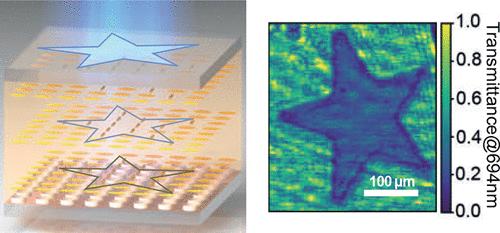
Embedding metasurfaces in liquid crystal (LC) cells is a promising technique for realizing tunable optical functionalities. Here, we demonstrate spatially controlled all-optical switching of the optical response of a homogeneous silicon nanocylinder metasurface featuring various Mie-type resonances in the spectral range between 670 and 720 nm integrated in a nematic LC cell. The initial alignment of the LC molecules is controlled by photoalignment layers, where the alignment direction is defined by homogeneous exposure with linearly polarized light at a 450 nm wavelength. Exposure of the photoalignment layer with the same light, whose polarization is rotated by 90°, induces a local change in the direction of the LC alignment and modulates the optical response of the metasurface. The resulting spatially dependent optical properties of the metasurface system are characterized by hyperspectral imaging. The described technique allows the nonvolatile creation of complex spatio-spectral response functions with a spatial resolution of 20 μm. Moreover, we demonstrate that the response of the LC-integrated metasurface can be switched multiple times by subsequent exposures with alternating orthogonal polarizations. Finally, we show that the images can be temporarily erased by heating the sample above the critical LC transition temperature, where the LC transitions to its isotropic phase. The demonstrated approach represents the controlling-light-by-light concept, an alternative to electro-optical or electromechanical control methods, which require complicated electronic architectures for spatially resolved modulation. Our results hold significant potential for applications such as next-generation displays or spatial light modulators that require spatial control of a tunable, tailored optical response.
期刊介绍:
Published as soon as accepted and summarized in monthly issues, ACS Photonics will publish Research Articles, Letters, Perspectives, and Reviews, to encompass the full scope of published research in this field.



 京公网安备 11010802042870号
京ICP备2023020795号-1
京公网安备 11010802042870号
京ICP备2023020795号-1

 分享
分享
 求助内容:
求助内容: 应助结果提醒方式:
 扫码关注我们
