{"title":"Molecular dynamics simulations of the structure and dynamics in mixtures of ionic liquids and alcohols†","authors":"Farkhondeh Mozaffari","doi":"10.1039/D4CP03215B","DOIUrl":null,"url":null,"abstract":"<p >Molecular dynamics simulations were conducted on mixtures of ionic liquids (ILs) and alcohols, specifically methanol, ethanol, and 1-propanol. Two different ILs, [Mmim][MeSO<small><sub>4</sub></small>] and [Bmim][MeSO<small><sub>4</sub></small>], were used with varying alcohol mole fractions to investigate the impact of alkyl chain length of cations, alcohol types, and alcohol concentrations on different structural and dynamic properties. Unique characteristics of the ILs were observed due to the varying polarity of solvents and the creation of diverse local environments surrounding the ILs. The alcohols weaken the hydrogen bond network of the ILs. A better anion–cation packing was observed for [Mmim][MeSO<small><sub>4</sub></small>]–alcohol than for [Bmim][MeSO<small><sub>4</sub></small>]–alcohol mixtures. The free volume and clustering of alcohol molecules in [Mmim][MeSO<small><sub>4</sub></small>]–alcohol mixtures were stronger than those in [Bmim][MeSO<small><sub>4</sub></small>]–alcohol mixtures; these effects were stronger for mixtures containing longer-chain alcohols. Alcohols accelerate the dynamics of ILs, examined in terms of the anion/cation diffusion coefficients, dynamics of ion-pair formation/rupture, and dynamics of the hydrogen bond formed between the anion and the cation. This effect is more pronounced for mixtures of ILs with shorter-chain alcohols. These findings are consistent with the results obtained for the structural perturbations in ILs in the presence of alcohols, <em>i.e.</em>, weakening of the hydrogen bond network in ILs upon addition of (shorter-chain) alcohols to the ILs, and reduced alcohol clustering.</p>","PeriodicalId":99,"journal":{"name":"Physical Chemistry Chemical Physics","volume":" 7","pages":" 3755-3772"},"PeriodicalIF":2.9000,"publicationDate":"2025-01-21","publicationTypes":"Journal Article","fieldsOfStudy":null,"isOpenAccess":false,"openAccessPdf":"","citationCount":"0","resultStr":null,"platform":"Semanticscholar","paperid":null,"PeriodicalName":"Physical Chemistry Chemical Physics","FirstCategoryId":"92","ListUrlMain":"https://pubs.rsc.org/en/content/articlelanding/2025/cp/d4cp03215b","RegionNum":3,"RegionCategory":"化学","ArticlePicture":[],"TitleCN":null,"AbstractTextCN":null,"PMCID":null,"EPubDate":"","PubModel":"","JCR":"Q3","JCRName":"CHEMISTRY, PHYSICAL","Score":null,"Total":0}
引用次数: 0
Abstract
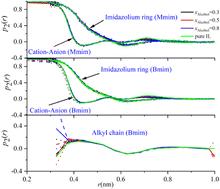
Molecular dynamics simulations were conducted on mixtures of ionic liquids (ILs) and alcohols, specifically methanol, ethanol, and 1-propanol. Two different ILs, [Mmim][MeSO4] and [Bmim][MeSO4], were used with varying alcohol mole fractions to investigate the impact of alkyl chain length of cations, alcohol types, and alcohol concentrations on different structural and dynamic properties. Unique characteristics of the ILs were observed due to the varying polarity of solvents and the creation of diverse local environments surrounding the ILs. The alcohols weaken the hydrogen bond network of the ILs. A better anion–cation packing was observed for [Mmim][MeSO4]–alcohol than for [Bmim][MeSO4]–alcohol mixtures. The free volume and clustering of alcohol molecules in [Mmim][MeSO4]–alcohol mixtures were stronger than those in [Bmim][MeSO4]–alcohol mixtures; these effects were stronger for mixtures containing longer-chain alcohols. Alcohols accelerate the dynamics of ILs, examined in terms of the anion/cation diffusion coefficients, dynamics of ion-pair formation/rupture, and dynamics of the hydrogen bond formed between the anion and the cation. This effect is more pronounced for mixtures of ILs with shorter-chain alcohols. These findings are consistent with the results obtained for the structural perturbations in ILs in the presence of alcohols, i.e., weakening of the hydrogen bond network in ILs upon addition of (shorter-chain) alcohols to the ILs, and reduced alcohol clustering.
期刊介绍:
Physical Chemistry Chemical Physics (PCCP) is an international journal co-owned by 19 physical chemistry and physics societies from around the world. This journal publishes original, cutting-edge research in physical chemistry, chemical physics and biophysical chemistry. To be suitable for publication in PCCP, articles must include significant innovation and/or insight into physical chemistry; this is the most important criterion that reviewers and Editors will judge against when evaluating submissions.
The journal has a broad scope and welcomes contributions spanning experiment, theory, computation and data science. Topical coverage includes spectroscopy, dynamics, kinetics, statistical mechanics, thermodynamics, electrochemistry, catalysis, surface science, quantum mechanics, quantum computing and machine learning. Interdisciplinary research areas such as polymers and soft matter, materials, nanoscience, energy, surfaces/interfaces, and biophysical chemistry are welcomed if they demonstrate significant innovation and/or insight into physical chemistry. Joined experimental/theoretical studies are particularly appreciated when complementary and based on up-to-date approaches.




 京公网安备 11010802042870号
京ICP备2023020795号-1
京公网安备 11010802042870号
京ICP备2023020795号-1

 分享
分享
 求助内容:
求助内容: 应助结果提醒方式:
 扫码关注我们
