Satchakorn Khammuang, Kantaphong Wongphen, Tanveer Hussain and Komsilp Kotmool
{"title":"Enhanced NH3 and NO sensing performance of Ti3C2O2 MXene by biaxial strain: insights from first-principles calculations†","authors":"Satchakorn Khammuang, Kantaphong Wongphen, Tanveer Hussain and Komsilp Kotmool","doi":"10.1039/D4CP04127E","DOIUrl":null,"url":null,"abstract":"<p >In this study, we investigate the adsorption properties of CO, NH<small><sub>3</sub></small>, and NO gases on Ti<small><sub>3</sub></small>C<small><sub>2</sub></small>O<small><sub>2</sub></small> MXene surfaces through density functional theory (DFT) calculations. A comprehensive analysis of the adsorption preferences, electronic properties, work function (<em>φ</em>), sensitivity (<em>S</em>), and recovery time (<em>τ</em>) was conducted, focusing on the effects of biaxial strain (<em>ε</em>) ranging from −2% to 4%. At free strain, toxic gases can adsorb onto the Ti<small><sub>3</sub></small>C<small><sub>2</sub></small>O<small><sub>2</sub></small> surface, with adsorption energies (<em>E</em><small><sub>ad</sub></small>) of −0.096 eV (CO), −0.344 eV (NH<small><sub>3</sub></small>), and −0.349 eV (NO), indicating moderate interactions between NH<small><sub>3</sub></small>, NO and the Ti<small><sub>3</sub></small>C<small><sub>2</sub></small>O<small><sub>2</sub></small> surface, while CO displays weaker physisorption. Electron density difference (EDD) and electron localization function (ELF) analyses underscore the electron transfer mechanisms, supporting the enhanced sensitivity of Ti<small><sub>3</sub></small>C<small><sub>2</sub></small>O<small><sub>2</sub></small> for NH<small><sub>3</sub></small> and NO detection. The influence of <em>ε</em> on gas adsorption behaviour was also studied, demonstrating that tensile strain enhances NH<small><sub>3</sub></small> adsorption (<em>E</em><small><sub>ad</sub></small> = −0.551 eV at <em>ε</em> = 4%), while NO exhibits an inverse trend under compressive strain (<em>E</em><small><sub>ad</sub></small> = −0.403 eV at <em>ε</em> = −2%). The <em>S</em> based on a change rate of <em>φ</em> was evaluated to be around 12% and 6% for NH<small><sub>3</sub></small> and NO, respectively, within the calculated strain range, indicating sufficient detection capability. Additionally, the <em>τ</em> for NH<small><sub>3</sub></small> and NO detection was computed. At 0% strain and 300 K, the <em>τ</em> values for NH<small><sub>3</sub></small> and NO are in the microsecond range, suggesting that detecting these gases under normal conditions poses a challenge. However, strain-tuned Ti<small><sub>3</sub></small>C<small><sub>2</sub></small>O<small><sub>2</sub></small> and lowered temperature enhance the gas sensing performance, with increased <em>τ</em> values at tensile strain for NH<small><sub>3</sub></small> and compressive strain for NO. These results suggest that Ti<small><sub>3</sub></small>C<small><sub>2</sub></small>O<small><sub>2</sub></small> MXene, when tuned with biaxial strain, is a promising candidate for detecting NH<small><sub>3</sub></small> and NO at low to room temperatures.</p>","PeriodicalId":99,"journal":{"name":"Physical Chemistry Chemical Physics","volume":" 7","pages":" 3827-3833"},"PeriodicalIF":2.9000,"publicationDate":"2025-01-21","publicationTypes":"Journal Article","fieldsOfStudy":null,"isOpenAccess":false,"openAccessPdf":"","citationCount":"0","resultStr":null,"platform":"Semanticscholar","paperid":null,"PeriodicalName":"Physical Chemistry Chemical Physics","FirstCategoryId":"92","ListUrlMain":"https://pubs.rsc.org/en/content/articlelanding/2025/cp/d4cp04127e","RegionNum":3,"RegionCategory":"化学","ArticlePicture":[],"TitleCN":null,"AbstractTextCN":null,"PMCID":null,"EPubDate":"","PubModel":"","JCR":"Q3","JCRName":"CHEMISTRY, PHYSICAL","Score":null,"Total":0}
引用次数: 0
Abstract
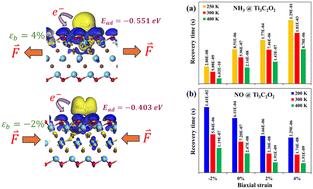
In this study, we investigate the adsorption properties of CO, NH3, and NO gases on Ti3C2O2 MXene surfaces through density functional theory (DFT) calculations. A comprehensive analysis of the adsorption preferences, electronic properties, work function (φ), sensitivity (S), and recovery time (τ) was conducted, focusing on the effects of biaxial strain (ε) ranging from −2% to 4%. At free strain, toxic gases can adsorb onto the Ti3C2O2 surface, with adsorption energies (Ead) of −0.096 eV (CO), −0.344 eV (NH3), and −0.349 eV (NO), indicating moderate interactions between NH3, NO and the Ti3C2O2 surface, while CO displays weaker physisorption. Electron density difference (EDD) and electron localization function (ELF) analyses underscore the electron transfer mechanisms, supporting the enhanced sensitivity of Ti3C2O2 for NH3 and NO detection. The influence of ε on gas adsorption behaviour was also studied, demonstrating that tensile strain enhances NH3 adsorption (Ead = −0.551 eV at ε = 4%), while NO exhibits an inverse trend under compressive strain (Ead = −0.403 eV at ε = −2%). The S based on a change rate of φ was evaluated to be around 12% and 6% for NH3 and NO, respectively, within the calculated strain range, indicating sufficient detection capability. Additionally, the τ for NH3 and NO detection was computed. At 0% strain and 300 K, the τ values for NH3 and NO are in the microsecond range, suggesting that detecting these gases under normal conditions poses a challenge. However, strain-tuned Ti3C2O2 and lowered temperature enhance the gas sensing performance, with increased τ values at tensile strain for NH3 and compressive strain for NO. These results suggest that Ti3C2O2 MXene, when tuned with biaxial strain, is a promising candidate for detecting NH3 and NO at low to room temperatures.
期刊介绍:
Physical Chemistry Chemical Physics (PCCP) is an international journal co-owned by 19 physical chemistry and physics societies from around the world. This journal publishes original, cutting-edge research in physical chemistry, chemical physics and biophysical chemistry. To be suitable for publication in PCCP, articles must include significant innovation and/or insight into physical chemistry; this is the most important criterion that reviewers and Editors will judge against when evaluating submissions.
The journal has a broad scope and welcomes contributions spanning experiment, theory, computation and data science. Topical coverage includes spectroscopy, dynamics, kinetics, statistical mechanics, thermodynamics, electrochemistry, catalysis, surface science, quantum mechanics, quantum computing and machine learning. Interdisciplinary research areas such as polymers and soft matter, materials, nanoscience, energy, surfaces/interfaces, and biophysical chemistry are welcomed if they demonstrate significant innovation and/or insight into physical chemistry. Joined experimental/theoretical studies are particularly appreciated when complementary and based on up-to-date approaches.




 京公网安备 11010802042870号
京ICP备2023020795号-1
京公网安备 11010802042870号
京ICP备2023020795号-1

 分享
分享
 求助内容:
求助内容: 应助结果提醒方式:
 扫码关注我们
