Xin Lu, Yang Liu, Ruiyu Tian, Xingjie Liu, Yuanyuan Wang and Yinhua Zhou
{"title":"Enhanced moisture and thermal stability of transparent electrodes via crosslinking for large-area flexible organic photovoltaic modules†","authors":"Xin Lu, Yang Liu, Ruiyu Tian, Xingjie Liu, Yuanyuan Wang and Yinhua Zhou","doi":"10.1039/D4EE05154H","DOIUrl":null,"url":null,"abstract":"<p >Moisture and thermal stability of flexible transparent electrodes are important for fabricating efficient large-area flexible organic photovoltaic (OPV) modules. Recently, silver nanowires (AgNWs)-embedded polyvinyl alcohol (PVA) was fabricated, possessing excellent optoelectronic properties, mechanical flexibility and surface smoothness for use in efficient large-area flexible OPV modules. However, PVA is vulnerable to moisture and heat, resulting in a narrow processing window for large-area flexible modules. Thus, in this work, we embedded AgNWs into a crosslinked PVA matrix (denoted as AgNWs-em-<em>c</em>PVA), which showed substantially enhanced thermal and moisture thermal stability. Specifically, AgNWs-em-<em>c</em>PVA could withstand a temperature of up to 200 °C, and its moisture adsorption was as low as 1.12% ± 0.19% at a relative humidity (R. H.) of 60% and a temperature of 25 °C for 168 h. The flexible large-area OPV module achieved an efficiency of 14.78% (active area: 52.3 cm<small><sup>2</sup></small>), which is the highest value reported to date for flexible large-area OPV modules on non-ITO electrodes. Furthermore, the flexible large-area OPV modules maintained 92.76% ± 2.50% of their initial efficiencies after continuous AM 1.5 illumination with a UV filter for 1008 hours.</p>","PeriodicalId":72,"journal":{"name":"Energy & Environmental Science","volume":" 5","pages":" 2426-2435"},"PeriodicalIF":30.8000,"publicationDate":"2025-01-20","publicationTypes":"Journal Article","fieldsOfStudy":null,"isOpenAccess":false,"openAccessPdf":"","citationCount":"0","resultStr":null,"platform":"Semanticscholar","paperid":null,"PeriodicalName":"Energy & Environmental Science","FirstCategoryId":"88","ListUrlMain":"https://pubs.rsc.org/en/content/articlelanding/2025/ee/d4ee05154h","RegionNum":1,"RegionCategory":"材料科学","ArticlePicture":[],"TitleCN":null,"AbstractTextCN":null,"PMCID":null,"EPubDate":"","PubModel":"","JCR":"Q1","JCRName":"CHEMISTRY, MULTIDISCIPLINARY","Score":null,"Total":0}
引用次数: 0
Abstract
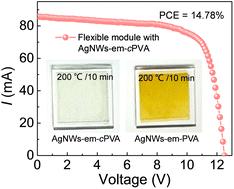
Moisture and thermal stability of flexible transparent electrodes are important for fabricating efficient large-area flexible organic photovoltaic (OPV) modules. Recently, silver nanowires (AgNWs)-embedded polyvinyl alcohol (PVA) was fabricated, possessing excellent optoelectronic properties, mechanical flexibility and surface smoothness for use in efficient large-area flexible OPV modules. However, PVA is vulnerable to moisture and heat, resulting in a narrow processing window for large-area flexible modules. Thus, in this work, we embedded AgNWs into a crosslinked PVA matrix (denoted as AgNWs-em-cPVA), which showed substantially enhanced thermal and moisture thermal stability. Specifically, AgNWs-em-cPVA could withstand a temperature of up to 200 °C, and its moisture adsorption was as low as 1.12% ± 0.19% at a relative humidity (R. H.) of 60% and a temperature of 25 °C for 168 h. The flexible large-area OPV module achieved an efficiency of 14.78% (active area: 52.3 cm2), which is the highest value reported to date for flexible large-area OPV modules on non-ITO electrodes. Furthermore, the flexible large-area OPV modules maintained 92.76% ± 2.50% of their initial efficiencies after continuous AM 1.5 illumination with a UV filter for 1008 hours.
期刊介绍:
Energy & Environmental Science, a peer-reviewed scientific journal, publishes original research and review articles covering interdisciplinary topics in the (bio)chemical and (bio)physical sciences, as well as chemical engineering disciplines. Published monthly by the Royal Society of Chemistry (RSC), a not-for-profit publisher, Energy & Environmental Science is recognized as a leading journal. It boasts an impressive impact factor of 8.500 as of 2009, ranking 8th among 140 journals in the category "Chemistry, Multidisciplinary," second among 71 journals in "Energy & Fuels," second among 128 journals in "Engineering, Chemical," and first among 181 scientific journals in "Environmental Sciences."
Energy & Environmental Science publishes various types of articles, including Research Papers (original scientific work), Review Articles, Perspectives, and Minireviews (feature review-type articles of broad interest), Communications (original scientific work of an urgent nature), Opinions (personal, often speculative viewpoints or hypotheses on current topics), and Analysis Articles (in-depth examination of energy-related issues).



 京公网安备 11010802042870号
京ICP备2023020795号-1
京公网安备 11010802042870号
京ICP备2023020795号-1

 分享
分享
 求助内容:
求助内容: 应助结果提醒方式:
 扫码关注我们
