Mauro Chiarito, Davide Stolfo, Alessandro Villaschi, Samantha Sartori, Luca Baldetti, Carlo Mario Lombardi, Marianna Adamo, Ferdinando Loiacono, Antonio Maria Sammartino, Mauro Riccardi, Daniela Tomasoni, Riccardo Maria Inciardi, Marta Maccallini, Gaia Gasparini, Benedetta Grossi, Stefano Contessi, Daniele Cocianni, Maria Perotto, Giuseppe Barone, Marco Merlo, Alberto Maria Cappelletti, Gianfranco Sinagra, Daniela Pini, Marco Metra, Matteo Pagnesi
{"title":"Predicting survival in patients with severe heart failure: Risk score validation in the HELP-HF cohort","authors":"Mauro Chiarito, Davide Stolfo, Alessandro Villaschi, Samantha Sartori, Luca Baldetti, Carlo Mario Lombardi, Marianna Adamo, Ferdinando Loiacono, Antonio Maria Sammartino, Mauro Riccardi, Daniela Tomasoni, Riccardo Maria Inciardi, Marta Maccallini, Gaia Gasparini, Benedetta Grossi, Stefano Contessi, Daniele Cocianni, Maria Perotto, Giuseppe Barone, Marco Merlo, Alberto Maria Cappelletti, Gianfranco Sinagra, Daniela Pini, Marco Metra, Matteo Pagnesi","doi":"10.1002/ejhf.3585","DOIUrl":null,"url":null,"abstract":"<div>\n \n \n <section>\n \n <h3> Aims</h3>\n \n <p>Accurate selection of patients with severe heart failure (HF) who might benefit from advanced therapies is crucial. The present study investigates the performance of the available risk scores aimed at predicting the risk of mortality in patients with severe HF.</p>\n </section>\n \n <section>\n \n <h3> Methods and results</h3>\n \n <p>The risk of 1-year mortality was estimated in patients with severe HF enrolled in the HELP-HF cohort according to the MAGGIC, 3-CHF, ADHF/NT-proBNP, and GWTG-HF risk scores, the number of criteria of the 2018 HFA-ESC definition of advanced HF, I NEED HELP markers, domains fulfilled of the 2019 HFA-ESC definition of frailty, the frailty index, and the INTERMACS profile. In addition, we tested the performance of different machine learning (ML)-based models to predict 1-year mortality. At 1-year follow-up, 265 patients (23.1%) died. The prognostic accuracy, tested in the subgroup of patients with completeness of all data regarding the variables included in the scores (497/1149 patients), resulted moderate for MAGGIC, GWTG-HF, and ADHF/NT-proBNP scores (area under the curve [AUC] ≥0.70) and only poor for the other tools. All the scores lost accuracy in estimating the rate of 1-year mortality in patients at the highest risk. Support vector machine-based model had the best AUC among ML-based models, slightly outperforming most of the tested risk scores.</p>\n </section>\n \n <section>\n \n <h3> Conclusion</h3>\n \n <p>Most of the scores used to predict the risk of mortality in HF performed poorly in real-world patients with severe HF and provided inaccurate estimate of the risk of 1-year mortality in patients at the highest risk. ML-based models did not significantly outperform the currently available risk scores and their use must be validated in large cohort of patients.</p>\n </section>\n </div>","PeriodicalId":164,"journal":{"name":"European Journal of Heart Failure","volume":"27 4","pages":"726-736"},"PeriodicalIF":10.8000,"publicationDate":"2025-01-20","publicationTypes":"Journal Article","fieldsOfStudy":null,"isOpenAccess":false,"openAccessPdf":"https://onlinelibrary.wiley.com/doi/epdf/10.1002/ejhf.3585","citationCount":"0","resultStr":null,"platform":"Semanticscholar","paperid":null,"PeriodicalName":"European Journal of Heart Failure","FirstCategoryId":"3","ListUrlMain":"https://onlinelibrary.wiley.com/doi/10.1002/ejhf.3585","RegionNum":1,"RegionCategory":"医学","ArticlePicture":[],"TitleCN":null,"AbstractTextCN":null,"PMCID":null,"EPubDate":"","PubModel":"","JCR":"Q1","JCRName":"CARDIAC & CARDIOVASCULAR SYSTEMS","Score":null,"Total":0}
引用次数: 0
Abstract
Aims
Accurate selection of patients with severe heart failure (HF) who might benefit from advanced therapies is crucial. The present study investigates the performance of the available risk scores aimed at predicting the risk of mortality in patients with severe HF.
Methods and results
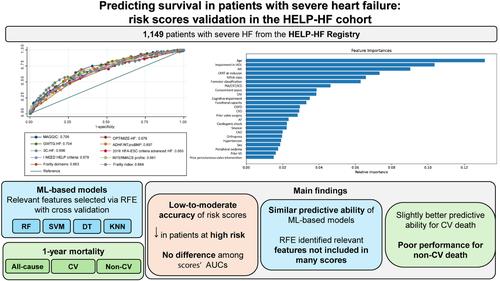
The risk of 1-year mortality was estimated in patients with severe HF enrolled in the HELP-HF cohort according to the MAGGIC, 3-CHF, ADHF/NT-proBNP, and GWTG-HF risk scores, the number of criteria of the 2018 HFA-ESC definition of advanced HF, I NEED HELP markers, domains fulfilled of the 2019 HFA-ESC definition of frailty, the frailty index, and the INTERMACS profile. In addition, we tested the performance of different machine learning (ML)-based models to predict 1-year mortality. At 1-year follow-up, 265 patients (23.1%) died. The prognostic accuracy, tested in the subgroup of patients with completeness of all data regarding the variables included in the scores (497/1149 patients), resulted moderate for MAGGIC, GWTG-HF, and ADHF/NT-proBNP scores (area under the curve [AUC] ≥0.70) and only poor for the other tools. All the scores lost accuracy in estimating the rate of 1-year mortality in patients at the highest risk. Support vector machine-based model had the best AUC among ML-based models, slightly outperforming most of the tested risk scores.
Conclusion
Most of the scores used to predict the risk of mortality in HF performed poorly in real-world patients with severe HF and provided inaccurate estimate of the risk of 1-year mortality in patients at the highest risk. ML-based models did not significantly outperform the currently available risk scores and their use must be validated in large cohort of patients.
期刊介绍:
European Journal of Heart Failure is an international journal dedicated to advancing knowledge in the field of heart failure management. The journal publishes reviews and editorials aimed at improving understanding, prevention, investigation, and treatment of heart failure. It covers various disciplines such as molecular and cellular biology, pathology, physiology, electrophysiology, pharmacology, clinical sciences, social sciences, and population sciences. The journal welcomes submissions of manuscripts on basic, clinical, and population sciences, as well as original contributions on nursing, care of the elderly, primary care, health economics, and other related specialist fields. It is published monthly and has a readership that includes cardiologists, emergency room physicians, intensivists, internists, general physicians, cardiac nurses, diabetologists, epidemiologists, basic scientists focusing on cardiovascular research, and those working in rehabilitation. The journal is abstracted and indexed in various databases such as Academic Search, Embase, MEDLINE/PubMed, and Science Citation Index.




 京公网安备 11010802042870号
京ICP备2023020795号-1
京公网安备 11010802042870号
京ICP备2023020795号-1

 分享
分享
 求助内容:
求助内容: 应助结果提醒方式:
 扫码关注我们
