{"title":"Roles of Interleukin-24 in Epithelial Repair: Bridging Injury and Regeneration","authors":"Morgan Bryant, Piotr P. Janas, Thibaut Sanchez","doi":"10.1111/all.16479","DOIUrl":null,"url":null,"abstract":"<p>The first line of defence against invading pathogens consists of the barrier epithelial tissues of the skin, gut and lungs. Upon injury, blood clot formation takes place, followed by the infiltration of immune cells that remove debris and subsequently promote tissue repair mechanisms. Structural cells then proliferate to rebuild lost tissue, and finally, the wound undergoes remodelling to restore the tissue architecture and function [<span>1</span>].</p><p>It has been long understood that disruption of skin integrity is often accompanied by pathogen invasion, resulting in an inflammatory response, which triggers the initial immune response commencing wound healing [<span>2</span>]. These initial wound repair stages are followed by tightly coordinated migration and proliferation of epidermal progenitors to restore tissue integrity. However, until recently, the exact signalling pathways allowing for coordination of re-epithelialisation, especially in the absence of pathogens, remained elusive.</p><p>The study conducted by Liu et al. [<span>3</span>] aimed to investigate the repair mechanisms following skin injury that are independent of the response to pathogen infection. Using a mouse model of skin wound healing, the group identified epithelial-specific increased phosphorylation of the transcription factor STAT3, accompanied by upregulation of IL-24 (Figure 1). Increased IL-24 appeared independent of microbial responses, as wounding in either germ-free mice or mice lacking TLR signalling still led to IL-24 upregulation. The authors hypothesised that IL-24 induction is mediated by epidermal stem cells (EpdSC) sensing ‘non-homeostatic’ patterns that are independent of pathogen-induced interferon signalling pathways.</p><p>Following the deletion of <i>Il24</i> or its receptor subunit, <i>Il20rb</i>, phosphorylation of STAT3 was markedly reduced around the wound edge, highlighting that IL-24 acts upstream of STAT3 in response to tissue damage. A deficiency in IL-24 signalling not only reduced epithelial proliferation but also distinctly impaired revascularisation and fibroblast-mediated stroma regeneration, leading to delayed wound closure. This effect was linked to the injury-induced hypoxic epithelial niche, which led to increased HIF1α expression in EpdSCs, further promoting IL-24 expression. In vitro studies further confirmed that a substantial increase in IL-24 expression was seen in hypoxic conditions.</p><p>Finally, the authors demonstrated that the HIF-1α-IL-24-STAT3 signalling axis causes metabolic changes in cells at the wound edge. The expression of a specific glucose transporter, GLUT1, appeared to be sensitive to the expression of IL-24, its receptor and subsequent signalling cascade. This transporter was found to play an important role in restoring the endothelial and fibroblast cell niche near the wound edge. Therefore, in response to hypoxic conditions arising following tissue injury, EpdSCs express IL-24 that alters their metabolism, migration and proliferation while orchestrating a multi-cellular response.</p><p>Different cell types present in the wound, other than EpdSCs, are known to be directly or indirectly sensitive to IL-24 [<span>4</span>]. These include immune cells such as macrophages, in which IL-24 induces an anti-inflammatory response [<span>5</span>]. T lymphocytes are also sensitive to this cytokine, but the associated cellular responses may have varying effects, which can in turn influence the recruitment of other immune cells such as neutrophils or monocytes affecting tissue repair outcomes [<span>4</span>].</p><p>IL-24 plays a significant role in several allergic diseases. In a model of allergic contact dermatitis (ACD), IL-24 expression is upregulated, further implicating it in skin immune regulation [<span>6</span>]. Mice with deficient IL-24 signalling have impaired neutrophil recruitment and are protected from developing chemical-induced contact hypersensitivity. IL-24 acting detrimentally in ACD and other pathologies emphasises the need to better understand its immunomodulatory role.</p><p>Developing novel therapies for chronic wounds and scarring requires advancing our understanding of IL-24's role. This includes gaining a deeper insight into its effects on various cell types within the wound niche and exploring how IL-24 signalling intersects with other tissue repair mechanisms, particularly in the context of infection or allergy.</p><p>The authors declare no conflicts of interest.</p>","PeriodicalId":122,"journal":{"name":"Allergy","volume":"80 5","pages":"1543-1545"},"PeriodicalIF":12.0000,"publicationDate":"2025-01-21","publicationTypes":"Journal Article","fieldsOfStudy":null,"isOpenAccess":false,"openAccessPdf":"https://onlinelibrary.wiley.com/doi/epdf/10.1111/all.16479","citationCount":"0","resultStr":null,"platform":"Semanticscholar","paperid":null,"PeriodicalName":"Allergy","FirstCategoryId":"3","ListUrlMain":"https://onlinelibrary.wiley.com/doi/10.1111/all.16479","RegionNum":1,"RegionCategory":"医学","ArticlePicture":[],"TitleCN":null,"AbstractTextCN":null,"PMCID":null,"EPubDate":"","PubModel":"","JCR":"Q1","JCRName":"ALLERGY","Score":null,"Total":0}
引用次数: 0
Abstract
The first line of defence against invading pathogens consists of the barrier epithelial tissues of the skin, gut and lungs. Upon injury, blood clot formation takes place, followed by the infiltration of immune cells that remove debris and subsequently promote tissue repair mechanisms. Structural cells then proliferate to rebuild lost tissue, and finally, the wound undergoes remodelling to restore the tissue architecture and function [1].
It has been long understood that disruption of skin integrity is often accompanied by pathogen invasion, resulting in an inflammatory response, which triggers the initial immune response commencing wound healing [2]. These initial wound repair stages are followed by tightly coordinated migration and proliferation of epidermal progenitors to restore tissue integrity. However, until recently, the exact signalling pathways allowing for coordination of re-epithelialisation, especially in the absence of pathogens, remained elusive.
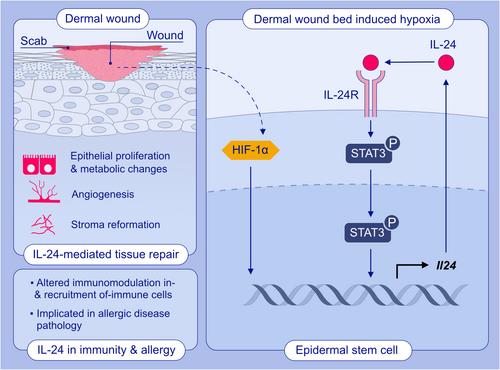
The study conducted by Liu et al. [3] aimed to investigate the repair mechanisms following skin injury that are independent of the response to pathogen infection. Using a mouse model of skin wound healing, the group identified epithelial-specific increased phosphorylation of the transcription factor STAT3, accompanied by upregulation of IL-24 (Figure 1). Increased IL-24 appeared independent of microbial responses, as wounding in either germ-free mice or mice lacking TLR signalling still led to IL-24 upregulation. The authors hypothesised that IL-24 induction is mediated by epidermal stem cells (EpdSC) sensing ‘non-homeostatic’ patterns that are independent of pathogen-induced interferon signalling pathways.
Following the deletion of Il24 or its receptor subunit, Il20rb, phosphorylation of STAT3 was markedly reduced around the wound edge, highlighting that IL-24 acts upstream of STAT3 in response to tissue damage. A deficiency in IL-24 signalling not only reduced epithelial proliferation but also distinctly impaired revascularisation and fibroblast-mediated stroma regeneration, leading to delayed wound closure. This effect was linked to the injury-induced hypoxic epithelial niche, which led to increased HIF1α expression in EpdSCs, further promoting IL-24 expression. In vitro studies further confirmed that a substantial increase in IL-24 expression was seen in hypoxic conditions.
Finally, the authors demonstrated that the HIF-1α-IL-24-STAT3 signalling axis causes metabolic changes in cells at the wound edge. The expression of a specific glucose transporter, GLUT1, appeared to be sensitive to the expression of IL-24, its receptor and subsequent signalling cascade. This transporter was found to play an important role in restoring the endothelial and fibroblast cell niche near the wound edge. Therefore, in response to hypoxic conditions arising following tissue injury, EpdSCs express IL-24 that alters their metabolism, migration and proliferation while orchestrating a multi-cellular response.
Different cell types present in the wound, other than EpdSCs, are known to be directly or indirectly sensitive to IL-24 [4]. These include immune cells such as macrophages, in which IL-24 induces an anti-inflammatory response [5]. T lymphocytes are also sensitive to this cytokine, but the associated cellular responses may have varying effects, which can in turn influence the recruitment of other immune cells such as neutrophils or monocytes affecting tissue repair outcomes [4].
IL-24 plays a significant role in several allergic diseases. In a model of allergic contact dermatitis (ACD), IL-24 expression is upregulated, further implicating it in skin immune regulation [6]. Mice with deficient IL-24 signalling have impaired neutrophil recruitment and are protected from developing chemical-induced contact hypersensitivity. IL-24 acting detrimentally in ACD and other pathologies emphasises the need to better understand its immunomodulatory role.
Developing novel therapies for chronic wounds and scarring requires advancing our understanding of IL-24's role. This includes gaining a deeper insight into its effects on various cell types within the wound niche and exploring how IL-24 signalling intersects with other tissue repair mechanisms, particularly in the context of infection or allergy.
期刊介绍:
Allergy is an international and multidisciplinary journal that aims to advance, impact, and communicate all aspects of the discipline of Allergy/Immunology. It publishes original articles, reviews, position papers, guidelines, editorials, news and commentaries, letters to the editors, and correspondences. The journal accepts articles based on their scientific merit and quality.
Allergy seeks to maintain contact between basic and clinical Allergy/Immunology and encourages contributions from contributors and readers from all countries. In addition to its publication, Allergy also provides abstracting and indexing information. Some of the databases that include Allergy abstracts are Abstracts on Hygiene & Communicable Disease, Academic Search Alumni Edition, AgBiotech News & Information, AGRICOLA Database, Biological Abstracts, PubMed Dietary Supplement Subset, and Global Health, among others.



 京公网安备 11010802042870号
京ICP备2023020795号-1
京公网安备 11010802042870号
京ICP备2023020795号-1

 分享
分享
 求助内容:
求助内容: 应助结果提醒方式:
 扫码关注我们
