Fuliang Bai, Jie Fan, Xiangyu Zhang, Xuemeng Wang, Shuo Liu
{"title":"Biodegradation of polyethylene with polyethylene-group-degrading enzyme delivered by the engineered Bacillus velezensis","authors":"Fuliang Bai, Jie Fan, Xiangyu Zhang, Xuemeng Wang, Shuo Liu","doi":"10.1016/j.jhazmat.2025.137330","DOIUrl":null,"url":null,"abstract":"<div><div>Microplastics (MPs) pose an emerging threat to vegetable growing soils in Harbin, which have a relatively high abundance (11,065 n/kg) with 17.26 of potential ecological risk of single polymer hazard (EI) and 33.92 of potential ecological risk index (PERI). Polyethylene (PE) is the main type of microplastic pollution in vegetable growing soils in Harbin. In this study, the engineered <em>Bacillus velezensis</em> with polyethylene-group-degrading enzyme pathway (BCAv-PEase) was constructed to enhance the degradation of MPs of PE (PE-MPs). BCAv-PEase increased the biodegradation of PE-MPs, promoted weight loss of PE films, elevated surface tension, and decreased the surface hydrophobicity of PE through upregulating activities of depolymerases, dehydrogenase, and catalase. Mechanism analysis showed that BCAv-PEase degraded PE-MPs by promoting the secretion of PEase, thereby leading to the generation of new oxygenated functional groups within the PE-MPs substrate, which further accelerated the metabolic pathway of PE-MPs. The analysis of the microbial community during the PE-MPs degradation processes revealed that BCAv-PEase emerged as the principal bacterial player and stimulated the abundance of microbes and functional genes associated with the biodegradation of PE. In conclusion, this study provides a potential mechanism for biodegradation of PE-MPs mediated by BCAv-PEase via modulating substrate selectivity and optimizing biocatalytic pathways.</div></div>","PeriodicalId":361,"journal":{"name":"Journal of Hazardous Materials","volume":"488 ","pages":"Article 137330"},"PeriodicalIF":11.3000,"publicationDate":"2025-05-05","publicationTypes":"Journal Article","fieldsOfStudy":null,"isOpenAccess":false,"openAccessPdf":"","citationCount":"0","resultStr":null,"platform":"Semanticscholar","paperid":null,"PeriodicalName":"Journal of Hazardous Materials","FirstCategoryId":"93","ListUrlMain":"https://www.sciencedirect.com/science/article/pii/S0304389425002420","RegionNum":1,"RegionCategory":"环境科学与生态学","ArticlePicture":[],"TitleCN":null,"AbstractTextCN":null,"PMCID":null,"EPubDate":"2025/1/22 0:00:00","PubModel":"Epub","JCR":"Q1","JCRName":"ENGINEERING, ENVIRONMENTAL","Score":null,"Total":0}
引用次数: 0
Abstract
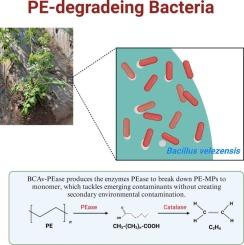
Microplastics (MPs) pose an emerging threat to vegetable growing soils in Harbin, which have a relatively high abundance (11,065 n/kg) with 17.26 of potential ecological risk of single polymer hazard (EI) and 33.92 of potential ecological risk index (PERI). Polyethylene (PE) is the main type of microplastic pollution in vegetable growing soils in Harbin. In this study, the engineered Bacillus velezensis with polyethylene-group-degrading enzyme pathway (BCAv-PEase) was constructed to enhance the degradation of MPs of PE (PE-MPs). BCAv-PEase increased the biodegradation of PE-MPs, promoted weight loss of PE films, elevated surface tension, and decreased the surface hydrophobicity of PE through upregulating activities of depolymerases, dehydrogenase, and catalase. Mechanism analysis showed that BCAv-PEase degraded PE-MPs by promoting the secretion of PEase, thereby leading to the generation of new oxygenated functional groups within the PE-MPs substrate, which further accelerated the metabolic pathway of PE-MPs. The analysis of the microbial community during the PE-MPs degradation processes revealed that BCAv-PEase emerged as the principal bacterial player and stimulated the abundance of microbes and functional genes associated with the biodegradation of PE. In conclusion, this study provides a potential mechanism for biodegradation of PE-MPs mediated by BCAv-PEase via modulating substrate selectivity and optimizing biocatalytic pathways.
期刊介绍:
The Journal of Hazardous Materials serves as a global platform for promoting cutting-edge research in the field of Environmental Science and Engineering. Our publication features a wide range of articles, including full-length research papers, review articles, and perspectives, with the aim of enhancing our understanding of the dangers and risks associated with various materials concerning public health and the environment. It is important to note that the term "environmental contaminants" refers specifically to substances that pose hazardous effects through contamination, while excluding those that do not have such impacts on the environment or human health. Moreover, we emphasize the distinction between wastes and hazardous materials in order to provide further clarity on the scope of the journal. We have a keen interest in exploring specific compounds and microbial agents that have adverse effects on the environment.



 京公网安备 11010802042870号
京ICP备2023020795号-1
京公网安备 11010802042870号
京ICP备2023020795号-1

 分享
分享
 求助内容:
求助内容: 应助结果提醒方式:
 扫码关注我们
