Adil Mansoor, Bushra Jabar, Syed Shoaib Ahmad Shah, Muhammad Sufyan Javed, Tayyaba Najam, Muhammad Ishaq, Shuo Chen, Fu Li, Xiao-Lei Shi, Yue-Xing Chen, Guang-Xing Liang, Zhi-Gang Chen and Zhuang-Hao Zheng
{"title":"Introducing atomistic dynamics at van der Waals surfaces for enhancing the thermoelectric performance of layered Bi0.4Sb1.6Te3†","authors":"Adil Mansoor, Bushra Jabar, Syed Shoaib Ahmad Shah, Muhammad Sufyan Javed, Tayyaba Najam, Muhammad Ishaq, Shuo Chen, Fu Li, Xiao-Lei Shi, Yue-Xing Chen, Guang-Xing Liang, Zhi-Gang Chen and Zhuang-Hao Zheng","doi":"10.1039/D4EE04930F","DOIUrl":null,"url":null,"abstract":"<p >Thermoelectrics (TEs) enable the direct conversion of heat into electricity, but the thermoelectric performance of the state-of-the-art layered materials has been limited owing to the restricted approaches available for decoupling the carrier and phonon transport. Herein, a unique and novel feature of the intralayer van der Waals bonds/interactions is explored for improving the structural evolution and transport properties of a layered TE material. The atomistic dynamics governing inversion in van der Waals layers/bonds is established as an innovative material engineering paradigm. We selected the layered state-of-the-art Bi<small><sub>0.4</sub></small>Sb<small><sub>1.6</sub></small>Te<small><sub>3</sub></small> material as a representative prototype to identify the transformative role of the intralayer in realizing high TE performance. The induced atomic diffusion at the van der Waals layers and prevailed crystal-amorphicity duality optimized the electronic and chemical environments with an elevated carrier concentration and maintained the Seebeck coefficient, which led to an improved power factor of ≈49 μW cm<small><sup>−1</sup></small> K<small><sup>−2</sup></small>. Besides, the atomistic surface reconstruction/defects caused a reduction in the thermal conductivity to ≈0.97 W m<small><sup>−1</sup></small> K<small><sup>−1</sup></small>, which led to an ultra-high figure of merit (ZT<small><sub>max</sub></small>) of ≈1.54 at ∼373 K. Thus, the present work provides a generic and practical strategy <em>via</em> the unique doping-dependent atomistic engineering, which can also be implemented in other layered structures to tailor the TE properties.</p>","PeriodicalId":72,"journal":{"name":"Energy & Environmental Science","volume":" 5","pages":" 2485-2498"},"PeriodicalIF":30.8000,"publicationDate":"2025-01-22","publicationTypes":"Journal Article","fieldsOfStudy":null,"isOpenAccess":false,"openAccessPdf":"","citationCount":"0","resultStr":null,"platform":"Semanticscholar","paperid":null,"PeriodicalName":"Energy & Environmental Science","FirstCategoryId":"88","ListUrlMain":"https://pubs.rsc.org/en/content/articlelanding/2025/ee/d4ee04930f","RegionNum":1,"RegionCategory":"材料科学","ArticlePicture":[],"TitleCN":null,"AbstractTextCN":null,"PMCID":null,"EPubDate":"","PubModel":"","JCR":"Q1","JCRName":"CHEMISTRY, MULTIDISCIPLINARY","Score":null,"Total":0}
引用次数: 0
Abstract
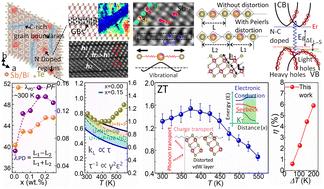
Thermoelectrics (TEs) enable the direct conversion of heat into electricity, but the thermoelectric performance of the state-of-the-art layered materials has been limited owing to the restricted approaches available for decoupling the carrier and phonon transport. Herein, a unique and novel feature of the intralayer van der Waals bonds/interactions is explored for improving the structural evolution and transport properties of a layered TE material. The atomistic dynamics governing inversion in van der Waals layers/bonds is established as an innovative material engineering paradigm. We selected the layered state-of-the-art Bi0.4Sb1.6Te3 material as a representative prototype to identify the transformative role of the intralayer in realizing high TE performance. The induced atomic diffusion at the van der Waals layers and prevailed crystal-amorphicity duality optimized the electronic and chemical environments with an elevated carrier concentration and maintained the Seebeck coefficient, which led to an improved power factor of ≈49 μW cm−1 K−2. Besides, the atomistic surface reconstruction/defects caused a reduction in the thermal conductivity to ≈0.97 W m−1 K−1, which led to an ultra-high figure of merit (ZTmax) of ≈1.54 at ∼373 K. Thus, the present work provides a generic and practical strategy via the unique doping-dependent atomistic engineering, which can also be implemented in other layered structures to tailor the TE properties.
期刊介绍:
Energy & Environmental Science, a peer-reviewed scientific journal, publishes original research and review articles covering interdisciplinary topics in the (bio)chemical and (bio)physical sciences, as well as chemical engineering disciplines. Published monthly by the Royal Society of Chemistry (RSC), a not-for-profit publisher, Energy & Environmental Science is recognized as a leading journal. It boasts an impressive impact factor of 8.500 as of 2009, ranking 8th among 140 journals in the category "Chemistry, Multidisciplinary," second among 71 journals in "Energy & Fuels," second among 128 journals in "Engineering, Chemical," and first among 181 scientific journals in "Environmental Sciences."
Energy & Environmental Science publishes various types of articles, including Research Papers (original scientific work), Review Articles, Perspectives, and Minireviews (feature review-type articles of broad interest), Communications (original scientific work of an urgent nature), Opinions (personal, often speculative viewpoints or hypotheses on current topics), and Analysis Articles (in-depth examination of energy-related issues).



 京公网安备 11010802042870号
京ICP备2023020795号-1
京公网安备 11010802042870号
京ICP备2023020795号-1

 分享
分享
 求助内容:
求助内容: 应助结果提醒方式:
 扫码关注我们
