Sonia Amado, Murat C Karataş, Elif Yüvrük, Aycan Kapucu
{"title":"EGEFACE: A new face memory test with static and dynamic images.","authors":"Sonia Amado, Murat C Karataş, Elif Yüvrük, Aycan Kapucu","doi":"10.3758/s13428-024-02592-0","DOIUrl":null,"url":null,"abstract":"<p><p>Face memory is a crucial cognitive ability necessary for maintaining a healthy social life. Recent studies reveal large individual differences in face recognition ability. Face memory tests are used to evaluate this ability. The main purpose of this study was to develop a new face memory test (EGEFACE) addressing the limitations of existing tests using both static and dynamic stimuli to increase ecological validity; employing face recognition algorithms to adjust test difficulty; measuring face memory accuracy independently of response bias by including both target-absent and target-present trials and using ROC analysis; and developing a test to measure both ends of the face recognition ability spectrum. After building a new database of static and dynamic faces, we created three difficulty levels using a face recognition algorithm. We collected data from 703 participants in two steps and examined the internal consistency, split-half reliability, and item-total score correlations. The reliability analysis confirmed that both target-absent and target-present trials of EGEFACE were reliable. High EGEFACE performers scored near super recognizer levels on CFMT+, while low performers showed limited overlap with prosopagnosic-level performance on CFMT+, suggesting EGEFACE's sensitivity across different levels of face recognition ability. Overall, results indicated a moderate positive correlation between EGEFACE and CFMT+, showing that both tests assess similar cognitive skills, while a low to moderate correlation with KFMT suggests that EGEFACE measures cognitive ability that is related to yet distinct from face perception. The results suggest that EGEFACE shows promise as an ecologically valid and effective alternative tool for assessing individual differences in face memory.</p>","PeriodicalId":8717,"journal":{"name":"Behavior Research Methods","volume":"57 2","pages":"64"},"PeriodicalIF":3.9000,"publicationDate":"2025-01-21","publicationTypes":"Journal Article","fieldsOfStudy":null,"isOpenAccess":false,"openAccessPdf":"https://www.ncbi.nlm.nih.gov/pmc/articles/PMC11750894/pdf/","citationCount":"0","resultStr":null,"platform":"Semanticscholar","paperid":null,"PeriodicalName":"Behavior Research Methods","FirstCategoryId":"102","ListUrlMain":"https://doi.org/10.3758/s13428-024-02592-0","RegionNum":2,"RegionCategory":"心理学","ArticlePicture":[],"TitleCN":null,"AbstractTextCN":null,"PMCID":null,"EPubDate":"","PubModel":"","JCR":"Q1","JCRName":"PSYCHOLOGY, EXPERIMENTAL","Score":null,"Total":0}
引用次数: 0
Abstract
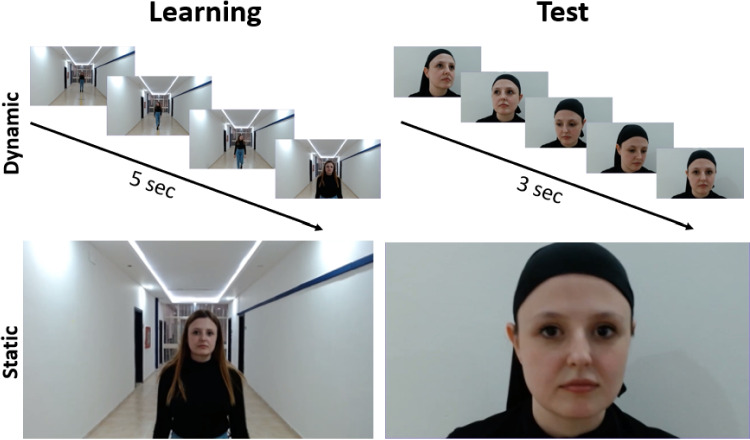
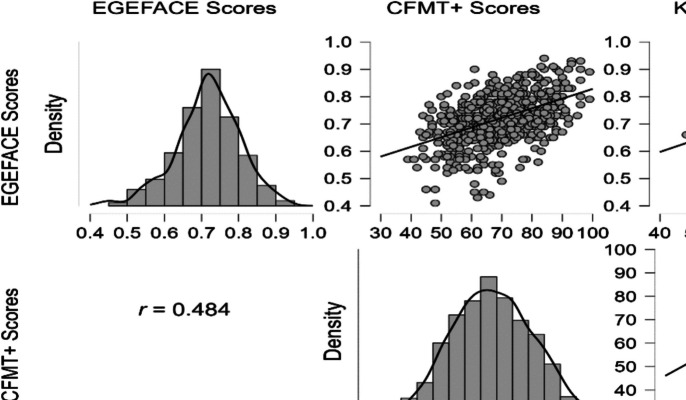
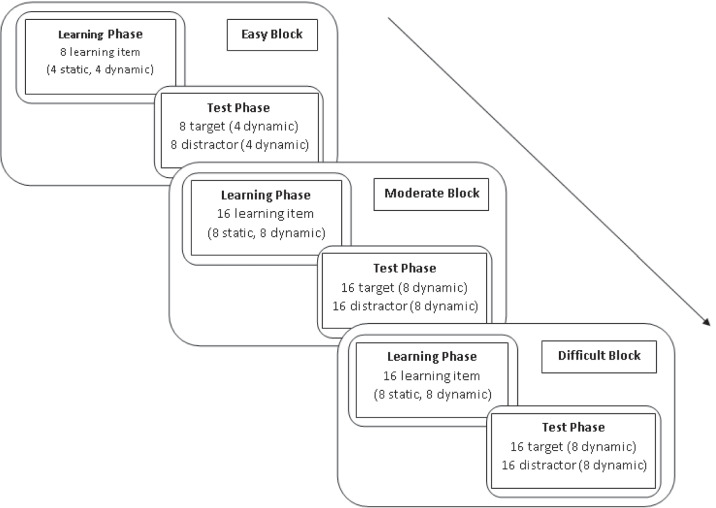
Face memory is a crucial cognitive ability necessary for maintaining a healthy social life. Recent studies reveal large individual differences in face recognition ability. Face memory tests are used to evaluate this ability. The main purpose of this study was to develop a new face memory test (EGEFACE) addressing the limitations of existing tests using both static and dynamic stimuli to increase ecological validity; employing face recognition algorithms to adjust test difficulty; measuring face memory accuracy independently of response bias by including both target-absent and target-present trials and using ROC analysis; and developing a test to measure both ends of the face recognition ability spectrum. After building a new database of static and dynamic faces, we created three difficulty levels using a face recognition algorithm. We collected data from 703 participants in two steps and examined the internal consistency, split-half reliability, and item-total score correlations. The reliability analysis confirmed that both target-absent and target-present trials of EGEFACE were reliable. High EGEFACE performers scored near super recognizer levels on CFMT+, while low performers showed limited overlap with prosopagnosic-level performance on CFMT+, suggesting EGEFACE's sensitivity across different levels of face recognition ability. Overall, results indicated a moderate positive correlation between EGEFACE and CFMT+, showing that both tests assess similar cognitive skills, while a low to moderate correlation with KFMT suggests that EGEFACE measures cognitive ability that is related to yet distinct from face perception. The results suggest that EGEFACE shows promise as an ecologically valid and effective alternative tool for assessing individual differences in face memory.
期刊介绍:
Behavior Research Methods publishes articles concerned with the methods, techniques, and instrumentation of research in experimental psychology. The journal focuses particularly on the use of computer technology in psychological research. An annual special issue is devoted to this field.



 京公网安备 11010802042870号
京ICP备2023020795号-1
京公网安备 11010802042870号
京ICP备2023020795号-1

 分享
分享
 求助内容:
求助内容: 应助结果提醒方式:
 扫码关注我们
