Jordan Gauthier, Emily C Liang, Jennifer J Huang, Erik L Kimble, Alexandre V Hirayama, Salvatore Fiorenza, Jenna M Voutsinas, Qian Vicky Wu, Carla A Jaeger-Ruckstuhl, Barbara S Pender, Delaney R Kirchmeier, Aiko Torkelson, Kristina Braathen, Ryan Basom, Mazyar Shadman, Noam E Kopmar, Ryan D Cassaday, Stanley R Riddell, David G Maloney, Cameron J Turtle
{"title":"Phase 1 study of CD19 CAR T-cell therapy harboring a fully human scFv in CAR-naïve adult patients with B-ALL.","authors":"Jordan Gauthier, Emily C Liang, Jennifer J Huang, Erik L Kimble, Alexandre V Hirayama, Salvatore Fiorenza, Jenna M Voutsinas, Qian Vicky Wu, Carla A Jaeger-Ruckstuhl, Barbara S Pender, Delaney R Kirchmeier, Aiko Torkelson, Kristina Braathen, Ryan Basom, Mazyar Shadman, Noam E Kopmar, Ryan D Cassaday, Stanley R Riddell, David G Maloney, Cameron J Turtle","doi":"10.1182/bloodadvances.2024015314","DOIUrl":null,"url":null,"abstract":"<p><strong>Abstract: </strong>CD19-directed chimeric antigen receptor-engineered (CAR) T-cell therapy elicits high response rates but fails to induce durable responses in most adults with relapsed or refractory (R/R) B-cell acute lymphoblastic leukemia (B-ALL). In a previous clinical trial, we observed anti-CAR immune responses associated with impaired in vivo CAR T-cell expansion after second infusions. Because these CD8+ T-cell responses were predominantly directed at peptides derived from the murine single-chain variable fragment (scFv) in the CAR, we conducted a clinical trial investigating the safety and efficacy of CD19 CAR T-cells engineered with a CAR incorporating a fully human scFv (JCAR021) in adults with R/R B-ALL (NCT03103971). Twenty-three patients received lymphodepletion chemotherapy and JCAR021 infusion. Nineteen patients developed cytokine release syndrome (any grade, 83%; grade 2, 61%) and 12 developed neurotoxicity (52%; grade ≥3, 35%). The overall response and complete response (CR)/CR with incomplete hematologic recovery (CRi) rates were 82% and 64%, respectively. We observed measurable residual disease-negative bone marrow (BM) responses in 82% of those with BM disease and extramedullary responses by positron emission tomography-computed tomography in 79% (CR, 50%) of those with measurable fluorodeoxyglucose-avid disease. The median duration of remission (DOR) was 10 months with a 4-year DOR probability of 29%. Four patients underwent allogeneic hematopoietic cell transplantation while in CR/CRi after JCAR021. Durable remissions were observed in patients with low BM disease burden. In contrast, the DOR was limited in those with high BM burden. We observed similar outcomes in CAR-naïve adult patients with B-ALL receiving CD19 CAR T cells expressing a fully human or murine scFv-containing CAR. This trial was registered at www.ClinicalTrials.gov as #NCT03103971.</p>","PeriodicalId":9228,"journal":{"name":"Blood advances","volume":" ","pages":"1861-1872"},"PeriodicalIF":7.1000,"publicationDate":"2025-04-22","publicationTypes":"Journal Article","fieldsOfStudy":null,"isOpenAccess":false,"openAccessPdf":"https://www.ncbi.nlm.nih.gov/pmc/articles/PMC12008683/pdf/","citationCount":"0","resultStr":null,"platform":"Semanticscholar","paperid":null,"PeriodicalName":"Blood advances","FirstCategoryId":"3","ListUrlMain":"https://doi.org/10.1182/bloodadvances.2024015314","RegionNum":1,"RegionCategory":"医学","ArticlePicture":[],"TitleCN":null,"AbstractTextCN":null,"PMCID":null,"EPubDate":"","PubModel":"","JCR":"Q1","JCRName":"HEMATOLOGY","Score":null,"Total":0}
引用次数: 0
Abstract
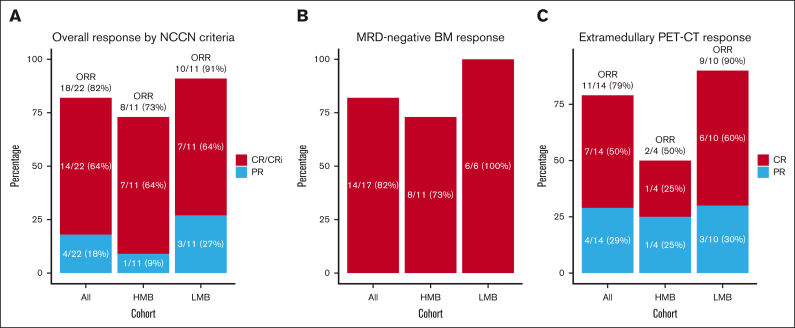
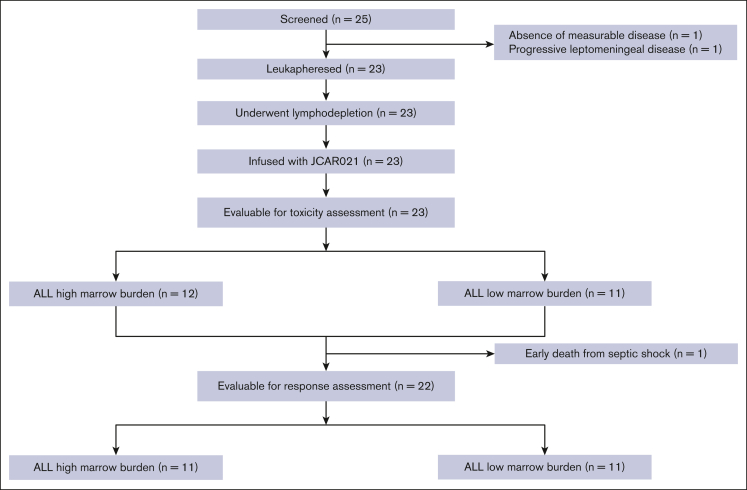
Abstract: CD19-directed chimeric antigen receptor-engineered (CAR) T-cell therapy elicits high response rates but fails to induce durable responses in most adults with relapsed or refractory (R/R) B-cell acute lymphoblastic leukemia (B-ALL). In a previous clinical trial, we observed anti-CAR immune responses associated with impaired in vivo CAR T-cell expansion after second infusions. Because these CD8+ T-cell responses were predominantly directed at peptides derived from the murine single-chain variable fragment (scFv) in the CAR, we conducted a clinical trial investigating the safety and efficacy of CD19 CAR T-cells engineered with a CAR incorporating a fully human scFv (JCAR021) in adults with R/R B-ALL (NCT03103971). Twenty-three patients received lymphodepletion chemotherapy and JCAR021 infusion. Nineteen patients developed cytokine release syndrome (any grade, 83%; grade 2, 61%) and 12 developed neurotoxicity (52%; grade ≥3, 35%). The overall response and complete response (CR)/CR with incomplete hematologic recovery (CRi) rates were 82% and 64%, respectively. We observed measurable residual disease-negative bone marrow (BM) responses in 82% of those with BM disease and extramedullary responses by positron emission tomography-computed tomography in 79% (CR, 50%) of those with measurable fluorodeoxyglucose-avid disease. The median duration of remission (DOR) was 10 months with a 4-year DOR probability of 29%. Four patients underwent allogeneic hematopoietic cell transplantation while in CR/CRi after JCAR021. Durable remissions were observed in patients with low BM disease burden. In contrast, the DOR was limited in those with high BM burden. We observed similar outcomes in CAR-naïve adult patients with B-ALL receiving CD19 CAR T cells expressing a fully human or murine scFv-containing CAR. This trial was registered at www.ClinicalTrials.gov as #NCT03103971.
期刊介绍:
Blood Advances, a semimonthly medical journal published by the American Society of Hematology, marks the first addition to the Blood family in 70 years. This peer-reviewed, online-only, open-access journal was launched under the leadership of founding editor-in-chief Robert Negrin, MD, from Stanford University Medical Center in Stanford, CA, with its inaugural issue released on November 29, 2016.
Blood Advances serves as an international platform for original articles detailing basic laboratory, translational, and clinical investigations in hematology. The journal comprehensively covers all aspects of hematology, including disorders of leukocytes (both benign and malignant), erythrocytes, platelets, hemostatic mechanisms, vascular biology, immunology, and hematologic oncology. Each article undergoes a rigorous peer-review process, with selection based on the originality of the findings, the high quality of the work presented, and the clarity of the presentation.




 京公网安备 11010802042870号
京ICP备2023020795号-1
京公网安备 11010802042870号
京ICP备2023020795号-1

 分享
分享
 求助内容:
求助内容: 应助结果提醒方式:
 扫码关注我们
