CXCR3 inhibition ameliorates mitochondrial function to mitigate oxidative damage through NCOA4-mediated ferritinophagy and improves the gut microbiota in mice
Yuan Gao , Yian Deng , Wenjie Li, Junjie Wang, Mingze Liu, Hanchuan Dai
{"title":"CXCR3 inhibition ameliorates mitochondrial function to mitigate oxidative damage through NCOA4-mediated ferritinophagy and improves the gut microbiota in mice","authors":"Yuan Gao , Yian Deng , Wenjie Li, Junjie Wang, Mingze Liu, Hanchuan Dai","doi":"10.1016/j.freeradbiomed.2025.01.034","DOIUrl":null,"url":null,"abstract":"<div><div>Nuclear receptor coactivator 4 (NCOA4)-mediated ferritinophagy contributes to maintain intracellular iron balance by regulating ferritin degradation, which is essential for redox homeostasis. CXC-motif chemokine receptor 3 (CXCR3) is involved in the regulation of oxidative stress and autophagy. However, its role in modulating intestinal oxidative damage through ferritinophagy and the gut microbiota remains unclear. In this study, the impacts of CXCR3 inhibition on intestine oxidative damage, ferritinophagy, and the gut microbiota, as well as the mitochondrial quality control were investigated both in vivo and in vitro. The results show that CXCR3 inhibition by AMG487 relieves Diquat-induced intestinal damage, enhances the expression of tight junction proteins, and promotes antioxidant capacity in mice. Simultaneously, CXCR3 inhibition improves gut microbiota composition, and triggers NCOA4-mediated ferritinophagy. Mechanistically, the effects of CXCR3 inhibition on ferritinophagy were explored in IPEC-J2 cells. Co-localization and interaction between CXCR3 and NCOA4 were observed. Downregulation of NCOA4-mediated ferritinophagy leads to increase the expression of tight junction proteins, reduces iron levels, restricts ROS accumulation, and enhances GPX4 expression. Moreover, CXCR3 suppression facilitates mitochondrial biogenesis and mitochondrial fusion, increases antioxidative capacity, and results in the elevation of tight junction proteins expression. These findings suggest that CXCR3 inhibition reverses Diquat-induced intestinal oxidative damage, enhances mitochondrial function, and improves gut microbiota composition by elevating NCOA4-mediated ferritinophagy, which implies that CXCR3 may serve as a potential therapeutic intervention targeting iron metabolism for treating intestinal diseases.</div></div>","PeriodicalId":12407,"journal":{"name":"Free Radical Biology and Medicine","volume":"229 ","pages":"Pages 384-398"},"PeriodicalIF":8.2000,"publicationDate":"2025-03-01","publicationTypes":"Journal Article","fieldsOfStudy":null,"isOpenAccess":false,"openAccessPdf":"","citationCount":"0","resultStr":null,"platform":"Semanticscholar","paperid":null,"PeriodicalName":"Free Radical Biology and Medicine","FirstCategoryId":"3","ListUrlMain":"https://www.sciencedirect.com/science/article/pii/S0891584925000401","RegionNum":2,"RegionCategory":"生物学","ArticlePicture":[],"TitleCN":null,"AbstractTextCN":null,"PMCID":null,"EPubDate":"2025/1/17 0:00:00","PubModel":"Epub","JCR":"Q1","JCRName":"BIOCHEMISTRY & MOLECULAR BIOLOGY","Score":null,"Total":0}
引用次数: 0
Abstract
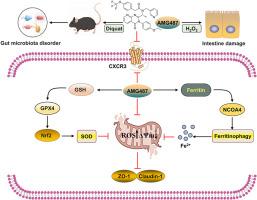
Nuclear receptor coactivator 4 (NCOA4)-mediated ferritinophagy contributes to maintain intracellular iron balance by regulating ferritin degradation, which is essential for redox homeostasis. CXC-motif chemokine receptor 3 (CXCR3) is involved in the regulation of oxidative stress and autophagy. However, its role in modulating intestinal oxidative damage through ferritinophagy and the gut microbiota remains unclear. In this study, the impacts of CXCR3 inhibition on intestine oxidative damage, ferritinophagy, and the gut microbiota, as well as the mitochondrial quality control were investigated both in vivo and in vitro. The results show that CXCR3 inhibition by AMG487 relieves Diquat-induced intestinal damage, enhances the expression of tight junction proteins, and promotes antioxidant capacity in mice. Simultaneously, CXCR3 inhibition improves gut microbiota composition, and triggers NCOA4-mediated ferritinophagy. Mechanistically, the effects of CXCR3 inhibition on ferritinophagy were explored in IPEC-J2 cells. Co-localization and interaction between CXCR3 and NCOA4 were observed. Downregulation of NCOA4-mediated ferritinophagy leads to increase the expression of tight junction proteins, reduces iron levels, restricts ROS accumulation, and enhances GPX4 expression. Moreover, CXCR3 suppression facilitates mitochondrial biogenesis and mitochondrial fusion, increases antioxidative capacity, and results in the elevation of tight junction proteins expression. These findings suggest that CXCR3 inhibition reverses Diquat-induced intestinal oxidative damage, enhances mitochondrial function, and improves gut microbiota composition by elevating NCOA4-mediated ferritinophagy, which implies that CXCR3 may serve as a potential therapeutic intervention targeting iron metabolism for treating intestinal diseases.
期刊介绍:
Free Radical Biology and Medicine is a leading journal in the field of redox biology, which is the study of the role of reactive oxygen species (ROS) and other oxidizing agents in biological systems. The journal serves as a premier forum for publishing innovative and groundbreaking research that explores the redox biology of health and disease, covering a wide range of topics and disciplines. Free Radical Biology and Medicine also commissions Special Issues that highlight recent advances in both basic and clinical research, with a particular emphasis on the mechanisms underlying altered metabolism and redox signaling. These Special Issues aim to provide a focused platform for the latest research in the field, fostering collaboration and knowledge exchange among researchers and clinicians.



 京公网安备 11010802042870号
京ICP备2023020795号-1
京公网安备 11010802042870号
京ICP备2023020795号-1

 分享
分享
 求助内容:
求助内容: 应助结果提醒方式:
 扫码关注我们
