Gary Ka-Ki Chung, Woohyung Lee, Danna Camille Vargas, Bulbul Sharma, Kai Sing Sun, Heidi Hung, Lee Sha Tong, Tsz Lui Tang, Hasiba Munir, Chi Yui Wong, Soniya Pun, Man Hin Chio, Eliza Lai-Yi Wong, Dong Dong, Eng-Kiong Yeoh
{"title":"Cardiovascular risk profiling among South Asian adults in Hong Kong: a latent class analysis.","authors":"Gary Ka-Ki Chung, Woohyung Lee, Danna Camille Vargas, Bulbul Sharma, Kai Sing Sun, Heidi Hung, Lee Sha Tong, Tsz Lui Tang, Hasiba Munir, Chi Yui Wong, Soniya Pun, Man Hin Chio, Eliza Lai-Yi Wong, Dong Dong, Eng-Kiong Yeoh","doi":"10.1186/s12939-025-02376-8","DOIUrl":null,"url":null,"abstract":"<p><strong>Background: </strong>South Asians living in urbanized settings are facing disproportionate cardiovascular burden largely attributable to modifiable risk factors. Given the rapid surge in South Asian population in Hong Kong, this study aims to identify and distinguish clusters of cardiovascular risk profiles among community-dwelling South Asian adults.</p><p><strong>Methods: </strong>Between June 2022 and December 2023, 1181 South Asian adults were recruited through territory-wide outreach health assessments on lifestyle, psychological distress, obesity, clinical cardiovascular conditions, and sociodemographic factors. Latent class analysis was performed to classify the cardiovascular profiles, followed by multinomial logistic regression to identify the sociodemographic characteristics across classes.</p><p><strong>Results: </strong>Five latent classes were identified: low risk (19.6%), lifestyle risk plus distress (8.9%), obesity risk (33.4%), lifestyle risk plus distress with obesity (26.6%), and high clinical risk (11.4%). Apart from the higher clinical risk in older adults, women tended to cluster into classes with obesity, while men and the economically active were more likely in classes with poorer lifestyles and stress. Pakistani and Nepalese consistently exhibited higher risks compared to Indians, whereas the less educated tended to cluster into the high clinical risk class.</p><p><strong>Conclusion: </strong>This study revealed distinct cardiovascular risk patterns and sociodemographic features within the South Asian community in Hong Kong. The heavy burden on obesity especially in women, lifestyle and psychological risks especially in men, and low overall physical activity level may be translated into a tremendous cardiovascular disease burden in the forthcoming decades, in particular among Pakistani and Nepalese as well as the socioeconomically disadvantaged.</p>","PeriodicalId":13745,"journal":{"name":"International Journal for Equity in Health","volume":"24 1","pages":"14"},"PeriodicalIF":4.1000,"publicationDate":"2025-01-17","publicationTypes":"Journal Article","fieldsOfStudy":null,"isOpenAccess":false,"openAccessPdf":"https://www.ncbi.nlm.nih.gov/pmc/articles/PMC11740419/pdf/","citationCount":"0","resultStr":null,"platform":"Semanticscholar","paperid":null,"PeriodicalName":"International Journal for Equity in Health","FirstCategoryId":"3","ListUrlMain":"https://doi.org/10.1186/s12939-025-02376-8","RegionNum":2,"RegionCategory":"医学","ArticlePicture":[],"TitleCN":null,"AbstractTextCN":null,"PMCID":null,"EPubDate":"","PubModel":"","JCR":"Q1","JCRName":"PUBLIC, ENVIRONMENTAL & OCCUPATIONAL HEALTH","Score":null,"Total":0}
引用次数: 0
Abstract
Background: South Asians living in urbanized settings are facing disproportionate cardiovascular burden largely attributable to modifiable risk factors. Given the rapid surge in South Asian population in Hong Kong, this study aims to identify and distinguish clusters of cardiovascular risk profiles among community-dwelling South Asian adults.
Methods: Between June 2022 and December 2023, 1181 South Asian adults were recruited through territory-wide outreach health assessments on lifestyle, psychological distress, obesity, clinical cardiovascular conditions, and sociodemographic factors. Latent class analysis was performed to classify the cardiovascular profiles, followed by multinomial logistic regression to identify the sociodemographic characteristics across classes.
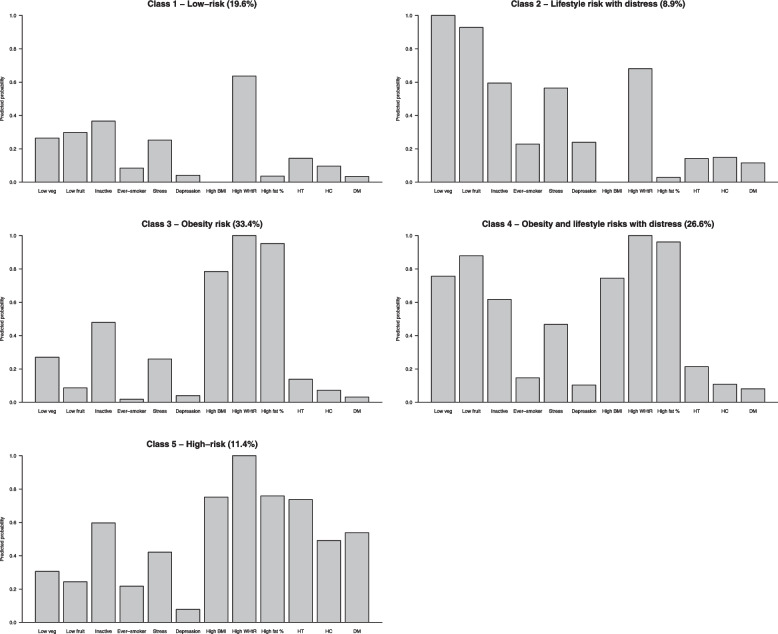
Results: Five latent classes were identified: low risk (19.6%), lifestyle risk plus distress (8.9%), obesity risk (33.4%), lifestyle risk plus distress with obesity (26.6%), and high clinical risk (11.4%). Apart from the higher clinical risk in older adults, women tended to cluster into classes with obesity, while men and the economically active were more likely in classes with poorer lifestyles and stress. Pakistani and Nepalese consistently exhibited higher risks compared to Indians, whereas the less educated tended to cluster into the high clinical risk class.
Conclusion: This study revealed distinct cardiovascular risk patterns and sociodemographic features within the South Asian community in Hong Kong. The heavy burden on obesity especially in women, lifestyle and psychological risks especially in men, and low overall physical activity level may be translated into a tremendous cardiovascular disease burden in the forthcoming decades, in particular among Pakistani and Nepalese as well as the socioeconomically disadvantaged.
期刊介绍:
International Journal for Equity in Health is an Open Access, peer-reviewed, online journal presenting evidence relevant to the search for, and attainment of, equity in health across and within countries. International Journal for Equity in Health aims to improve the understanding of issues that influence the health of populations. This includes the discussion of political, policy-related, economic, social and health services-related influences, particularly with regard to systematic differences in distributions of one or more aspects of health in population groups defined demographically, geographically, or socially.




 京公网安备 11010802042870号
京ICP备2023020795号-1
京公网安备 11010802042870号
京ICP备2023020795号-1

 分享
分享
 求助内容:
求助内容: 应助结果提醒方式:
 扫码关注我们
