{"title":"Performance Evaluation and Implications of Large Language Models in Radiology Board Exams: Prospective Comparative Analysis.","authors":"Boxiong Wei","doi":"10.2196/64284","DOIUrl":null,"url":null,"abstract":"<p><strong>Background: </strong>Artificial intelligence advancements have enabled large language models to significantly impact radiology education and diagnostic accuracy.</p><p><strong>Objective: </strong>This study evaluates the performance of mainstream large language models, including GPT-4, Claude, Bard, Tongyi Qianwen, and Gemini Pro, in radiology board exams.</p><p><strong>Methods: </strong>A comparative analysis of 150 multiple-choice questions from radiology board exams without images was conducted. Models were assessed on their accuracy for text-based questions and were categorized by cognitive levels and medical specialties using χ2 tests and ANOVA.</p><p><strong>Results: </strong>GPT-4 achieved the highest accuracy (83.3%, 125/150), significantly outperforming all other models. Specifically, Claude achieved an accuracy of 62% (93/150; P<.001), Bard 54.7% (82/150; P<.001), Tongyi Qianwen 70.7% (106/150; P=.009), and Gemini Pro 55.3% (83/150; P<.001). The odds ratios compared to GPT-4 were 0.33 (95% CI 0.18-0.60) for Claude, 0.24 (95% CI 0.13-0.44) for Bard, and 0.25 (95% CI 0.14-0.45) for Gemini Pro. Tongyi Qianwen performed relatively well with an accuracy of 70.7% (106/150; P=0.02) and had an odds ratio of 0.48 (95% CI 0.27-0.87) compared to GPT-4. Performance varied across question types and specialties, with GPT-4 excelling in both lower-order and higher-order questions, while Claude and Bard struggled with complex diagnostic questions.</p><p><strong>Conclusions: </strong>GPT-4 and Tongyi Qianwen show promise in medical education and training. The study emphasizes the need for domain-specific training datasets to enhance large language models' effectiveness in specialized fields like radiology.</p>","PeriodicalId":36236,"journal":{"name":"JMIR Medical Education","volume":"11 ","pages":"e64284"},"PeriodicalIF":3.2000,"publicationDate":"2025-01-16","publicationTypes":"Journal Article","fieldsOfStudy":null,"isOpenAccess":false,"openAccessPdf":"https://www.ncbi.nlm.nih.gov/pmc/articles/PMC11756834/pdf/","citationCount":"0","resultStr":null,"platform":"Semanticscholar","paperid":null,"PeriodicalName":"JMIR Medical Education","FirstCategoryId":"1085","ListUrlMain":"https://doi.org/10.2196/64284","RegionNum":0,"RegionCategory":null,"ArticlePicture":[],"TitleCN":null,"AbstractTextCN":null,"PMCID":null,"EPubDate":"","PubModel":"","JCR":"Q1","JCRName":"EDUCATION, SCIENTIFIC DISCIPLINES","Score":null,"Total":0}
引用次数: 0
Abstract
Background: Artificial intelligence advancements have enabled large language models to significantly impact radiology education and diagnostic accuracy.
Objective: This study evaluates the performance of mainstream large language models, including GPT-4, Claude, Bard, Tongyi Qianwen, and Gemini Pro, in radiology board exams.
Methods: A comparative analysis of 150 multiple-choice questions from radiology board exams without images was conducted. Models were assessed on their accuracy for text-based questions and were categorized by cognitive levels and medical specialties using χ2 tests and ANOVA.
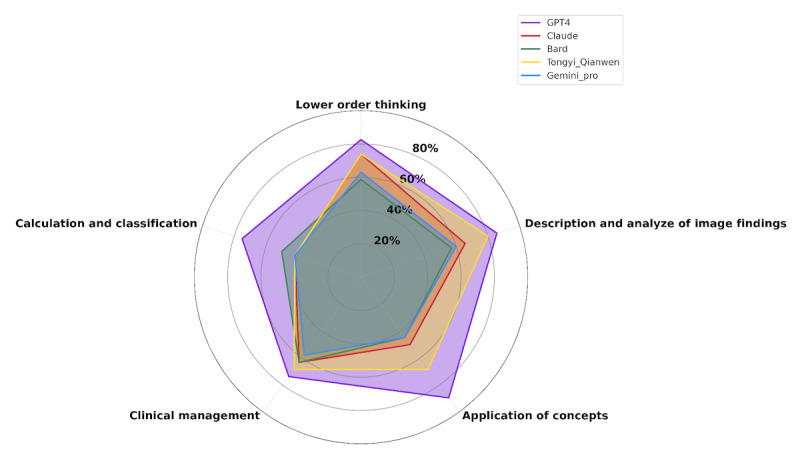
Results: GPT-4 achieved the highest accuracy (83.3%, 125/150), significantly outperforming all other models. Specifically, Claude achieved an accuracy of 62% (93/150; P<.001), Bard 54.7% (82/150; P<.001), Tongyi Qianwen 70.7% (106/150; P=.009), and Gemini Pro 55.3% (83/150; P<.001). The odds ratios compared to GPT-4 were 0.33 (95% CI 0.18-0.60) for Claude, 0.24 (95% CI 0.13-0.44) for Bard, and 0.25 (95% CI 0.14-0.45) for Gemini Pro. Tongyi Qianwen performed relatively well with an accuracy of 70.7% (106/150; P=0.02) and had an odds ratio of 0.48 (95% CI 0.27-0.87) compared to GPT-4. Performance varied across question types and specialties, with GPT-4 excelling in both lower-order and higher-order questions, while Claude and Bard struggled with complex diagnostic questions.
Conclusions: GPT-4 and Tongyi Qianwen show promise in medical education and training. The study emphasizes the need for domain-specific training datasets to enhance large language models' effectiveness in specialized fields like radiology.




 京公网安备 11010802042870号
京ICP备2023020795号-1
京公网安备 11010802042870号
京ICP备2023020795号-1

 分享
分享
 求助内容:
求助内容: 应助结果提醒方式:
 扫码关注我们
