{"title":"Measurement and Analysis of Optical Transmission Characteristics of the Human Skull","authors":"Peiquan Chen, Liang Zhou, Zhaohui Liu, Shuang Liu","doi":"10.1002/jbio.202400414","DOIUrl":null,"url":null,"abstract":"<div>\n \n <p>The brain, as a vital part of central nervous system, receives approximately 25% of body's blood supply, making accurate monitoring of cerebral blood flow essential. While fNIRS is widely used for measuring brain physiology, complex tissue structure affects light intensity, spot size, and detection accuracy. Many studies rely on simulations with limited experimental validation. In this study, we used real adult skulls and agar to create a mimic model, building a transmission optical system with 13 wavelength filters and varying agar thicknesses. Peak intensity of transmitted light and size of scattered spot were measured at different wavelengths, and transmittance, total attenuation coefficient, and spot diameter enlargement of cranial mimics at different wavelengths were obtained. Results showed wavelengths below 550 nm struggled to penetrate the skull, while those above 700 nm penetrated deeper and diffused more. This suggests that short wavelengths capture epidermal PPG signals, whereas longer wavelengths detect both epidermal and intracranial signals.</p>\n </div>","PeriodicalId":184,"journal":{"name":"Journal of Biophotonics","volume":"18 3","pages":""},"PeriodicalIF":2.0000,"publicationDate":"2025-01-17","publicationTypes":"Journal Article","fieldsOfStudy":null,"isOpenAccess":false,"openAccessPdf":"","citationCount":"0","resultStr":null,"platform":"Semanticscholar","paperid":null,"PeriodicalName":"Journal of Biophotonics","FirstCategoryId":"101","ListUrlMain":"https://onlinelibrary.wiley.com/doi/10.1002/jbio.202400414","RegionNum":3,"RegionCategory":"物理与天体物理","ArticlePicture":[],"TitleCN":null,"AbstractTextCN":null,"PMCID":null,"EPubDate":"","PubModel":"","JCR":"Q3","JCRName":"BIOCHEMICAL RESEARCH METHODS","Score":null,"Total":0}
引用次数: 0
Abstract
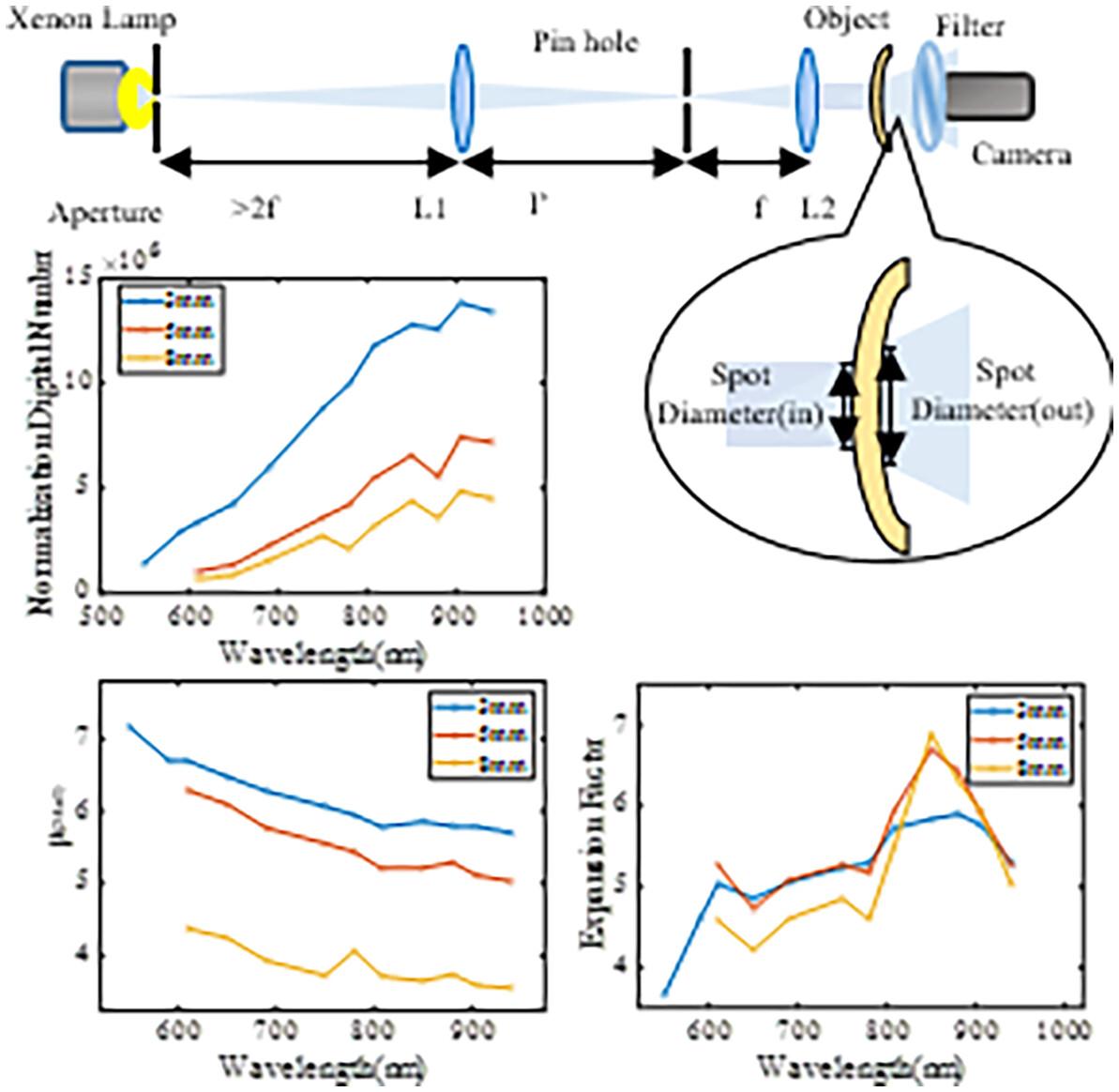
The brain, as a vital part of central nervous system, receives approximately 25% of body's blood supply, making accurate monitoring of cerebral blood flow essential. While fNIRS is widely used for measuring brain physiology, complex tissue structure affects light intensity, spot size, and detection accuracy. Many studies rely on simulations with limited experimental validation. In this study, we used real adult skulls and agar to create a mimic model, building a transmission optical system with 13 wavelength filters and varying agar thicknesses. Peak intensity of transmitted light and size of scattered spot were measured at different wavelengths, and transmittance, total attenuation coefficient, and spot diameter enlargement of cranial mimics at different wavelengths were obtained. Results showed wavelengths below 550 nm struggled to penetrate the skull, while those above 700 nm penetrated deeper and diffused more. This suggests that short wavelengths capture epidermal PPG signals, whereas longer wavelengths detect both epidermal and intracranial signals.
期刊介绍:
The first international journal dedicated to publishing reviews and original articles from this exciting field, the Journal of Biophotonics covers the broad range of research on interactions between light and biological material. The journal offers a platform where the physicist communicates with the biologist and where the clinical practitioner learns about the latest tools for the diagnosis of diseases. As such, the journal is highly interdisciplinary, publishing cutting edge research in the fields of life sciences, medicine, physics, chemistry, and engineering. The coverage extends from fundamental research to specific developments, while also including the latest applications.



 京公网安备 11010802042870号
京ICP备2023020795号-1
京公网安备 11010802042870号
京ICP备2023020795号-1

 分享
分享
 求助内容:
求助内容: 应助结果提醒方式:
 扫码关注我们
