Ai-Min Li, Peter Y. Zavalij, Fred Omenya, Xiaolin Li, Chunsheng Wang
{"title":"Salt-in-presalt electrolyte solutions for high-potential non-aqueous sodium metal batteries","authors":"Ai-Min Li, Peter Y. Zavalij, Fred Omenya, Xiaolin Li, Chunsheng Wang","doi":"10.1038/s41565-024-01848-2","DOIUrl":null,"url":null,"abstract":"Room-temperature non-aqueous sodium metal batteries are viable candidates for cost-effective and safe electrochemical energy storage. However, they show low specific energy and poor cycle life as the use of conventional organic-based non-aqueous electrolyte solutions enables the formation of interphases that cannot prevent degradations at the positive and negative electrodes. Here, to promote the formation of inorganic NaF-rich interphases on both negative and positive electrodes, we propose the salt-in-presalt (SIPS) electrolyte formulation strategy. In SIPS, sodium bis(fluorosulfonyl)imide (NaFSI) salt is dissolved in the liquid precursor of the sodium bis(trifluoromethylsulfonyl)imide (NaTFSI) salt, that is, N,N-dimethyltrifluoromethane-sulfonamide, called PreTFSI. The prepared 0.5 M NaFSI in PreTFSI (SIPS5) electrolyte solution shows an electrochemical stability up to 6.7 V versus Na|Na+ and enables a Na stripping/plating average Coulombic efficiency of 99.7% at 2.0 mA cm−2 and 4.0 mAh cm−2 in Na||Al cell configuration. By testing SIPS5 in Na metal and ‘anode-less’ coin and pouch cell configurations using NaNi0.6Mn0.2Co0.2O2 or sulfurized polyacrylonitrile as positive electrode active materials, we demonstrate the ability of the SIPS strategy to deliver improved specific discharge capacity and capacity retentions at high cell potentials and moderate applied specific currents for cell cycle life up to 1,000 cycles. The specific energy and cycle life of rechargeable non-aqueous Na-based batteries are influenced by the type of electrolyte used. Here the authors propose a sulfonyl imide-rich electrolyte solution to improve the energy content and life span of various Na-based batteries.","PeriodicalId":18915,"journal":{"name":"Nature nanotechnology","volume":"20 3","pages":"388-396"},"PeriodicalIF":34.9000,"publicationDate":"2025-01-23","publicationTypes":"Journal Article","fieldsOfStudy":null,"isOpenAccess":false,"openAccessPdf":"","citationCount":"0","resultStr":null,"platform":"Semanticscholar","paperid":null,"PeriodicalName":"Nature nanotechnology","FirstCategoryId":"88","ListUrlMain":"https://www.nature.com/articles/s41565-024-01848-2","RegionNum":1,"RegionCategory":"材料科学","ArticlePicture":[],"TitleCN":null,"AbstractTextCN":null,"PMCID":null,"EPubDate":"","PubModel":"","JCR":"Q1","JCRName":"MATERIALS SCIENCE, MULTIDISCIPLINARY","Score":null,"Total":0}
引用次数: 0
Abstract
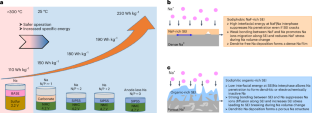
Room-temperature non-aqueous sodium metal batteries are viable candidates for cost-effective and safe electrochemical energy storage. However, they show low specific energy and poor cycle life as the use of conventional organic-based non-aqueous electrolyte solutions enables the formation of interphases that cannot prevent degradations at the positive and negative electrodes. Here, to promote the formation of inorganic NaF-rich interphases on both negative and positive electrodes, we propose the salt-in-presalt (SIPS) electrolyte formulation strategy. In SIPS, sodium bis(fluorosulfonyl)imide (NaFSI) salt is dissolved in the liquid precursor of the sodium bis(trifluoromethylsulfonyl)imide (NaTFSI) salt, that is, N,N-dimethyltrifluoromethane-sulfonamide, called PreTFSI. The prepared 0.5 M NaFSI in PreTFSI (SIPS5) electrolyte solution shows an electrochemical stability up to 6.7 V versus Na|Na+ and enables a Na stripping/plating average Coulombic efficiency of 99.7% at 2.0 mA cm−2 and 4.0 mAh cm−2 in Na||Al cell configuration. By testing SIPS5 in Na metal and ‘anode-less’ coin and pouch cell configurations using NaNi0.6Mn0.2Co0.2O2 or sulfurized polyacrylonitrile as positive electrode active materials, we demonstrate the ability of the SIPS strategy to deliver improved specific discharge capacity and capacity retentions at high cell potentials and moderate applied specific currents for cell cycle life up to 1,000 cycles. The specific energy and cycle life of rechargeable non-aqueous Na-based batteries are influenced by the type of electrolyte used. Here the authors propose a sulfonyl imide-rich electrolyte solution to improve the energy content and life span of various Na-based batteries.
室温非水金属钠电池是具有成本效益和安全性的电化学储能可行的候选者。然而,它们表现出较低的比能和较差的循环寿命,因为使用传统的有机基非水电解质溶液会形成不能阻止正极和负极降解的界面相。为了促进正负极上无机富钠界面相的形成,我们提出了盐下盐(SIPS)电解质配方策略。在SIPS中,双(氟磺酰基)亚胺钠(NaFSI)盐溶解在双(三氟甲基磺酰基)亚胺钠(NaTFSI)盐的液体前体中,即N,N-二甲基三氟甲烷-磺酰胺,称为prefsi。在prefsi (SIPS5)电解质溶液中制备的0.5 M NaFSI相对于Na|Na+的电化学稳定性高达6.7 V,在2.0 mA cm - 2和4.0 mAh cm - 2 Na||Al电池结构下,Na剥离/镀平均库仑效率达到99.7%。通过测试SIPS5在Na金属和“无阳极”硬币和袋状电池配置中使用NaNi0.6Mn0.2Co0.2O2或硫化聚丙烯丙烯烯作为正极活性材料,我们证明了SIPS策略在高电池电位和适度的应用比电流下提供改进的比放电容量和容量保持的能力,电池循环寿命可达1000次。
期刊介绍:
Nature Nanotechnology is a prestigious journal that publishes high-quality papers in various areas of nanoscience and nanotechnology. The journal focuses on the design, characterization, and production of structures, devices, and systems that manipulate and control materials at atomic, molecular, and macromolecular scales. It encompasses both bottom-up and top-down approaches, as well as their combinations.
Furthermore, Nature Nanotechnology fosters the exchange of ideas among researchers from diverse disciplines such as chemistry, physics, material science, biomedical research, engineering, and more. It promotes collaboration at the forefront of this multidisciplinary field. The journal covers a wide range of topics, from fundamental research in physics, chemistry, and biology, including computational work and simulations, to the development of innovative devices and technologies for various industrial sectors such as information technology, medicine, manufacturing, high-performance materials, energy, and environmental technologies. It includes coverage of organic, inorganic, and hybrid materials.




 京公网安备 11010802042870号
京ICP备2023020795号-1
京公网安备 11010802042870号
京ICP备2023020795号-1

 分享
分享
 求助内容:
求助内容: 应助结果提醒方式:
 扫码关注我们
