{"title":"Evaluating long-range orientational ordering of water around proteins: signature of a tug-of-war scenario†","authors":"Subhabrata Hazra and Biman Jana","doi":"10.1039/D4CP04451G","DOIUrl":null,"url":null,"abstract":"<p >Long-range perturbations of water structure and dynamics by biomolecules are of great interest owing to their potential role in biomolecular recognition. In this article, we examined the local and long-range orientational structure of water molecules surrounding proteins with different total charges (+8, 0 and −8), both with and without the presence of a physiological salt environment. A prominent population of in-oriented water molecules was observed in the first hydration shell of the proteins, irrespective of their total charges. Starting from the third hydration layer, water molecules primarily reflected the total charge of the respective protein. This long-range ordering persisted up to the ninth hydration layer without a physiological salt environment and vanished beyond the fifth hydration shell in the presence of a physiological salt environment. Long-range orientational ordering around different types of surface atoms of a protein showed a particularly rich and heterogeneous behaviour. When the surface atom's charge and the protein's total charge were opposite, a clear signature of a tug-of-war was demonstrated in the long-range orientational ordering of water molecules. While water molecules reported the surface atom's charge at shorter distances, at longer distances, water molecules reported the total charge of the protein, with a crossover occurring around 10 Å. This phenomenon persisted even in the presence of a physiological salt environment. Evidence of destructive/constructive superposition of water-mediated orientation waves originating from two individual proteins with similar/opposite total charges was also demonstrated. These results are important for understanding long-range water-mediated recognition phenomena among biomolecules (<em>e.g.</em>, protein–protein, protein–ligand, and protein–DNA interactions).</p>","PeriodicalId":99,"journal":{"name":"Physical Chemistry Chemical Physics","volume":" 7","pages":" 3930-3940"},"PeriodicalIF":2.9000,"publicationDate":"2025-01-22","publicationTypes":"Journal Article","fieldsOfStudy":null,"isOpenAccess":false,"openAccessPdf":"","citationCount":"0","resultStr":null,"platform":"Semanticscholar","paperid":null,"PeriodicalName":"Physical Chemistry Chemical Physics","FirstCategoryId":"92","ListUrlMain":"https://pubs.rsc.org/en/content/articlelanding/2025/cp/d4cp04451g","RegionNum":3,"RegionCategory":"化学","ArticlePicture":[],"TitleCN":null,"AbstractTextCN":null,"PMCID":null,"EPubDate":"","PubModel":"","JCR":"Q3","JCRName":"CHEMISTRY, PHYSICAL","Score":null,"Total":0}
引用次数: 0
Abstract
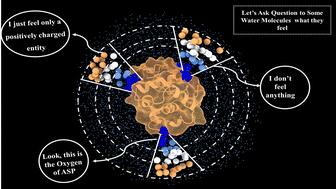
Long-range perturbations of water structure and dynamics by biomolecules are of great interest owing to their potential role in biomolecular recognition. In this article, we examined the local and long-range orientational structure of water molecules surrounding proteins with different total charges (+8, 0 and −8), both with and without the presence of a physiological salt environment. A prominent population of in-oriented water molecules was observed in the first hydration shell of the proteins, irrespective of their total charges. Starting from the third hydration layer, water molecules primarily reflected the total charge of the respective protein. This long-range ordering persisted up to the ninth hydration layer without a physiological salt environment and vanished beyond the fifth hydration shell in the presence of a physiological salt environment. Long-range orientational ordering around different types of surface atoms of a protein showed a particularly rich and heterogeneous behaviour. When the surface atom's charge and the protein's total charge were opposite, a clear signature of a tug-of-war was demonstrated in the long-range orientational ordering of water molecules. While water molecules reported the surface atom's charge at shorter distances, at longer distances, water molecules reported the total charge of the protein, with a crossover occurring around 10 Å. This phenomenon persisted even in the presence of a physiological salt environment. Evidence of destructive/constructive superposition of water-mediated orientation waves originating from two individual proteins with similar/opposite total charges was also demonstrated. These results are important for understanding long-range water-mediated recognition phenomena among biomolecules (e.g., protein–protein, protein–ligand, and protein–DNA interactions).
期刊介绍:
Physical Chemistry Chemical Physics (PCCP) is an international journal co-owned by 19 physical chemistry and physics societies from around the world. This journal publishes original, cutting-edge research in physical chemistry, chemical physics and biophysical chemistry. To be suitable for publication in PCCP, articles must include significant innovation and/or insight into physical chemistry; this is the most important criterion that reviewers and Editors will judge against when evaluating submissions.
The journal has a broad scope and welcomes contributions spanning experiment, theory, computation and data science. Topical coverage includes spectroscopy, dynamics, kinetics, statistical mechanics, thermodynamics, electrochemistry, catalysis, surface science, quantum mechanics, quantum computing and machine learning. Interdisciplinary research areas such as polymers and soft matter, materials, nanoscience, energy, surfaces/interfaces, and biophysical chemistry are welcomed if they demonstrate significant innovation and/or insight into physical chemistry. Joined experimental/theoretical studies are particularly appreciated when complementary and based on up-to-date approaches.




 京公网安备 11010802042870号
京ICP备2023020795号-1
京公网安备 11010802042870号
京ICP备2023020795号-1

 分享
分享
 求助内容:
求助内容: 应助结果提醒方式:
 扫码关注我们
