Jonas Segervald, Dmitry Malyshev, Rasmus Öberg, Erik Zäll, Xueen Jia, Thomas Wågberg, Magnus Andersson
{"title":"Ultra-Sensitive Detection of Bacterial Spores via SERS.","authors":"Jonas Segervald, Dmitry Malyshev, Rasmus Öberg, Erik Zäll, Xueen Jia, Thomas Wågberg, Magnus Andersson","doi":"10.1021/acssensors.4c03151","DOIUrl":null,"url":null,"abstract":"<p><p>Bacterial spores are highly resilient and capable of surviving extreme conditions, making them a persistent threat in contexts such as disease transmission, food safety, and bioterrorism. Their ability to withstand conventional sterilization methods necessitates rapid and accurate detection techniques to effectively mitigate the risks they present. In this study, we introduce a surface-enhanced Raman spectroscopy (SERS) approach for detecting <i>Bacillus thuringiensis</i> spores by targeting calcium dipicolinate acid (CaDPA), a biomarker uniquely associated with bacterial spores. Our method uses probe sonication to disrupt spores, releasing their CaDPA, which is then detected by SERS on drop-dried supernatant mixed with gold nanorods. This simple approach enables the selective detection of CaDPA, distinguishing it from other spore components and background noise. We demonstrate detection of biogenic CaDPA from concentrations as low as 10<sup>3</sup> spores/mL, with sensitivity reaching beyond CaDPA levels of a single spore. Finally, we show the method's robustness by detecting CaDPA from a realistic sample of fresh milk mixed with spores. These findings highlight the potential of SERS as a sensitive and specific technique for bacterial spore detection, with implications for fields requiring rapid and reliable spore identification.</p>","PeriodicalId":24,"journal":{"name":"ACS Sensors","volume":" ","pages":"1237-1248"},"PeriodicalIF":9.1000,"publicationDate":"2025-02-28","publicationTypes":"Journal Article","fieldsOfStudy":null,"isOpenAccess":false,"openAccessPdf":"https://www.ncbi.nlm.nih.gov/pmc/articles/PMC11877637/pdf/","citationCount":"0","resultStr":null,"platform":"Semanticscholar","paperid":null,"PeriodicalName":"ACS Sensors","FirstCategoryId":"92","ListUrlMain":"https://doi.org/10.1021/acssensors.4c03151","RegionNum":1,"RegionCategory":"化学","ArticlePicture":[],"TitleCN":null,"AbstractTextCN":null,"PMCID":null,"EPubDate":"2025/1/23 0:00:00","PubModel":"Epub","JCR":"Q1","JCRName":"CHEMISTRY, ANALYTICAL","Score":null,"Total":0}
引用次数: 0
Abstract
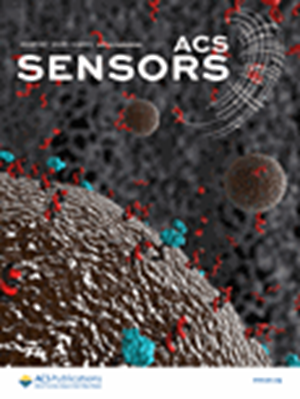
Bacterial spores are highly resilient and capable of surviving extreme conditions, making them a persistent threat in contexts such as disease transmission, food safety, and bioterrorism. Their ability to withstand conventional sterilization methods necessitates rapid and accurate detection techniques to effectively mitigate the risks they present. In this study, we introduce a surface-enhanced Raman spectroscopy (SERS) approach for detecting Bacillus thuringiensis spores by targeting calcium dipicolinate acid (CaDPA), a biomarker uniquely associated with bacterial spores. Our method uses probe sonication to disrupt spores, releasing their CaDPA, which is then detected by SERS on drop-dried supernatant mixed with gold nanorods. This simple approach enables the selective detection of CaDPA, distinguishing it from other spore components and background noise. We demonstrate detection of biogenic CaDPA from concentrations as low as 103 spores/mL, with sensitivity reaching beyond CaDPA levels of a single spore. Finally, we show the method's robustness by detecting CaDPA from a realistic sample of fresh milk mixed with spores. These findings highlight the potential of SERS as a sensitive and specific technique for bacterial spore detection, with implications for fields requiring rapid and reliable spore identification.
期刊介绍:
ACS Sensors is a peer-reviewed research journal that focuses on the dissemination of new and original knowledge in the field of sensor science, particularly those that selectively sense chemical or biological species or processes. The journal covers a broad range of topics, including but not limited to biosensors, chemical sensors, gas sensors, intracellular sensors, single molecule sensors, cell chips, and microfluidic devices. It aims to publish articles that address conceptual advances in sensing technology applicable to various types of analytes or application papers that report on the use of existing sensing concepts in new ways or for new analytes.




 京公网安备 11010802042870号
京ICP备2023020795号-1
京公网安备 11010802042870号
京ICP备2023020795号-1

 分享
分享
 求助内容:
求助内容: 应助结果提醒方式:
 扫码关注我们
