Injectable in situ forming hydrogel based on carboxymethyl chitosan for sustained release of hyaluronic acid: A viscosupplement for biomedical applications
{"title":"Injectable in situ forming hydrogel based on carboxymethyl chitosan for sustained release of hyaluronic acid: A viscosupplement for biomedical applications","authors":"Noura Zamini , Hamid Mirzadeh , Atefeh Solouk , Reza Shafipour","doi":"10.1016/j.carbpol.2025.123227","DOIUrl":null,"url":null,"abstract":"<div><div>The reduction in hyaluronic acid concentration and viscosity in the synovial fluid of patients struggling with osteoarthritis increases the abrasion of articular cartilage. The aim of this study was to design a semi-IPN hydrogel based on genipin-crosslinked carboxymethyl chitosan (CMCh) and glycerol to achieve long-term release of hyaluronic acid. The results showed that hydrogel comprising CMCh (3 % wt.), HA (0.3 % wt.), and glycerol (1.25 % wt.), with high structural sustainability (over 45 % within 30 days of exposure to PBS/lysozyme medium), swelling ratio of 368.6 %, compression modulus of 8.4 kPa, elongation at break of 64.4 %, and cell viability of >90 % (in 48 h exposure), provides a long retention time and release of HA, which leads to gradual absorption, minimizes pain, and maintains joint mobility, as well as preventing multiple injections. The non-Newtonian behavior of the hydrogel (before crosslinking) along with the favorable gelation time help the viscosupplement to be easily injected and then maintain its position till the end of the crosslinking process within 18min. Considering all the data obtained, it is hypothesized that the optimum sample, namely CHG4Gly1.25, resulting in excellent injectability and moldability, can serve as a novel and promising substrate for biomaterial applications.</div></div>","PeriodicalId":261,"journal":{"name":"Carbohydrate Polymers","volume":"352 ","pages":"Article 123227"},"PeriodicalIF":12.5000,"publicationDate":"2025-01-03","publicationTypes":"Journal Article","fieldsOfStudy":null,"isOpenAccess":false,"openAccessPdf":"","citationCount":"0","resultStr":null,"platform":"Semanticscholar","paperid":null,"PeriodicalName":"Carbohydrate Polymers","FirstCategoryId":"92","ListUrlMain":"https://www.sciencedirect.com/science/article/pii/S0144861725000086","RegionNum":1,"RegionCategory":"化学","ArticlePicture":[],"TitleCN":null,"AbstractTextCN":null,"PMCID":null,"EPubDate":"","PubModel":"","JCR":"Q1","JCRName":"CHEMISTRY, APPLIED","Score":null,"Total":0}
引用次数: 0
Abstract
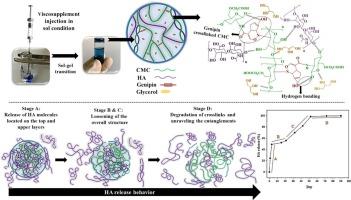
The reduction in hyaluronic acid concentration and viscosity in the synovial fluid of patients struggling with osteoarthritis increases the abrasion of articular cartilage. The aim of this study was to design a semi-IPN hydrogel based on genipin-crosslinked carboxymethyl chitosan (CMCh) and glycerol to achieve long-term release of hyaluronic acid. The results showed that hydrogel comprising CMCh (3 % wt.), HA (0.3 % wt.), and glycerol (1.25 % wt.), with high structural sustainability (over 45 % within 30 days of exposure to PBS/lysozyme medium), swelling ratio of 368.6 %, compression modulus of 8.4 kPa, elongation at break of 64.4 %, and cell viability of >90 % (in 48 h exposure), provides a long retention time and release of HA, which leads to gradual absorption, minimizes pain, and maintains joint mobility, as well as preventing multiple injections. The non-Newtonian behavior of the hydrogel (before crosslinking) along with the favorable gelation time help the viscosupplement to be easily injected and then maintain its position till the end of the crosslinking process within 18min. Considering all the data obtained, it is hypothesized that the optimum sample, namely CHG4Gly1.25, resulting in excellent injectability and moldability, can serve as a novel and promising substrate for biomaterial applications.
期刊介绍:
Carbohydrate Polymers stands as a prominent journal in the glycoscience field, dedicated to exploring and harnessing the potential of polysaccharides with applications spanning bioenergy, bioplastics, biomaterials, biorefining, chemistry, drug delivery, food, health, nanotechnology, packaging, paper, pharmaceuticals, medicine, oil recovery, textiles, tissue engineering, wood, and various aspects of glycoscience.
The journal emphasizes the central role of well-characterized carbohydrate polymers, highlighting their significance as the primary focus rather than a peripheral topic. Each paper must prominently feature at least one named carbohydrate polymer, evident in both citation and title, with a commitment to innovative research that advances scientific knowledge.



 京公网安备 11010802042870号
京ICP备2023020795号-1
京公网安备 11010802042870号
京ICP备2023020795号-1

 分享
分享
 求助内容:
求助内容: 应助结果提醒方式:
 扫码关注我们
