Brad J Winn, Derek J Haight, D S Blaise Williams, Brett S Kirby
{"title":"Skeletal muscle elastic modulus in marathon distance runners.","authors":"Brad J Winn, Derek J Haight, D S Blaise Williams, Brett S Kirby","doi":"10.1007/s00421-025-05708-2","DOIUrl":null,"url":null,"abstract":"<p><p>Skeletal muscle shear elastic modulus is a non-invasive surrogate for early detection of muscle damage and soreness consequent to unaccustomed eccentric muscle work. We investigated the influence of marathon distance running on skeletal muscle shear elastic modulus. Shear modulus of the rectus femoris was measured via ultrasound shear wave elastography in 80 participants (30 female, 50 male) before and after running a World Marathon Major. Experience level, muscle soreness and run readiness were surveyed. Pre-marathon shear elastic modulus was lower in competitive vs recreational runners (13.0 ± 4.6 vs 15.6 ± 5.6 kPa; P = 0.0014), lower for fastest vs slowest finish times (11.6 ± 3.0 vs 16.9 ± 6.5 kPa; P = < 0.0001) and associated with marathon finish time (r = - 0.40; P < 0.0003). Marathon running increased shear modulus (~ 23%), irrespective of experience, sex or course, but was blunted in runners wearing highly cushioned footwear with plates who had matched finish times (Other = ~ 31% vs Vaporfly = ~ 17%). Muscle soreness was strongly associated with run readiness (R<sup>2</sup> = 0.995; P = 0.0026), and marathon recovery time was longer in runners with greater increases in marathon-mediated shear modulus. Skeletal muscle elastic modulus may reflect both short- and long-term muscle adaptation as a function of marathon running, or factors occurring before or after a marathon itself, such as exercise capacity or recovery time. These data are consistent with marathon-mediated muscle damage and soreness, but equally highlight a possibility to monitor and modulate outcomes in favor of a runner.</p>","PeriodicalId":12005,"journal":{"name":"European Journal of Applied Physiology","volume":" ","pages":"1701-1715"},"PeriodicalIF":2.7000,"publicationDate":"2025-06-01","publicationTypes":"Journal Article","fieldsOfStudy":null,"isOpenAccess":false,"openAccessPdf":"https://www.ncbi.nlm.nih.gov/pmc/articles/PMC12174218/pdf/","citationCount":"0","resultStr":null,"platform":"Semanticscholar","paperid":null,"PeriodicalName":"European Journal of Applied Physiology","FirstCategoryId":"3","ListUrlMain":"https://doi.org/10.1007/s00421-025-05708-2","RegionNum":3,"RegionCategory":"医学","ArticlePicture":[],"TitleCN":null,"AbstractTextCN":null,"PMCID":null,"EPubDate":"2025/1/23 0:00:00","PubModel":"Epub","JCR":"Q2","JCRName":"PHYSIOLOGY","Score":null,"Total":0}
引用次数: 0
Abstract
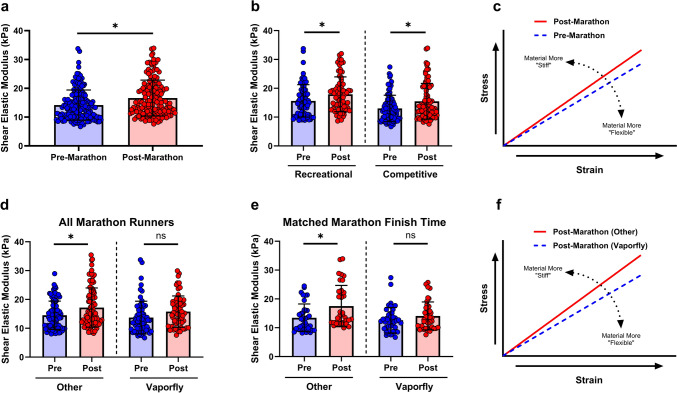
Skeletal muscle shear elastic modulus is a non-invasive surrogate for early detection of muscle damage and soreness consequent to unaccustomed eccentric muscle work. We investigated the influence of marathon distance running on skeletal muscle shear elastic modulus. Shear modulus of the rectus femoris was measured via ultrasound shear wave elastography in 80 participants (30 female, 50 male) before and after running a World Marathon Major. Experience level, muscle soreness and run readiness were surveyed. Pre-marathon shear elastic modulus was lower in competitive vs recreational runners (13.0 ± 4.6 vs 15.6 ± 5.6 kPa; P = 0.0014), lower for fastest vs slowest finish times (11.6 ± 3.0 vs 16.9 ± 6.5 kPa; P = < 0.0001) and associated with marathon finish time (r = - 0.40; P < 0.0003). Marathon running increased shear modulus (~ 23%), irrespective of experience, sex or course, but was blunted in runners wearing highly cushioned footwear with plates who had matched finish times (Other = ~ 31% vs Vaporfly = ~ 17%). Muscle soreness was strongly associated with run readiness (R2 = 0.995; P = 0.0026), and marathon recovery time was longer in runners with greater increases in marathon-mediated shear modulus. Skeletal muscle elastic modulus may reflect both short- and long-term muscle adaptation as a function of marathon running, or factors occurring before or after a marathon itself, such as exercise capacity or recovery time. These data are consistent with marathon-mediated muscle damage and soreness, but equally highlight a possibility to monitor and modulate outcomes in favor of a runner.
期刊介绍:
The European Journal of Applied Physiology (EJAP) aims to promote mechanistic advances in human integrative and translational physiology. Physiology is viewed broadly, having overlapping context with related disciplines such as biomechanics, biochemistry, endocrinology, ergonomics, immunology, motor control, and nutrition. EJAP welcomes studies dealing with physical exercise, training and performance. Studies addressing physiological mechanisms are preferred over descriptive studies. Papers dealing with animal models or pathophysiological conditions are not excluded from consideration, but must be clearly relevant to human physiology.






 京公网安备 11010802042870号
京ICP备2023020795号-1
京公网安备 11010802042870号
京ICP备2023020795号-1

 分享
分享
 求助内容:
求助内容: 应助结果提醒方式:
 扫码关注我们
