Sophie L Campman, Anders Boyd, Janke Schinkel, Liza Coyer, Charles Agyemang, Henrike Galenkamp, Anitra D M Koopman, Felix P Chilunga, Jelle Koopsen, Aeilko H Zwinderman, Suzanne Jurriaans, Karien Stronks, Maria Prins
{"title":"SARS-CoV-2 infection and vaccination status in six ethnic groups in Amsterdam, The Netherlands, May to November 2022.","authors":"Sophie L Campman, Anders Boyd, Janke Schinkel, Liza Coyer, Charles Agyemang, Henrike Galenkamp, Anitra D M Koopman, Felix P Chilunga, Jelle Koopsen, Aeilko H Zwinderman, Suzanne Jurriaans, Karien Stronks, Maria Prins","doi":"10.1017/S0950268825000056","DOIUrl":null,"url":null,"abstract":"<p><p>We studied severe acute respiratory syndrome coronavirus 2 (SARS-CoV-2) infection and vaccination status among six ethnic groups in Amsterdam, the Netherlands. We analysed participants of the Healthy Life in an Urban Setting cohort who were tested for SARS-CoV-2 spike protein antibodies between 17 May and 21 November 2022. We categorized participants with antibodies as only infected, only vaccinated (≥1 dose), or both infected and vaccinated, based on self-reported prior infection and vaccination status and previous seroprevalence data. We compared infection and vaccination status between ethnic groups using multivariable, multinomial logistic regression. Of the 1,482 included participants, 98.5% had SARS-CoV-2 antibodies (<i>P</i> between ethnic groups = 0.899). Being previously infected and vaccinated ranged from 41.5% (95% confidence interval (CI) = 35.0-47.9%) in the African Surinamese to 67.1% (95% CI = 59.1-75.0%) in the Turkish group. Compared to participants of Dutch origin, participants of South-Asian Surinamese (adjusted odds ratio (aOR) = 3.31, 95% CI = 1.50-7.31)), African Surinamese (aOR = 10.41, 95% CI = 5.17-20.94), Turkish (aOR = 3.74, 95% CI = 1.52-9.20), or Moroccan (aOR = 15.24, 95% CI = 6.70-34.65) origin were more likely to be only infected than infected and vaccinated, after adjusting for age, sex, household size, trust in the government's response to the pandemic, and month of study visit. SARS-CoV-2 infection and vaccination status varied across ethnic groups, particularly regarding non-vaccination. As hybrid immunity is most protective against coronavirus disease 2019, future vaccination campaigns should encourage vaccination uptake in specific demographic groups with only infection.</p>","PeriodicalId":11721,"journal":{"name":"Epidemiology and Infection","volume":" ","pages":"e23"},"PeriodicalIF":2.2000,"publicationDate":"2025-01-23","publicationTypes":"Journal Article","fieldsOfStudy":null,"isOpenAccess":false,"openAccessPdf":"https://www.ncbi.nlm.nih.gov/pmc/articles/PMC11822580/pdf/","citationCount":"0","resultStr":null,"platform":"Semanticscholar","paperid":null,"PeriodicalName":"Epidemiology and Infection","FirstCategoryId":"3","ListUrlMain":"https://doi.org/10.1017/S0950268825000056","RegionNum":4,"RegionCategory":"医学","ArticlePicture":[],"TitleCN":null,"AbstractTextCN":null,"PMCID":null,"EPubDate":"","PubModel":"","JCR":"Q3","JCRName":"INFECTIOUS DISEASES","Score":null,"Total":0}
引用次数: 0
Abstract
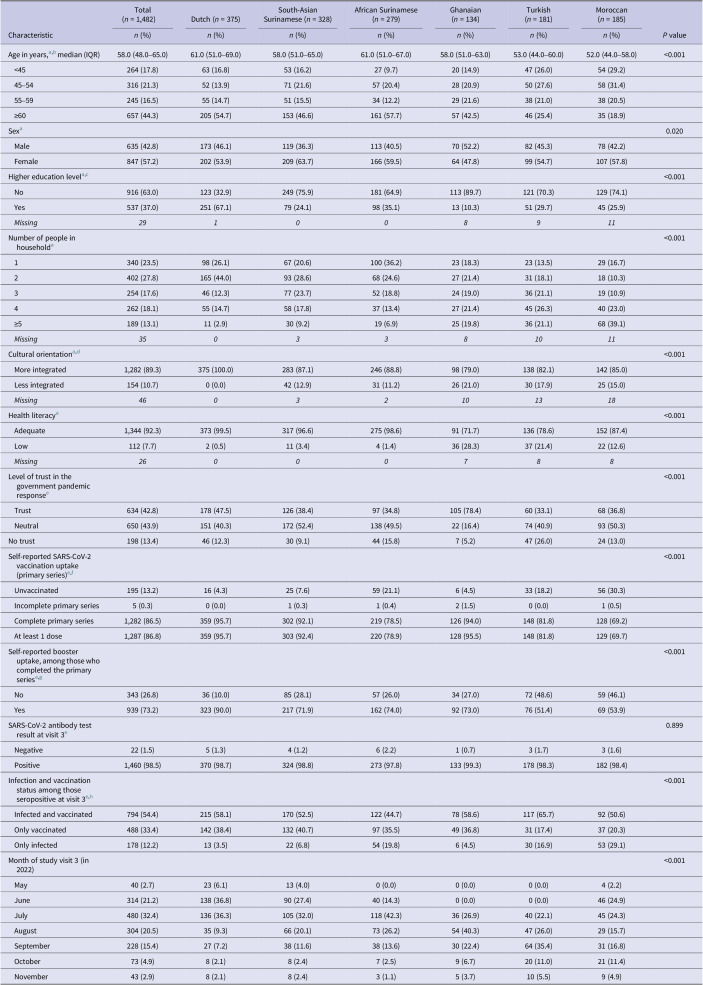
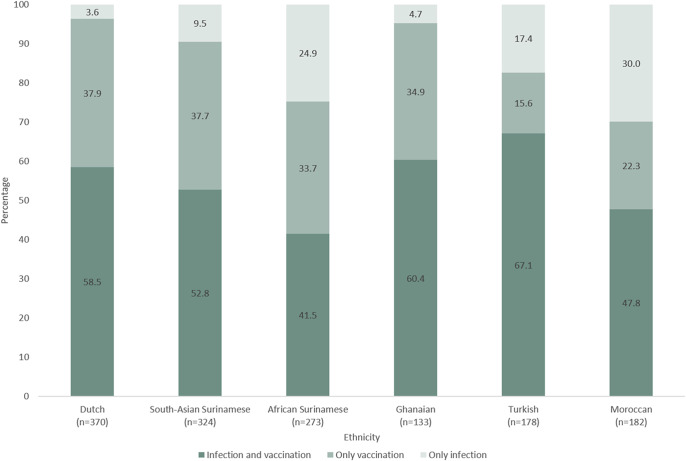
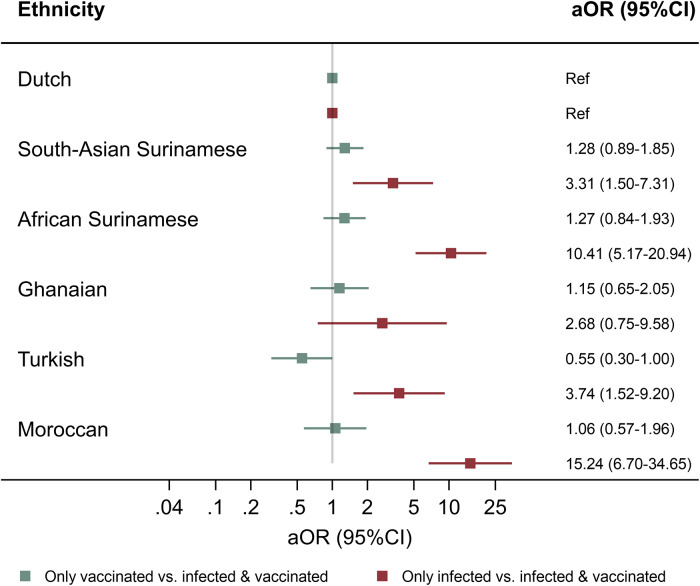
We studied severe acute respiratory syndrome coronavirus 2 (SARS-CoV-2) infection and vaccination status among six ethnic groups in Amsterdam, the Netherlands. We analysed participants of the Healthy Life in an Urban Setting cohort who were tested for SARS-CoV-2 spike protein antibodies between 17 May and 21 November 2022. We categorized participants with antibodies as only infected, only vaccinated (≥1 dose), or both infected and vaccinated, based on self-reported prior infection and vaccination status and previous seroprevalence data. We compared infection and vaccination status between ethnic groups using multivariable, multinomial logistic regression. Of the 1,482 included participants, 98.5% had SARS-CoV-2 antibodies (P between ethnic groups = 0.899). Being previously infected and vaccinated ranged from 41.5% (95% confidence interval (CI) = 35.0-47.9%) in the African Surinamese to 67.1% (95% CI = 59.1-75.0%) in the Turkish group. Compared to participants of Dutch origin, participants of South-Asian Surinamese (adjusted odds ratio (aOR) = 3.31, 95% CI = 1.50-7.31)), African Surinamese (aOR = 10.41, 95% CI = 5.17-20.94), Turkish (aOR = 3.74, 95% CI = 1.52-9.20), or Moroccan (aOR = 15.24, 95% CI = 6.70-34.65) origin were more likely to be only infected than infected and vaccinated, after adjusting for age, sex, household size, trust in the government's response to the pandemic, and month of study visit. SARS-CoV-2 infection and vaccination status varied across ethnic groups, particularly regarding non-vaccination. As hybrid immunity is most protective against coronavirus disease 2019, future vaccination campaigns should encourage vaccination uptake in specific demographic groups with only infection.
期刊介绍:
Epidemiology & Infection publishes original reports and reviews on all aspects of infection in humans and animals. Particular emphasis is given to the epidemiology, prevention and control of infectious diseases. The scope covers the zoonoses, outbreaks, food hygiene, vaccine studies, statistics and the clinical, social and public-health aspects of infectious disease, as well as some tropical infections. It has become the key international periodical in which to find the latest reports on recently discovered infections and new technology. For those concerned with policy and planning for the control of infections, the papers on mathematical modelling of epidemics caused by historical, current and emergent infections are of particular value.



 京公网安备 11010802042870号
京ICP备2023020795号-1
京公网安备 11010802042870号
京ICP备2023020795号-1

 分享
分享
 求助内容:
求助内容: 应助结果提醒方式:
 扫码关注我们
