Christina J Megli, Sophia M Carlin, Elizabeth J Giacobe, Gideon H Hillebrand, Thomas A Hooven
{"title":"Virulence and pathogenicity of group B <i>Streptococcus</i>: Virulence factors and their roles in perinatal infection.","authors":"Christina J Megli, Sophia M Carlin, Elizabeth J Giacobe, Gideon H Hillebrand, Thomas A Hooven","doi":"10.1080/21505594.2025.2451173","DOIUrl":null,"url":null,"abstract":"<p><p>This review summarizes key virulence factors associated with group B <i>Streptococcus</i> (GBS), a significant pathogen particularly affecting pregnant women, fetuses, and infants. Beginning with an introduction to the historical transition of GBS from a zoonotic pathogen to a prominent cause of human infections, particularly in the perinatal period, the review describes major disease manifestations caused by GBS, including sepsis, meningitis, chorioamnionitis, pneumonia, and others, linking each to specific virulence mechanisms. A detailed exploration of the genetic basis for GBS pathogenicity follows, emphasizing the roles of capsules in pathogenesis and immune evasion. The paper also examines the molecular structures and functions of key GBS surface proteins, such as pili, serine-rich repeat proteins, and fibrinogen-binding proteins, which facilitate colonization and disease. Additionally, the review discusses the significance of environmental sensing and response systems, like the two-component systems, in adapting GBS to different host environments. We conclude by addressing current efforts in vaccine development, underscoring the need for effective prevention strategies against this pervasive pathogen.</p>","PeriodicalId":23747,"journal":{"name":"Virulence","volume":"16 1","pages":"2451173"},"PeriodicalIF":5.4000,"publicationDate":"2025-12-01","publicationTypes":"Journal Article","fieldsOfStudy":null,"isOpenAccess":false,"openAccessPdf":"https://www.ncbi.nlm.nih.gov/pmc/articles/PMC11758947/pdf/","citationCount":"0","resultStr":null,"platform":"Semanticscholar","paperid":null,"PeriodicalName":"Virulence","FirstCategoryId":"99","ListUrlMain":"https://doi.org/10.1080/21505594.2025.2451173","RegionNum":1,"RegionCategory":"农林科学","ArticlePicture":[],"TitleCN":null,"AbstractTextCN":null,"PMCID":null,"EPubDate":"2025/1/23 0:00:00","PubModel":"Epub","JCR":"Q1","JCRName":"IMMUNOLOGY","Score":null,"Total":0}
引用次数: 0
Abstract
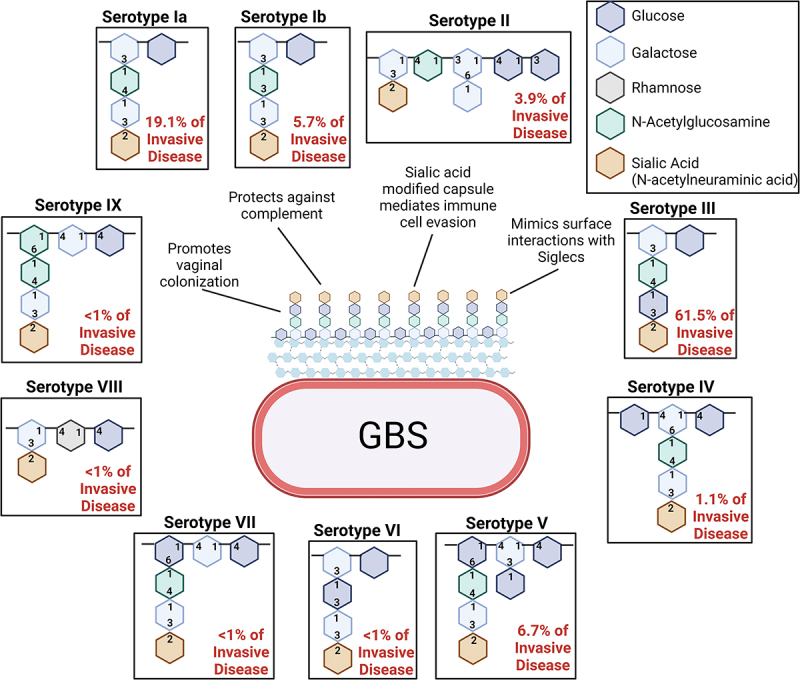
This review summarizes key virulence factors associated with group B Streptococcus (GBS), a significant pathogen particularly affecting pregnant women, fetuses, and infants. Beginning with an introduction to the historical transition of GBS from a zoonotic pathogen to a prominent cause of human infections, particularly in the perinatal period, the review describes major disease manifestations caused by GBS, including sepsis, meningitis, chorioamnionitis, pneumonia, and others, linking each to specific virulence mechanisms. A detailed exploration of the genetic basis for GBS pathogenicity follows, emphasizing the roles of capsules in pathogenesis and immune evasion. The paper also examines the molecular structures and functions of key GBS surface proteins, such as pili, serine-rich repeat proteins, and fibrinogen-binding proteins, which facilitate colonization and disease. Additionally, the review discusses the significance of environmental sensing and response systems, like the two-component systems, in adapting GBS to different host environments. We conclude by addressing current efforts in vaccine development, underscoring the need for effective prevention strategies against this pervasive pathogen.
期刊介绍:
Virulence is a fully open access peer-reviewed journal. All articles will (if accepted) be available for anyone to read anywhere, at any time immediately on publication.
Virulence is the first international peer-reviewed journal of its kind to focus exclusively on microbial pathogenicity, the infection process and host-pathogen interactions. To address the new infectious challenges, emerging infectious agents and antimicrobial resistance, there is a clear need for interdisciplinary research.





 京公网安备 11010802042870号
京ICP备2023020795号-1
京公网安备 11010802042870号
京ICP备2023020795号-1

 分享
分享
 求助内容:
求助内容: 应助结果提醒方式:
 扫码关注我们
