Stella de Haan, Marine Dourte, Michele Deantoni, Mathilde Reyt, Marion Baillet, Christian Berthomier, Vincenzo Muto, Gregory Hammad, Christian Cajochen, Carolin F Reichert, Micheline Maire, Christina Schmidt, Svetlana Postnova
{"title":"Impact of Varying Sleep Pressure on Daytime Sleep Propensity in Healthy Young and Older Adults.","authors":"Stella de Haan, Marine Dourte, Michele Deantoni, Mathilde Reyt, Marion Baillet, Christian Berthomier, Vincenzo Muto, Gregory Hammad, Christian Cajochen, Carolin F Reichert, Micheline Maire, Christina Schmidt, Svetlana Postnova","doi":"10.3390/clockssleep7010002","DOIUrl":null,"url":null,"abstract":"<p><p>Fixed sleep schedules with an 8 h time in bed (TIB) are used to ensure participants are well-rested before laboratory studies. However, such schedules may lead to cumulative excess wakefulness in young individuals. Effects on older individuals are unknown. We combine modelling and experimental data to quantify the effects of sleep debt on sleep propensity in healthy younger and older participants. A model of arousal dynamics was fitted to sleep data from 22 young (20-31 y.o.) and 26 older (61-82 y.o.) individuals (25 male) undertaking 10 short sleep-wake cycles during a 40 h napping protocol, following >1 week of fixed 8 h TIB schedules. Homeostatic sleep drive at the study start was varied systematically to identify best fits between observed and predicted sleep profiles for individuals and group averages. Daytime sleep duration was the same on the two days of the protocol within the groups but different between the groups (young: 3.14 ± 0.98 h vs. 3.06 ± 0.75 h, older: 2.60 ± 0.98 h vs. 2.37 ± 0.64 h). The model predicted an initial homeostatic drive of 11.2 ± 3.5% (young) and 10.1 ± 3.5% (older) above well-rested. Individual variability in first-day, but not second-day, sleep patterns was explained by the differences in the initial homeostatic drive for both age groups. Our study suggests that both younger and older participants arrive at the laboratory with cumulative sleep debt, despite 8 h TiB schedules, which dissipates after the first four sleep opportunities on the protocol. This has implications for protocol design and the interpretation of laboratory studies.</p>","PeriodicalId":33568,"journal":{"name":"Clocks & Sleep","volume":"7 1","pages":""},"PeriodicalIF":2.1000,"publicationDate":"2025-01-02","publicationTypes":"Journal Article","fieldsOfStudy":null,"isOpenAccess":false,"openAccessPdf":"https://www.ncbi.nlm.nih.gov/pmc/articles/PMC11755553/pdf/","citationCount":"0","resultStr":null,"platform":"Semanticscholar","paperid":null,"PeriodicalName":"Clocks & Sleep","FirstCategoryId":"1085","ListUrlMain":"https://doi.org/10.3390/clockssleep7010002","RegionNum":0,"RegionCategory":null,"ArticlePicture":[],"TitleCN":null,"AbstractTextCN":null,"PMCID":null,"EPubDate":"","PubModel":"","JCR":"Q3","JCRName":"CLINICAL NEUROLOGY","Score":null,"Total":0}
引用次数: 0
Abstract
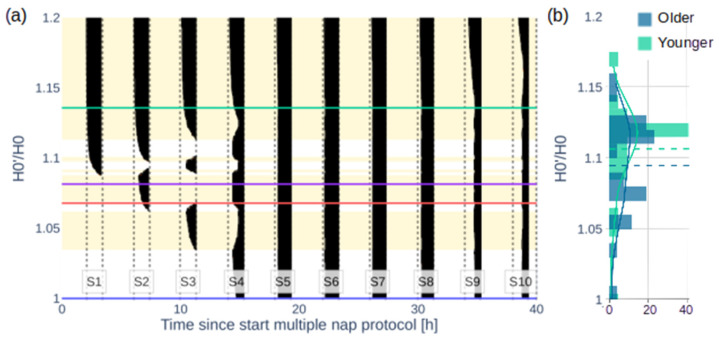
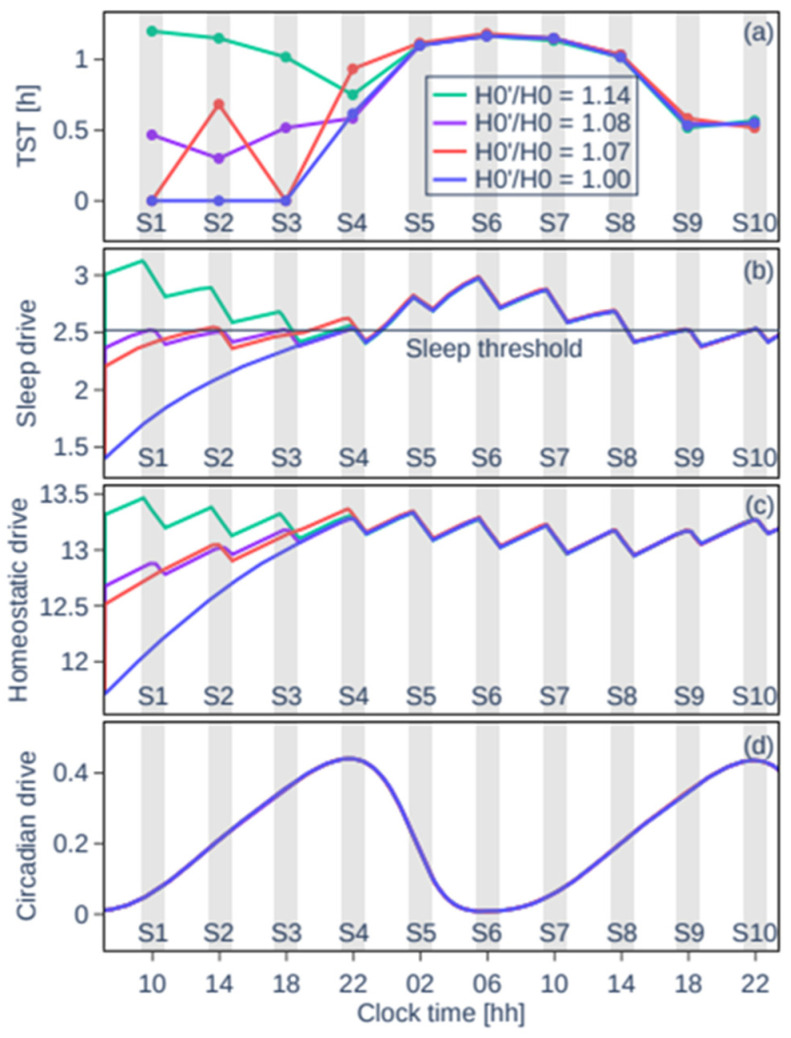
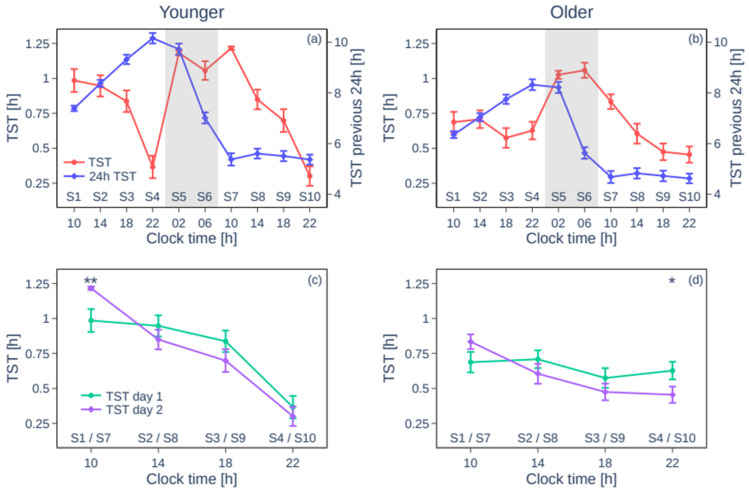
Fixed sleep schedules with an 8 h time in bed (TIB) are used to ensure participants are well-rested before laboratory studies. However, such schedules may lead to cumulative excess wakefulness in young individuals. Effects on older individuals are unknown. We combine modelling and experimental data to quantify the effects of sleep debt on sleep propensity in healthy younger and older participants. A model of arousal dynamics was fitted to sleep data from 22 young (20-31 y.o.) and 26 older (61-82 y.o.) individuals (25 male) undertaking 10 short sleep-wake cycles during a 40 h napping protocol, following >1 week of fixed 8 h TIB schedules. Homeostatic sleep drive at the study start was varied systematically to identify best fits between observed and predicted sleep profiles for individuals and group averages. Daytime sleep duration was the same on the two days of the protocol within the groups but different between the groups (young: 3.14 ± 0.98 h vs. 3.06 ± 0.75 h, older: 2.60 ± 0.98 h vs. 2.37 ± 0.64 h). The model predicted an initial homeostatic drive of 11.2 ± 3.5% (young) and 10.1 ± 3.5% (older) above well-rested. Individual variability in first-day, but not second-day, sleep patterns was explained by the differences in the initial homeostatic drive for both age groups. Our study suggests that both younger and older participants arrive at the laboratory with cumulative sleep debt, despite 8 h TiB schedules, which dissipates after the first four sleep opportunities on the protocol. This has implications for protocol design and the interpretation of laboratory studies.
使用固定的睡眠时间表,在床上8小时(TIB),以确保参与者在实验室研究之前得到充分休息。然而,这样的时间表可能会导致年轻人累积过度清醒。对老年人的影响尚不清楚。我们结合模型和实验数据来量化睡眠债对健康年轻人和老年人睡眠倾向的影响。唤醒动力学模型拟合了22名年轻人(20-31岁)和26名老年人(61-82岁)(25名男性)的睡眠数据,这些人在40小时的午睡方案中进行了10次短睡眠-觉醒周期,并遵循固定的8小时TIB时间表。研究开始时,稳态睡眠驱动系统地进行了变化,以确定观察到的和预测的个人睡眠特征和群体平均水平之间的最佳匹配。两组白天睡眠时间相同,但各组之间存在差异(年轻组:3.14±0.98 h vs. 3.06±0.75 h,老年组:2.60±0.98 h vs. 2.37±0.64 h)。该模型预测初始稳态驱动为11.2±3.5%(年轻组)和10.1±3.5%(老年组)高于充分休息。第一天(而不是第二天)睡眠模式的个体差异可以用两个年龄组初始体内平衡驱动的差异来解释。我们的研究表明,尽管有8小时的TiB计划,但年轻和年长的参与者在到达实验室时都有累积的睡眠债务,这种债务在协议规定的前四次睡眠机会后就会消失。这对方案设计和实验室研究的解释具有启示意义。




 京公网安备 11010802042870号
京ICP备2023020795号-1
京公网安备 11010802042870号
京ICP备2023020795号-1

 分享
分享
 求助内容:
求助内容: 应助结果提醒方式:
 扫码关注我们
