Wesley V. Cain DO , Roman A. Jandarov PhD , Mohana Priya SRP, MPH , Marepalli Rao PhD, MS , Jonathan A. Bernstein MD
{"title":"Utility of serum biomarkers in real-world practice for predicting response to omalizumab therapy in patients with chronic spontaneous urticaria","authors":"Wesley V. Cain DO , Roman A. Jandarov PhD , Mohana Priya SRP, MPH , Marepalli Rao PhD, MS , Jonathan A. Bernstein MD","doi":"10.1016/j.jacig.2024.100386","DOIUrl":null,"url":null,"abstract":"<div><h3>Background</h3><div>Omalizumab (OMA), a recombinant humanized IgG monoclonal anti-IgE antibody, is approved for treatment for chronic spontaneous urticaria (CSU) refractory to second-generation H<sub>1</sub>-antihistamine (SGAH) therapy. However, currently, there are no validated serum biomarkers to reliably predict response to OMA treatment.</div></div><div><h3>Objective</h3><div>We explored the real-world clinical utility of using serum biomarkers for predicting response to OMA for CSU patients with disease refractory to high-dose SGAH therapy.</div></div><div><h3>Methods</h3><div>A single-center, retrospective chart review of CSU patients treated with OMA enrolled patients who had at their initial evaluation collection of a basophil histamine release assay for detecting IgG antibodies targeting FcεR1α subunit before starting OMA treatment. In addition, total IgE, IgG–anti–thyroid peroxidase (TPO), C-reactive protein, and absolute eosinophil count, if available, were analyzed as predictors for OMA response. The validated Outcome and Assessment Information Set Database (OASIS-D) rating system was used to assess responsiveness to OMA.</div></div><div><h3>Results</h3><div>High levels of IgG–anti-TPO were significantly associated with a poor response to OMA. However, basophil histamine release assay, total IgE, C-reactive protein, and absolute eosinophil count, as well as IgG–anti-TPO/total IgE ratios, were not predictive of a response to OMA therapy.</div></div><div><h3>Conclusions</h3><div>This real-world study confirms previous reports that a high IgG–anti-TPO level is a reliable predictor of poor response to OMA. However, better validation of basophil histamine release assay and other immunoassays that measure IgG antibodies to FcεR1α subunit are required before they can be recommended as predictors for OMA response. Whether any of these biomarkers are relevant for predicting response to novel advanced therapeutics under current development requires further investigation.</div></div>","PeriodicalId":75041,"journal":{"name":"The journal of allergy and clinical immunology. Global","volume":"4 1","pages":"Article 100386"},"PeriodicalIF":0.0000,"publicationDate":"2025-02-01","publicationTypes":"Journal Article","fieldsOfStudy":null,"isOpenAccess":false,"openAccessPdf":"https://www.ncbi.nlm.nih.gov/pmc/articles/PMC11751516/pdf/","citationCount":"0","resultStr":null,"platform":"Semanticscholar","paperid":null,"PeriodicalName":"The journal of allergy and clinical immunology. Global","FirstCategoryId":"1085","ListUrlMain":"https://www.sciencedirect.com/science/article/pii/S2772829324001826","RegionNum":0,"RegionCategory":null,"ArticlePicture":[],"TitleCN":null,"AbstractTextCN":null,"PMCID":null,"EPubDate":"2024/12/12 0:00:00","PubModel":"Epub","JCR":"","JCRName":"","Score":null,"Total":0}
引用次数: 0
Abstract
Background
Omalizumab (OMA), a recombinant humanized IgG monoclonal anti-IgE antibody, is approved for treatment for chronic spontaneous urticaria (CSU) refractory to second-generation H1-antihistamine (SGAH) therapy. However, currently, there are no validated serum biomarkers to reliably predict response to OMA treatment.
Objective
We explored the real-world clinical utility of using serum biomarkers for predicting response to OMA for CSU patients with disease refractory to high-dose SGAH therapy.
Methods
A single-center, retrospective chart review of CSU patients treated with OMA enrolled patients who had at their initial evaluation collection of a basophil histamine release assay for detecting IgG antibodies targeting FcεR1α subunit before starting OMA treatment. In addition, total IgE, IgG–anti–thyroid peroxidase (TPO), C-reactive protein, and absolute eosinophil count, if available, were analyzed as predictors for OMA response. The validated Outcome and Assessment Information Set Database (OASIS-D) rating system was used to assess responsiveness to OMA.
Results
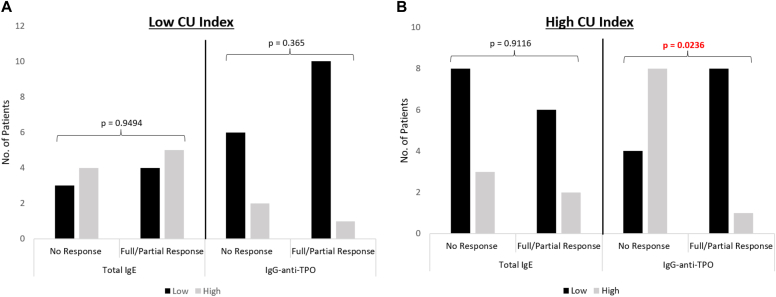
High levels of IgG–anti-TPO were significantly associated with a poor response to OMA. However, basophil histamine release assay, total IgE, C-reactive protein, and absolute eosinophil count, as well as IgG–anti-TPO/total IgE ratios, were not predictive of a response to OMA therapy.
Conclusions
This real-world study confirms previous reports that a high IgG–anti-TPO level is a reliable predictor of poor response to OMA. However, better validation of basophil histamine release assay and other immunoassays that measure IgG antibodies to FcεR1α subunit are required before they can be recommended as predictors for OMA response. Whether any of these biomarkers are relevant for predicting response to novel advanced therapeutics under current development requires further investigation.






 京公网安备 11010802042870号
京ICP备2023020795号-1
京公网安备 11010802042870号
京ICP备2023020795号-1

 分享
分享
 求助内容:
求助内容: 应助结果提醒方式:
 扫码关注我们
