Bianca Introini, Alexander Hahn, Werner Kühlbrandt
{"title":"Cryo-EM structure of the NDH–PSI–LHCI supercomplex from Spinacia oleracea","authors":"Bianca Introini, Alexander Hahn, Werner Kühlbrandt","doi":"10.1038/s41594-024-01478-1","DOIUrl":null,"url":null,"abstract":"The nicotinamide adenine dinucleotide phosphate (NADPH) dehydrogenase (NDH) complex is crucial for photosynthetic cyclic electron flow and respiration, transferring electrons from ferredoxin to plastoquinone while transporting H+ across the chloroplast membrane. This process boosts adenosine triphosphate production, regardless of NADPH levels. In flowering plants, NDH forms a supercomplex with photosystem I, enhancing its stability under high light. We report the cryo-electron microscopy structure of the NDH supercomplex in Spinacia oleracea at a resolution of 3.0–3.3 Å. The supercomplex consists of 41 protein subunits, 154 chlorophylls and 38 carotenoids. Subunit interactions are reinforced by 46 distinct lipids. The structure of NDH resembles that of mitochondrial complex I closely, including the quinol-binding site and an extensive internal aqueous passage for proton translocation. A well-resolved catalytic plastoquinone (PQ) occupies the PQ channel. The pronounced structural similarity to complex I sheds light on electron transfer and proton translocation within the NDH supercomplex. Here, the authors report the structure of the nicotinamide adenine dinucleotide phosphate dehydrogenase–photosystem I–light-harvesting complex I supercomplex, providing insights into subunit interactions and the role of cofactors.","PeriodicalId":49141,"journal":{"name":"Nature Structural & Molecular Biology","volume":"32 6","pages":"968-978"},"PeriodicalIF":10.1000,"publicationDate":"2025-01-24","publicationTypes":"Journal Article","fieldsOfStudy":null,"isOpenAccess":false,"openAccessPdf":"https://www.nature.comhttps://www.nature.com/articles/s41594-024-01478-1.pdf","citationCount":"0","resultStr":null,"platform":"Semanticscholar","paperid":null,"PeriodicalName":"Nature Structural & Molecular Biology","FirstCategoryId":"99","ListUrlMain":"https://www.nature.com/articles/s41594-024-01478-1","RegionNum":1,"RegionCategory":"生物学","ArticlePicture":[],"TitleCN":null,"AbstractTextCN":null,"PMCID":null,"EPubDate":"","PubModel":"","JCR":"Q1","JCRName":"BIOCHEMISTRY & MOLECULAR BIOLOGY","Score":null,"Total":0}
引用次数: 0
Abstract
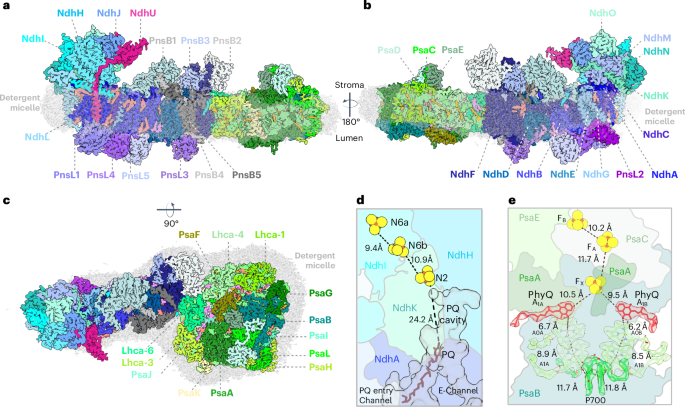
The nicotinamide adenine dinucleotide phosphate (NADPH) dehydrogenase (NDH) complex is crucial for photosynthetic cyclic electron flow and respiration, transferring electrons from ferredoxin to plastoquinone while transporting H+ across the chloroplast membrane. This process boosts adenosine triphosphate production, regardless of NADPH levels. In flowering plants, NDH forms a supercomplex with photosystem I, enhancing its stability under high light. We report the cryo-electron microscopy structure of the NDH supercomplex in Spinacia oleracea at a resolution of 3.0–3.3 Å. The supercomplex consists of 41 protein subunits, 154 chlorophylls and 38 carotenoids. Subunit interactions are reinforced by 46 distinct lipids. The structure of NDH resembles that of mitochondrial complex I closely, including the quinol-binding site and an extensive internal aqueous passage for proton translocation. A well-resolved catalytic plastoquinone (PQ) occupies the PQ channel. The pronounced structural similarity to complex I sheds light on electron transfer and proton translocation within the NDH supercomplex. Here, the authors report the structure of the nicotinamide adenine dinucleotide phosphate dehydrogenase–photosystem I–light-harvesting complex I supercomplex, providing insights into subunit interactions and the role of cofactors.
期刊介绍:
Nature Structural & Molecular Biology is a comprehensive platform that combines structural and molecular research. Our journal focuses on exploring the functional and mechanistic aspects of biological processes, emphasizing how molecular components collaborate to achieve a particular function. While structural data can shed light on these insights, our publication does not require them as a prerequisite.




 京公网安备 11010802042870号
京ICP备2023020795号-1
京公网安备 11010802042870号
京ICP备2023020795号-1

 分享
分享
 求助内容:
求助内容: 应助结果提醒方式:
 扫码关注我们
