John P. Laporte, Mohammad A. B. S. Akhonda, Luis E. Cortina, Mary E. Faulkner, Zhaoyuan Gong, Alex Guo, Jonghyun Bae, Noam Y. Fox, Nathan Zhang, Christopher M. Bergeron, Luigi Ferrucci, Josephine M. Egan, Mustapha Bouhrara
{"title":"Investigating the association between human brainstem microstructural integrity and hypertension using magnetic resonance relaxometry","authors":"John P. Laporte, Mohammad A. B. S. Akhonda, Luis E. Cortina, Mary E. Faulkner, Zhaoyuan Gong, Alex Guo, Jonghyun Bae, Noam Y. Fox, Nathan Zhang, Christopher M. Bergeron, Luigi Ferrucci, Josephine M. Egan, Mustapha Bouhrara","doi":"10.1038/s41440-025-02114-1","DOIUrl":null,"url":null,"abstract":"The brainstem plays a vital role in regulating blood pressure, and disruptions to its neural pathways have been linked to hypertension. However, it remains unclear whether subtle microstructural changes in the brainstem are associated with an individual’s blood pressure status. This exploratory, cross-sectional study investigated the relationship between brainstem microstructure, myelination, and hypertensive status in 116 cognitively unimpaired adults (aged 22–94 years). Advanced MRI techniques, including relaxometry (R1, R2) and myelin water fraction (MWF) analysis, were employed to assess microstructural integrity and myelin content in ten brainstem subregions. Our results revealed significant associations between higher microstructural damage or lower myelin content (indicated by lower R1, R2, or MWF values) and hypertensive status, particularly in the midbrain tegmentum. Notably, combining these MRI metrics yielded high classification accuracy (AUC > 0.85). Our findings suggest a potential link between disrupted brainstem tissue integrity, myelin content, and elevated blood pressure, warranting further longitudinal investigations to explore this relationship.","PeriodicalId":13029,"journal":{"name":"Hypertension Research","volume":"48 4","pages":"1564-1574"},"PeriodicalIF":4.6000,"publicationDate":"2025-01-23","publicationTypes":"Journal Article","fieldsOfStudy":null,"isOpenAccess":false,"openAccessPdf":"https://www.nature.com/articles/s41440-025-02114-1.pdf","citationCount":"0","resultStr":null,"platform":"Semanticscholar","paperid":null,"PeriodicalName":"Hypertension Research","FirstCategoryId":"3","ListUrlMain":"https://www.nature.com/articles/s41440-025-02114-1","RegionNum":2,"RegionCategory":"医学","ArticlePicture":[],"TitleCN":null,"AbstractTextCN":null,"PMCID":null,"EPubDate":"","PubModel":"","JCR":"Q1","JCRName":"PERIPHERAL VASCULAR DISEASE","Score":null,"Total":0}
引用次数: 0
Abstract
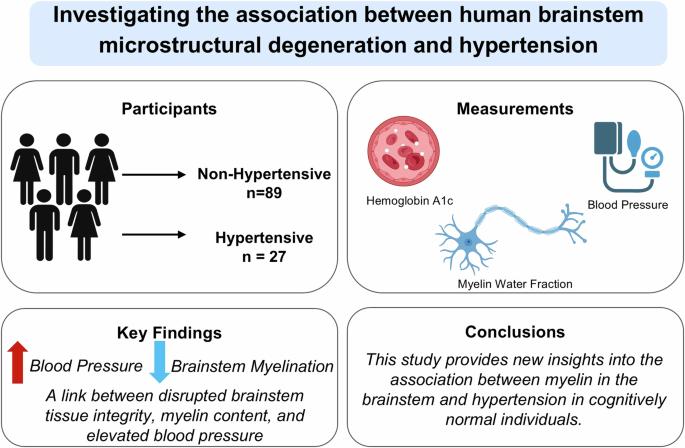
The brainstem plays a vital role in regulating blood pressure, and disruptions to its neural pathways have been linked to hypertension. However, it remains unclear whether subtle microstructural changes in the brainstem are associated with an individual’s blood pressure status. This exploratory, cross-sectional study investigated the relationship between brainstem microstructure, myelination, and hypertensive status in 116 cognitively unimpaired adults (aged 22–94 years). Advanced MRI techniques, including relaxometry (R1, R2) and myelin water fraction (MWF) analysis, were employed to assess microstructural integrity and myelin content in ten brainstem subregions. Our results revealed significant associations between higher microstructural damage or lower myelin content (indicated by lower R1, R2, or MWF values) and hypertensive status, particularly in the midbrain tegmentum. Notably, combining these MRI metrics yielded high classification accuracy (AUC > 0.85). Our findings suggest a potential link between disrupted brainstem tissue integrity, myelin content, and elevated blood pressure, warranting further longitudinal investigations to explore this relationship.
期刊介绍:
Hypertension Research is the official publication of the Japanese Society of Hypertension. The journal publishes papers reporting original clinical and experimental research that contribute to the advancement of knowledge in the field of hypertension and related cardiovascular diseases. The journal publishes Review Articles, Articles, Correspondence and Comments.



 京公网安备 11010802042870号
京ICP备2023020795号-1
京公网安备 11010802042870号
京ICP备2023020795号-1

 分享
分享
 求助内容:
求助内容: 应助结果提醒方式:
 扫码关注我们
