Gezaildo Santos Silva , Flávia Izabely Nunes Moreira , Thatyane Mariano Rodrigues de Albuquerque , Thaianaly Leite Abreu , Eike Guilherme Torres de Souza , Layane Rosa da Silva , Antonia Dayane Jenyffer de Farias Marques , Mércia de Sousa Galvão , Marcos dos Santos Lima , Evandro Leite de Souza , Marta Suely Madruga , Louise Emy Kurozawa , Taliana Kênia Alencar Bezerra
{"title":"Microencapsulated phenolic compounds from organic coffee husk: Impacts on human gut microbiota and in vitro prebiotic potential","authors":"Gezaildo Santos Silva , Flávia Izabely Nunes Moreira , Thatyane Mariano Rodrigues de Albuquerque , Thaianaly Leite Abreu , Eike Guilherme Torres de Souza , Layane Rosa da Silva , Antonia Dayane Jenyffer de Farias Marques , Mércia de Sousa Galvão , Marcos dos Santos Lima , Evandro Leite de Souza , Marta Suely Madruga , Louise Emy Kurozawa , Taliana Kênia Alencar Bezerra","doi":"10.1016/j.foodres.2024.115597","DOIUrl":null,"url":null,"abstract":"<div><div>This research investigated the influence of the microencapsulation of phenolic compounds (PCs) from organic coffee husk with whey protein concentrate (WPC) and maltodextrin on the abundance of intestinal bacterial populations and their metabolic activity during <em>in vitro</em> fecal fermentation. The microencapsulated PCs were gradually metabolized during fecal fermentation, resulting in significant transformations and an increase in PCs in the fermentation media. The metabolism of PCs by the fecal microbiota occurred concurrently with the consumption of sugars, production of organic acids, and reduction in pH in the media. The PCs, especially when encapsulated, promoted an increase in the abundance of <em>Lactobacillus</em> spp./<em>Enterococcus</em> spp., <em>Bifidobacterium</em> spp., and <em>Ruminococcus albus</em>/<em>R. flavefaciens</em>, and a reduction in the abundance of <em>Bacteroides</em> spp./<em>Prevotella</em> spp., <em>Clostridium histolyticum</em>, and <em>Eubacterium rectale</em>/<em>Clostridium cocoides</em>. The results suggest that the PCs exhibited prebiotic potential, with their efficacy enhanced by microencapsulation, particularly when WPC was used exclusively as the encapsulating agent.</div></div>","PeriodicalId":323,"journal":{"name":"Food Research International","volume":"201 ","pages":"Article 115597"},"PeriodicalIF":8.0000,"publicationDate":"2025-02-01","publicationTypes":"Journal Article","fieldsOfStudy":null,"isOpenAccess":false,"openAccessPdf":"","citationCount":"0","resultStr":null,"platform":"Semanticscholar","paperid":null,"PeriodicalName":"Food Research International","FirstCategoryId":"97","ListUrlMain":"https://www.sciencedirect.com/science/article/pii/S0963996924016685","RegionNum":1,"RegionCategory":"农林科学","ArticlePicture":[],"TitleCN":null,"AbstractTextCN":null,"PMCID":null,"EPubDate":"","PubModel":"","JCR":"Q1","JCRName":"FOOD SCIENCE & TECHNOLOGY","Score":null,"Total":0}
引用次数: 0
Abstract
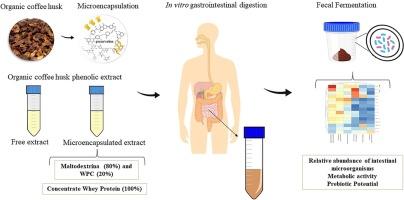
This research investigated the influence of the microencapsulation of phenolic compounds (PCs) from organic coffee husk with whey protein concentrate (WPC) and maltodextrin on the abundance of intestinal bacterial populations and their metabolic activity during in vitro fecal fermentation. The microencapsulated PCs were gradually metabolized during fecal fermentation, resulting in significant transformations and an increase in PCs in the fermentation media. The metabolism of PCs by the fecal microbiota occurred concurrently with the consumption of sugars, production of organic acids, and reduction in pH in the media. The PCs, especially when encapsulated, promoted an increase in the abundance of Lactobacillus spp./Enterococcus spp., Bifidobacterium spp., and Ruminococcus albus/R. flavefaciens, and a reduction in the abundance of Bacteroides spp./Prevotella spp., Clostridium histolyticum, and Eubacterium rectale/Clostridium cocoides. The results suggest that the PCs exhibited prebiotic potential, with their efficacy enhanced by microencapsulation, particularly when WPC was used exclusively as the encapsulating agent.
期刊介绍:
Food Research International serves as a rapid dissemination platform for significant and impactful research in food science, technology, engineering, and nutrition. The journal focuses on publishing novel, high-quality, and high-impact review papers, original research papers, and letters to the editors across various disciplines in the science and technology of food. Additionally, it follows a policy of publishing special issues on topical and emergent subjects in food research or related areas. Selected, peer-reviewed papers from scientific meetings, workshops, and conferences on the science, technology, and engineering of foods are also featured in special issues.



 京公网安备 11010802042870号
京ICP备2023020795号-1
京公网安备 11010802042870号
京ICP备2023020795号-1

 分享
分享
 求助内容:
求助内容: 应助结果提醒方式:
 扫码关注我们
