[Atlantoaxial joint space and pharyngeal airway changes in skeletal class Ⅲ patients with mandibular deviation after combined orthodontic-orthognathic treatment: a cone-beam CT analysis].
{"title":"[Atlantoaxial joint space and pharyngeal airway changes in skeletal class Ⅲ patients with mandibular deviation after combined orthodontic-orthognathic treatment: a cone-beam CT analysis].","authors":"Y Wang, Y Wang, D Yang, J C Sun, L L Zheng","doi":"10.3760/cma.j.cn112144-20240815-00313","DOIUrl":null,"url":null,"abstract":"<p><p><b>Objective:</b> To explore the changes of atlantoaxial joint spaces and pharyngeal airway after combined orthodontic-orthognathic treatment in skeletal class Ⅲ patients with mandibular deviation. <b>Methods:</b> A total of 34 adult skeletal class Ⅲ patients (10 males and 24 females) with mandibular deviation who received combined orthodontic-orthognathic treatment at the Department of Orthodontics and the Department of Orthognathic Surgery in the Stomatological Hospital of Chongqing Medical University from August 2014 to October 2021 were retrospectively selected. The patients were 22 (5) years old (18-33 years). Cone-beam CT data of patients taken before treatment (T0), after preoperative orthodontics (T1), and 6 to 12 months after orthognathic surgery (T2) were collected. The anterior atlanto-dental interval (ADI), variance of bilateral lateral atlanto-dental interval (VBLADI), the anterior posterior length (APL), maximum transverse width (LTW), aspect ratio (L/W), cross-sectional area (CSA) of each airway cross-section, the airway volumes, as well as the positions of the maxillofacial landmark points [subspinale (point A), supramental (point B), posterior nasal spine (point PNS), the most anterior and superior point of the hyoid bone (point H)] were measured at different time points. The correlations between airway changes, maxillofacial movements as well as the changes in the atlantoaxial joint spaces were also analyzed. <b>Results:</b> During the combined orthodontic-orthognathic treatment, no statistically significant differences were found in the ADI and VBLADI among different treatment time points (all <i>P></i>0.05). After preoperative orthodontics, the volume of total airway increased from 20 868 (6 669) mm<sup>3</sup> to 21 302 (8 911) mm<sup>3</sup> (<i>P<</i>0.05). After orthognathic surgery, there were no statistically significant differences in the APL, CSA of the PNS plane, the L/W of the uvula plane, and the nasopharyngeal airway volume compared with those after preoperative orthodontics (all <i>P></i>0.05). The L/W of the PNS plane after surgery was significantly increased compared with that after preoperative orthodontics (<i>P<</i>0.05), while other airway parameters were all significantly decreased compared with those after preoperative orthodontics (all <i>P<</i>0.05). Compared with before treatment, the nasopharyngeal airway volume after surgery [6 186 (1 707) mm³] increased significantly (<i>P<</i>0.05) and the palatopharyngeal airway volume [8 145 (2 594) mm³] and the glossopharyngeal airway volume [5 605 (4 395) mm³] decreased significantly (all <i>P<</i>0.05). There was no statistically significant difference in the total airway volume between after surgery and before treatment (<i>P></i>0.05). Correlation analysis showed that after preoperative orthodontics, the amount of the sagittal movement of point B was moderately positively correlated with the total airway volume change (<i>r=</i>0.40, <i>P=</i>0.022). Before and after orthognathic surgery, the amount of the sagittal movement of point PNS was moderately positively correlated with the changes in the palatopharyngeal airway volume and the total airway volume (<i>r=</i>0.43, <i>P=</i>0.015; <i>r=</i>0.46, <i>P=</i>0.008). In addition, the change in VBLADI before and after orthognathic surgery was weakly positively correlated with the changes in the CSA of the PNS plane and the APL of the uvula plane (<i>r=</i>0.35, <i>P=</i>0.029; <i>r=</i>0.38, <i>P=</i>0.016). <b>Conclusions:</b> During the combined orthodontic-orthognathic treatment, the anterior atlanto-dental interval in skeletal class Ⅲ patients with mandibular deviation remained stable among different treatment time points. The total airway volume increased after preoperative orthodontics. After orthognathic surgery, the backward movement of the mandible tended to reduce the size of the pharyngeal airway, and the morphology of the glossopharyngeal airway tended to become more flattened. The changes in the pharyngeal airway dimensions were correlated with the maxillomandibular movements and the atlantoaxial joint space changes.</p>","PeriodicalId":23965,"journal":{"name":"中华口腔医学杂志","volume":"60 2","pages":"123-131"},"PeriodicalIF":0.0000,"publicationDate":"2025-02-09","publicationTypes":"Journal Article","fieldsOfStudy":null,"isOpenAccess":false,"openAccessPdf":"","citationCount":"0","resultStr":null,"platform":"Semanticscholar","paperid":null,"PeriodicalName":"中华口腔医学杂志","FirstCategoryId":"3","ListUrlMain":"https://doi.org/10.3760/cma.j.cn112144-20240815-00313","RegionNum":0,"RegionCategory":null,"ArticlePicture":[],"TitleCN":null,"AbstractTextCN":null,"PMCID":null,"EPubDate":"","PubModel":"","JCR":"Q4","JCRName":"Medicine","Score":null,"Total":0}
引用次数: 0
Abstract
Objective: To explore the changes of atlantoaxial joint spaces and pharyngeal airway after combined orthodontic-orthognathic treatment in skeletal class Ⅲ patients with mandibular deviation. Methods: A total of 34 adult skeletal class Ⅲ patients (10 males and 24 females) with mandibular deviation who received combined orthodontic-orthognathic treatment at the Department of Orthodontics and the Department of Orthognathic Surgery in the Stomatological Hospital of Chongqing Medical University from August 2014 to October 2021 were retrospectively selected. The patients were 22 (5) years old (18-33 years). Cone-beam CT data of patients taken before treatment (T0), after preoperative orthodontics (T1), and 6 to 12 months after orthognathic surgery (T2) were collected. The anterior atlanto-dental interval (ADI), variance of bilateral lateral atlanto-dental interval (VBLADI), the anterior posterior length (APL), maximum transverse width (LTW), aspect ratio (L/W), cross-sectional area (CSA) of each airway cross-section, the airway volumes, as well as the positions of the maxillofacial landmark points [subspinale (point A), supramental (point B), posterior nasal spine (point PNS), the most anterior and superior point of the hyoid bone (point H)] were measured at different time points. The correlations between airway changes, maxillofacial movements as well as the changes in the atlantoaxial joint spaces were also analyzed. Results: During the combined orthodontic-orthognathic treatment, no statistically significant differences were found in the ADI and VBLADI among different treatment time points (all P>0.05). After preoperative orthodontics, the volume of total airway increased from 20 868 (6 669) mm3 to 21 302 (8 911) mm3 (P<0.05). After orthognathic surgery, there were no statistically significant differences in the APL, CSA of the PNS plane, the L/W of the uvula plane, and the nasopharyngeal airway volume compared with those after preoperative orthodontics (all P>0.05). The L/W of the PNS plane after surgery was significantly increased compared with that after preoperative orthodontics (P<0.05), while other airway parameters were all significantly decreased compared with those after preoperative orthodontics (all P<0.05). Compared with before treatment, the nasopharyngeal airway volume after surgery [6 186 (1 707) mm³] increased significantly (P<0.05) and the palatopharyngeal airway volume [8 145 (2 594) mm³] and the glossopharyngeal airway volume [5 605 (4 395) mm³] decreased significantly (all P<0.05). There was no statistically significant difference in the total airway volume between after surgery and before treatment (P>0.05). Correlation analysis showed that after preoperative orthodontics, the amount of the sagittal movement of point B was moderately positively correlated with the total airway volume change (r=0.40, P=0.022). Before and after orthognathic surgery, the amount of the sagittal movement of point PNS was moderately positively correlated with the changes in the palatopharyngeal airway volume and the total airway volume (r=0.43, P=0.015; r=0.46, P=0.008). In addition, the change in VBLADI before and after orthognathic surgery was weakly positively correlated with the changes in the CSA of the PNS plane and the APL of the uvula plane (r=0.35, P=0.029; r=0.38, P=0.016). Conclusions: During the combined orthodontic-orthognathic treatment, the anterior atlanto-dental interval in skeletal class Ⅲ patients with mandibular deviation remained stable among different treatment time points. The total airway volume increased after preoperative orthodontics. After orthognathic surgery, the backward movement of the mandible tended to reduce the size of the pharyngeal airway, and the morphology of the glossopharyngeal airway tended to become more flattened. The changes in the pharyngeal airway dimensions were correlated with the maxillomandibular movements and the atlantoaxial joint space changes.
期刊介绍:
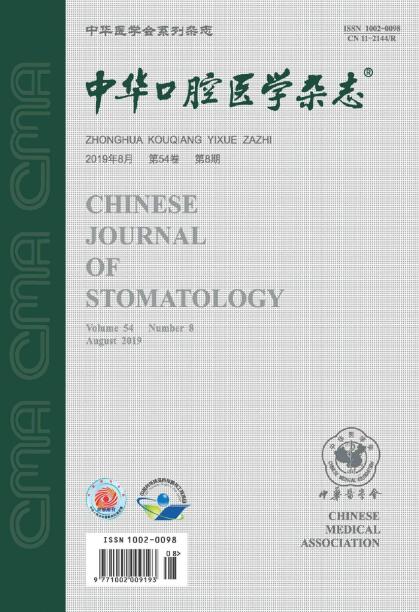
Founded in August 1953, Chinese Journal of Stomatology is a monthly academic journal of stomatology published publicly at home and abroad, sponsored by the Chinese Medical Association and co-sponsored by the Chinese Stomatology Association. It mainly reports the leading scientific research results and clinical diagnosis and treatment experience in the field of oral medicine, as well as the basic theoretical research that has a guiding role in oral clinical practice and is closely combined with oral clinical practice.
Chinese Journal of Over the years, Stomatology has been published in Medline, Scopus database, Toxicology Abstracts Database, Chemical Abstracts Database, American Cancer database, Russian Abstracts database, China Core Journal of Science and Technology, Peking University Core Journal, CSCD and other more than 20 important journals at home and abroad Physical medicine database and retrieval system included.



 京公网安备 11010802042870号
京ICP备2023020795号-1
京公网安备 11010802042870号
京ICP备2023020795号-1

 分享
分享
 求助内容:
求助内容: 应助结果提醒方式:
 扫码关注我们
