Nathan Ashe, Sarah Wozniak, Malcolm Conner, Rayan Ahmed, Olivia Keenan, Michelle R Demetres, Nour Makarem, Parisa Tehranifar, Rajalakshmi Nandakumar, Arnab K Ghosh
{"title":"Association of extreme heat events with sleep and cardiovascular health: a scoping review.","authors":"Nathan Ashe, Sarah Wozniak, Malcolm Conner, Rayan Ahmed, Olivia Keenan, Michelle R Demetres, Nour Makarem, Parisa Tehranifar, Rajalakshmi Nandakumar, Arnab K Ghosh","doi":"10.1186/s13643-024-02742-7","DOIUrl":null,"url":null,"abstract":"<p><strong>Background: </strong>Extreme heat events (EHEs), driven by anthropogenic climate change, exacerbate the risk of cardiovascular disease (CVD), although the underlying mechanisms are unclear. A possible mechanism leading to heat-related CVD is disturbances in sleep health, which can increase the risk of hypertension, and is associated with ideal cardiovascular health. Thus, our objective was to systematically review the peer-reviewed literature that describes the relationship between EHEs, sleep health, and cardiovascular measures and outcomes and narratively describe methodologies, evidence, and gaps in this area in order to develop a future research agenda linking sleep health, EHEs, and CVD.</p><p><strong>Methods: </strong>A comprehensive literature search was performed in the following databases from inception-June 2023: Ovid MEDLINE, Ovid Embase, CINAHL, Web of Science, and the Cochrane Library. Studies retrieved were then screened for eligibility against predefined inclusion/exclusion criteria. Then studies were described qualitatively in relation to study design, findings, and the evidence linking the relationship between sleep health, EHEs, and CVD.</p><p><strong>Results: </strong>Of the 2035 records screened, only three studies met the inclusion criteria. In these three studies, EHE was measured as absolute temperatures (greater than 30 °C) or relative temperatures (i.e., 90th percentile daily maximum temperature within the region). Cardiovascular (CV) measures described included blood pressure (BP), heart rate (HR), and HR variability (no CVD outcomes were described), and objective and subjective measurements of sleep health outcomes included sleep duration, calmness, ease of falling asleep, ease of awakening, freshness after awakening, and sleep satisfaction. Two studies were controlled trials, and one was a cohort study. During EHEs, individuals slept for shorter periods of time and less efficiently, with greater degrees of HR variability in two of the three studies lasting at most 1-2 days; BP (both systolic and diastolic) significantly decreased during EHEs in two of the studies. No formal assessment of a mediating relationship between EHE exposure, sleep outcomes, and CV measures was undertaken.</p><p><strong>Conclusions: </strong>Few studies examine the link between CVD, sleep, and extreme heat as a possible mechanism of elevated CVD risk during EHEs, despite a strong physiological rationale. Our findings highlight an important gap in the literature that should be closely examined as EHEs become more frequent and their harmful impacts of health increase.</p>","PeriodicalId":22162,"journal":{"name":"Systematic Reviews","volume":"14 1","pages":"19"},"PeriodicalIF":3.9000,"publicationDate":"2025-01-22","publicationTypes":"Journal Article","fieldsOfStudy":null,"isOpenAccess":false,"openAccessPdf":"https://www.ncbi.nlm.nih.gov/pmc/articles/PMC11760692/pdf/","citationCount":"0","resultStr":null,"platform":"Semanticscholar","paperid":null,"PeriodicalName":"Systematic Reviews","FirstCategoryId":"3","ListUrlMain":"https://doi.org/10.1186/s13643-024-02742-7","RegionNum":4,"RegionCategory":"医学","ArticlePicture":[],"TitleCN":null,"AbstractTextCN":null,"PMCID":null,"EPubDate":"","PubModel":"","JCR":"Q1","JCRName":"MEDICINE, GENERAL & INTERNAL","Score":null,"Total":0}
引用次数: 0
Abstract
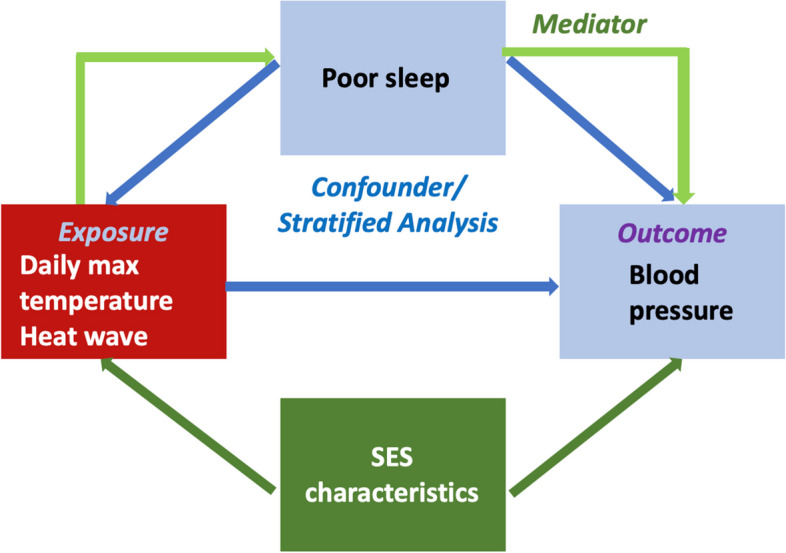
Background: Extreme heat events (EHEs), driven by anthropogenic climate change, exacerbate the risk of cardiovascular disease (CVD), although the underlying mechanisms are unclear. A possible mechanism leading to heat-related CVD is disturbances in sleep health, which can increase the risk of hypertension, and is associated with ideal cardiovascular health. Thus, our objective was to systematically review the peer-reviewed literature that describes the relationship between EHEs, sleep health, and cardiovascular measures and outcomes and narratively describe methodologies, evidence, and gaps in this area in order to develop a future research agenda linking sleep health, EHEs, and CVD.
Methods: A comprehensive literature search was performed in the following databases from inception-June 2023: Ovid MEDLINE, Ovid Embase, CINAHL, Web of Science, and the Cochrane Library. Studies retrieved were then screened for eligibility against predefined inclusion/exclusion criteria. Then studies were described qualitatively in relation to study design, findings, and the evidence linking the relationship between sleep health, EHEs, and CVD.
Results: Of the 2035 records screened, only three studies met the inclusion criteria. In these three studies, EHE was measured as absolute temperatures (greater than 30 °C) or relative temperatures (i.e., 90th percentile daily maximum temperature within the region). Cardiovascular (CV) measures described included blood pressure (BP), heart rate (HR), and HR variability (no CVD outcomes were described), and objective and subjective measurements of sleep health outcomes included sleep duration, calmness, ease of falling asleep, ease of awakening, freshness after awakening, and sleep satisfaction. Two studies were controlled trials, and one was a cohort study. During EHEs, individuals slept for shorter periods of time and less efficiently, with greater degrees of HR variability in two of the three studies lasting at most 1-2 days; BP (both systolic and diastolic) significantly decreased during EHEs in two of the studies. No formal assessment of a mediating relationship between EHE exposure, sleep outcomes, and CV measures was undertaken.
Conclusions: Few studies examine the link between CVD, sleep, and extreme heat as a possible mechanism of elevated CVD risk during EHEs, despite a strong physiological rationale. Our findings highlight an important gap in the literature that should be closely examined as EHEs become more frequent and their harmful impacts of health increase.
背景:由人为气候变化驱动的极端高温事件(EHEs)加剧了心血管疾病(CVD)的风险,尽管其潜在机制尚不清楚。导致热相关心血管疾病的一个可能机制是睡眠健康紊乱,这可能增加高血压的风险,并与理想的心血管健康有关。因此,我们的目标是系统地回顾同行评议的文献,这些文献描述了EHEs、睡眠健康和心血管测量和结果之间的关系,并叙述了该领域的方法、证据和差距,以便制定未来的研究议程,将睡眠健康、EHEs和CVD联系起来。方法:从inception到2023年6月,在以下数据库中进行全面的文献检索:Ovid MEDLINE, Ovid Embase, CINAHL, Web of Science和Cochrane Library。然后根据预定义的纳入/排除标准筛选检索到的研究。 然后对研究进行定性描述,涉及研究设计、发现和证据,将睡眠健康、EHEs和CVD之间的关系联系起来。结果:在筛选的2035份记录中,只有3项研究符合纳入标准。在这三项研究中,EHE被测量为绝对温度(大于30°C)或相对温度(即该地区内第90百分位日最高温度)。所描述的心血管(CV)测量包括血压(BP)、心率(HR)和心率变异性(未描述CVD结果),睡眠健康结果的客观和主观测量包括睡眠持续时间、平静、入睡难易程度、醒来难易程度、醒来后新鲜度和睡眠满意度。两项研究是对照试验,一项是队列研究。在EHEs期间,个体睡眠时间较短,效率较低,三个研究中有两个的HR变异程度较大,持续时间最多为1-2天;在两项研究中,EHEs期间血压(收缩压和舒张压)显著降低。没有对EHE暴露、睡眠结果和CV测量之间的中介关系进行正式评估。结论:尽管有强有力的生理基础,但很少有研究将CVD、睡眠和极端高温作为EHEs期间CVD风险升高的可能机制。我们的研究结果强调了文献中的一个重要空白,随着EHEs越来越频繁,其对健康的有害影响也越来越大,应该对这一空白进行仔细研究。
期刊介绍:
Systematic Reviews encompasses all aspects of the design, conduct and reporting of systematic reviews. The journal publishes high quality systematic review products including systematic review protocols, systematic reviews related to a very broad definition of health, rapid reviews, updates of already completed systematic reviews, and methods research related to the science of systematic reviews, such as decision modelling. At this time Systematic Reviews does not accept reviews of in vitro studies. The journal also aims to ensure that the results of all well-conducted systematic reviews are published, regardless of their outcome.




 京公网安备 11010802042870号
京ICP备2023020795号-1
京公网安备 11010802042870号
京ICP备2023020795号-1

 分享
分享
 求助内容:
求助内容: 应助结果提醒方式:
 扫码关注我们
