Xinlei Yu , Jingjing Wu , Zehui Qiu , Yuyao Shi , Liu Lin , Xichang Wang , Long Zhang
{"title":"Evaluation of edible quality and processing suitability of segmented products from silver carp under different thermal processing methods","authors":"Xinlei Yu , Jingjing Wu , Zehui Qiu , Yuyao Shi , Liu Lin , Xichang Wang , Long Zhang","doi":"10.1016/j.foodres.2024.115623","DOIUrl":null,"url":null,"abstract":"<div><div>This study investigated the edible quality differences in muscle segments of silver carp (<em>Hypophthalmichthys molitrix</em>) and established an evaluation model for processing suitability. The results showed that steamed dorsal meat had the highest levels of total free amino acids, umami amino acids, and total volatile compounds. Fried tail meat exhibited the highest content of sweet amino acids and equivalent umami concentration (EUC) values, which were superior in all fried meat parts compared to those that were steamed. Key quality indicators for steaming included L*, crude protein, 5ʹ-inosine monophosphate (IMP), (E)-2-Nonenal, and lysine, while IMP, moisture, 2-acetyl-1-pyrroline, and proline were key quality indicators for frying. The established processing suitability evaluation model accurately predicted overall sensory acceptability. Dorsal and belly portions of <em>H. molitrix</em> were best suited for steaming, whereas the tail was more suitable for frying.</div></div>","PeriodicalId":323,"journal":{"name":"Food Research International","volume":"201 ","pages":"Article 115623"},"PeriodicalIF":8.0000,"publicationDate":"2025-02-01","publicationTypes":"Journal Article","fieldsOfStudy":null,"isOpenAccess":false,"openAccessPdf":"","citationCount":"0","resultStr":null,"platform":"Semanticscholar","paperid":null,"PeriodicalName":"Food Research International","FirstCategoryId":"97","ListUrlMain":"https://www.sciencedirect.com/science/article/pii/S0963996924016946","RegionNum":1,"RegionCategory":"农林科学","ArticlePicture":[],"TitleCN":null,"AbstractTextCN":null,"PMCID":null,"EPubDate":"2024/12/30 0:00:00","PubModel":"Epub","JCR":"Q1","JCRName":"FOOD SCIENCE & TECHNOLOGY","Score":null,"Total":0}
引用次数: 0
Abstract
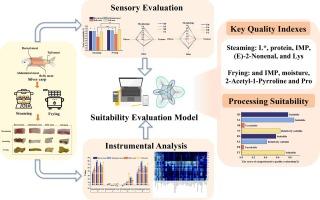
This study investigated the edible quality differences in muscle segments of silver carp (Hypophthalmichthys molitrix) and established an evaluation model for processing suitability. The results showed that steamed dorsal meat had the highest levels of total free amino acids, umami amino acids, and total volatile compounds. Fried tail meat exhibited the highest content of sweet amino acids and equivalent umami concentration (EUC) values, which were superior in all fried meat parts compared to those that were steamed. Key quality indicators for steaming included L*, crude protein, 5ʹ-inosine monophosphate (IMP), (E)-2-Nonenal, and lysine, while IMP, moisture, 2-acetyl-1-pyrroline, and proline were key quality indicators for frying. The established processing suitability evaluation model accurately predicted overall sensory acceptability. Dorsal and belly portions of H. molitrix were best suited for steaming, whereas the tail was more suitable for frying.
期刊介绍:
Food Research International serves as a rapid dissemination platform for significant and impactful research in food science, technology, engineering, and nutrition. The journal focuses on publishing novel, high-quality, and high-impact review papers, original research papers, and letters to the editors across various disciplines in the science and technology of food. Additionally, it follows a policy of publishing special issues on topical and emergent subjects in food research or related areas. Selected, peer-reviewed papers from scientific meetings, workshops, and conferences on the science, technology, and engineering of foods are also featured in special issues.



 京公网安备 11010802042870号
京ICP备2023020795号-1
京公网安备 11010802042870号
京ICP备2023020795号-1

 分享
分享
 求助内容:
求助内容: 应助结果提醒方式:
 扫码关注我们
