Tanvi H. Visal, Recep Bayraktar, Petra den Hollander, Michael A. Attathikhun, Tieling Zhou, Jing Wang, Li Shen, Corina-Elena Minciuna, Meng Chen, Elizve Barrientos-Toro, Harsh Batra, Maria Gabriela Raso, Fei Yang, Edwin R. Parra, Aysegul A. Sahin, George A. Calin, Sendurai A. Mani
{"title":"Accumulation of CD38 in Hybrid Epithelial/Mesenchymal Cells Promotes Immune Remodeling and Metastasis in Breast Cancer","authors":"Tanvi H. Visal, Recep Bayraktar, Petra den Hollander, Michael A. Attathikhun, Tieling Zhou, Jing Wang, Li Shen, Corina-Elena Minciuna, Meng Chen, Elizve Barrientos-Toro, Harsh Batra, Maria Gabriela Raso, Fei Yang, Edwin R. Parra, Aysegul A. Sahin, George A. Calin, Sendurai A. Mani","doi":"10.1158/0008-5472.can-24-0400","DOIUrl":null,"url":null,"abstract":"Triple-negative breast cancer (TNBC) is a highly metastatic subtype of breast cancer. The epithelial-to-mesenchymal transition is a nonbinary process in the metastatic cascade that generates tumor cells with both epithelial and mesenchymal traits known as hybrid EM cells. Recent studies have elucidated the enhanced metastatic potential of cancers featuring the hybrid EM phenotype, highlighting the need to uncover molecular drivers and targetable vulnerabilities of the hybrid EM state. Here, we discovered that hybrid EM breast tumors are enriched in CD38, an immunosuppressive molecule associated with worse clinical outcomes in liquid malignancies. Altering CD38 expression in tumor cell impacted migratory, invasive, and metastatic capabilities of hybrid EM cells. Abrogation of CD38 expression stimulated an antitumor immune response, thereby preventing the generation of an immunosuppressive microenvironment in hybrid EM tumors. CD38 levels positively correlated with PD-L1 expression in samples from patients with TNBC. Moreover, targeting CD38 potentiated the activity of anti–PD-L1, eliciting strong antitumor immunity, with reduced tumor growth in hybrid EM models. Overall, this research exposes upregulation of CD38 as a specific survival strategy utilized by hybrid EM breast tumors to suppress immune cell activity and sustain metastasis, with strong implications in other carcinomas that have hybrid EM properties. Significance: Hybrid cells co-featuring epithelial and mesenchymal traits in triple-negative breast cancer express elevated levels of CD38 to induce immunosuppression and metastasis, indicating CD38 inhibition as potential strategy for treating breast cancer.","PeriodicalId":9441,"journal":{"name":"Cancer research","volume":"34 1","pages":""},"PeriodicalIF":16.6000,"publicationDate":"2025-01-24","publicationTypes":"Journal Article","fieldsOfStudy":null,"isOpenAccess":false,"openAccessPdf":"","citationCount":"0","resultStr":null,"platform":"Semanticscholar","paperid":null,"PeriodicalName":"Cancer research","FirstCategoryId":"3","ListUrlMain":"https://doi.org/10.1158/0008-5472.can-24-0400","RegionNum":1,"RegionCategory":"医学","ArticlePicture":[],"TitleCN":null,"AbstractTextCN":null,"PMCID":null,"EPubDate":"","PubModel":"","JCR":"Q1","JCRName":"ONCOLOGY","Score":null,"Total":0}
引用次数: 0
Abstract
Triple-negative breast cancer (TNBC) is a highly metastatic subtype of breast cancer. The epithelial-to-mesenchymal transition is a nonbinary process in the metastatic cascade that generates tumor cells with both epithelial and mesenchymal traits known as hybrid EM cells. Recent studies have elucidated the enhanced metastatic potential of cancers featuring the hybrid EM phenotype, highlighting the need to uncover molecular drivers and targetable vulnerabilities of the hybrid EM state. Here, we discovered that hybrid EM breast tumors are enriched in CD38, an immunosuppressive molecule associated with worse clinical outcomes in liquid malignancies. Altering CD38 expression in tumor cell impacted migratory, invasive, and metastatic capabilities of hybrid EM cells. Abrogation of CD38 expression stimulated an antitumor immune response, thereby preventing the generation of an immunosuppressive microenvironment in hybrid EM tumors. CD38 levels positively correlated with PD-L1 expression in samples from patients with TNBC. Moreover, targeting CD38 potentiated the activity of anti–PD-L1, eliciting strong antitumor immunity, with reduced tumor growth in hybrid EM models. Overall, this research exposes upregulation of CD38 as a specific survival strategy utilized by hybrid EM breast tumors to suppress immune cell activity and sustain metastasis, with strong implications in other carcinomas that have hybrid EM properties. Significance: Hybrid cells co-featuring epithelial and mesenchymal traits in triple-negative breast cancer express elevated levels of CD38 to induce immunosuppression and metastasis, indicating CD38 inhibition as potential strategy for treating breast cancer.
期刊介绍:
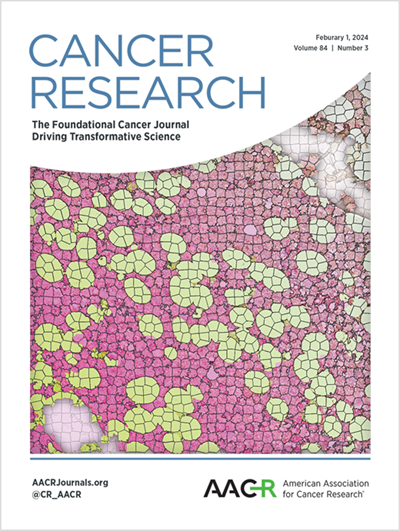
Cancer Research, published by the American Association for Cancer Research (AACR), is a journal that focuses on impactful original studies, reviews, and opinion pieces relevant to the broad cancer research community. Manuscripts that present conceptual or technological advances leading to insights into cancer biology are particularly sought after. The journal also places emphasis on convergence science, which involves bridging multiple distinct areas of cancer research.
With primary subsections including Cancer Biology, Cancer Immunology, Cancer Metabolism and Molecular Mechanisms, Translational Cancer Biology, Cancer Landscapes, and Convergence Science, Cancer Research has a comprehensive scope. It is published twice a month and has one volume per year, with a print ISSN of 0008-5472 and an online ISSN of 1538-7445.
Cancer Research is abstracted and/or indexed in various databases and platforms, including BIOSIS Previews (R) Database, MEDLINE, Current Contents/Life Sciences, Current Contents/Clinical Medicine, Science Citation Index, Scopus, and Web of Science.



 京公网安备 11010802042870号
京ICP备2023020795号-1
京公网安备 11010802042870号
京ICP备2023020795号-1

 分享
分享
 求助内容:
求助内容: 应助结果提醒方式:
 扫码关注我们
