{"title":"Jerk-Limited Online Trajectory Scaling for Cable-Driven Parallel Robots","authors":"Ruobing Wang;Yangmin Li","doi":"10.1109/TASE.2025.3533583","DOIUrl":null,"url":null,"abstract":"Motion planning of cable-driven parallel robots (CDPRs) suffers from difficulties imposed by the flexibility and unilateral property of cables. Existing methods either rely on specific motion primitives or employ complex numerical search or optimization processes, which cannot be applied to real-time applications with arbitrary path constraints. Aiming to narrow this research gap, this paper proposes a look-ahead online scaling approach to generate feasible trajectories of CDPRs subject to cable velocity, acceleration, jerk and tension constraints. Firstly, based on a desired path, the constraint equations are converted into the equivalent bounds on the path states by a look-ahead bounds estimation module. Then the timing law is online scaled by three cascaded controllers to fulfill the estimated bounds. Finally, the scaled timing law and the desired path are combined to form the final trajectory. Comparative studies on a laboratory-developed CDPR prototype demonstrate that the proposed approach outperforms state-of-the-art methods in terms of solution quality and computation time. Note to Practitioners–This paper was motivated by the problem of generating feasible trajectories of cable-driven parallel robots (CDPRs) subject to cable velocity, acceleration, jerk and tension constraints. Existing approaches either rely on specific motion primitives or employ complex numerical search or optimization processes, which cannot be applied to real-time applications with arbitrary path constraints. This paper proposes a look-ahead online scaling approach to generate feasible trajectories of CDPRs subject to these constraints. The approach uses a look-ahead bounds estimation module to determine the constraint bounds on the path states and preserve the stability of the approach. And a cascaded trajectory scaling algorithm is designed to steer the constrained path states to track a reference signal. A theoretical proof of the convergence of the scaling algorithm is provided. Through comparative studies, we show that the approach outperforms state-of-the-art methods in terms of solution quality and computation time. Experiments on a real robot prototype indicate that our method effectively improves motion accuracy and alleviates robot vibrations by considering the jerk constraints.","PeriodicalId":51060,"journal":{"name":"IEEE Transactions on Automation Science and Engineering","volume":"22 ","pages":"11529-11539"},"PeriodicalIF":6.4000,"publicationDate":"2025-01-24","publicationTypes":"Journal Article","fieldsOfStudy":null,"isOpenAccess":false,"openAccessPdf":"","citationCount":"0","resultStr":null,"platform":"Semanticscholar","paperid":null,"PeriodicalName":"IEEE Transactions on Automation Science and Engineering","FirstCategoryId":"94","ListUrlMain":"https://ieeexplore.ieee.org/document/10852338/","RegionNum":2,"RegionCategory":"计算机科学","ArticlePicture":[],"TitleCN":null,"AbstractTextCN":null,"PMCID":null,"EPubDate":"","PubModel":"","JCR":"Q1","JCRName":"AUTOMATION & CONTROL SYSTEMS","Score":null,"Total":0}
引用次数: 0
Abstract
Motion planning of cable-driven parallel robots (CDPRs) suffers from difficulties imposed by the flexibility and unilateral property of cables. Existing methods either rely on specific motion primitives or employ complex numerical search or optimization processes, which cannot be applied to real-time applications with arbitrary path constraints. Aiming to narrow this research gap, this paper proposes a look-ahead online scaling approach to generate feasible trajectories of CDPRs subject to cable velocity, acceleration, jerk and tension constraints. Firstly, based on a desired path, the constraint equations are converted into the equivalent bounds on the path states by a look-ahead bounds estimation module. Then the timing law is online scaled by three cascaded controllers to fulfill the estimated bounds. Finally, the scaled timing law and the desired path are combined to form the final trajectory. Comparative studies on a laboratory-developed CDPR prototype demonstrate that the proposed approach outperforms state-of-the-art methods in terms of solution quality and computation time. Note to Practitioners–This paper was motivated by the problem of generating feasible trajectories of cable-driven parallel robots (CDPRs) subject to cable velocity, acceleration, jerk and tension constraints. Existing approaches either rely on specific motion primitives or employ complex numerical search or optimization processes, which cannot be applied to real-time applications with arbitrary path constraints. This paper proposes a look-ahead online scaling approach to generate feasible trajectories of CDPRs subject to these constraints. The approach uses a look-ahead bounds estimation module to determine the constraint bounds on the path states and preserve the stability of the approach. And a cascaded trajectory scaling algorithm is designed to steer the constrained path states to track a reference signal. A theoretical proof of the convergence of the scaling algorithm is provided. Through comparative studies, we show that the approach outperforms state-of-the-art methods in terms of solution quality and computation time. Experiments on a real robot prototype indicate that our method effectively improves motion accuracy and alleviates robot vibrations by considering the jerk constraints.
期刊介绍:
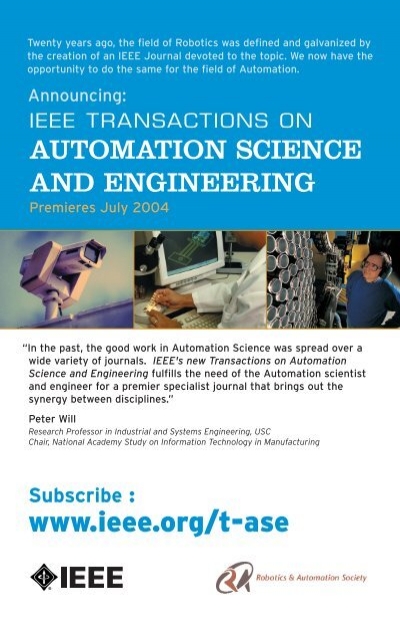
The IEEE Transactions on Automation Science and Engineering (T-ASE) publishes fundamental papers on Automation, emphasizing scientific results that advance efficiency, quality, productivity, and reliability. T-ASE encourages interdisciplinary approaches from computer science, control systems, electrical engineering, mathematics, mechanical engineering, operations research, and other fields. T-ASE welcomes results relevant to industries such as agriculture, biotechnology, healthcare, home automation, maintenance, manufacturing, pharmaceuticals, retail, security, service, supply chains, and transportation. T-ASE addresses a research community willing to integrate knowledge across disciplines and industries. For this purpose, each paper includes a Note to Practitioners that summarizes how its results can be applied or how they might be extended to apply in practice.



 京公网安备 11010802042870号
京ICP备2023020795号-1
京公网安备 11010802042870号
京ICP备2023020795号-1

 分享
分享
 求助内容:
求助内容: 应助结果提醒方式:
 扫码关注我们
