The Impact of Postoperative Prophylactic Medication on Long-Term Surgical, Severe Endoscopic and Endoscopic or Radiologic Recurrence Following Primary Ileocecal Resection in Patients With Crohn's Disease

IF 6.7 1区 医学 Q1 GASTROENTEROLOGY & HEPATOLOGY Alimentary Pharmacology & Therapeutics Pub Date : 2025-01-24 DOI:10.1111/apt.18496
Sebastiaan ten Bokkel Huinink, Michiel T. J. Bak, Evelien M. J. Beelen, Nicole S. Erler, Mark S. Silverberg, Matthieu Allez, Frank Hoentjen, Alexander G. L. Bodelier, Gerard Dijkstra, Marielle Romberg-Camps, Nanne K. H. de Boer, Laurents P. S. Stassen, Andrea E. van der Meulen – de Jong, Rachel L. West, C. Janneke van der Woude, Oddeke van Ruler, Annemarie C. de Vries, the Dutch Initiative on Crohn and Colitis (ICC)
{"title":"The Impact of Postoperative Prophylactic Medication on Long-Term Surgical, Severe Endoscopic and Endoscopic or Radiologic Recurrence Following Primary Ileocecal Resection in Patients With Crohn's Disease","authors":"Sebastiaan ten Bokkel Huinink,&nbsp;Michiel T. J. Bak,&nbsp;Evelien M. J. Beelen,&nbsp;Nicole S. Erler,&nbsp;Mark S. Silverberg,&nbsp;Matthieu Allez,&nbsp;Frank Hoentjen,&nbsp;Alexander G. L. Bodelier,&nbsp;Gerard Dijkstra,&nbsp;Marielle Romberg-Camps,&nbsp;Nanne K. H. de Boer,&nbsp;Laurents P. S. Stassen,&nbsp;Andrea E. van der Meulen – de Jong,&nbsp;Rachel L. West,&nbsp;C. Janneke van der Woude,&nbsp;Oddeke van Ruler,&nbsp;Annemarie C. de Vries,&nbsp;the Dutch Initiative on Crohn and Colitis (ICC)","doi":"10.1111/apt.18496","DOIUrl":null,"url":null,"abstract":"<div>\n \n \n <section>\n \n <h3> Background</h3>\n \n <p>The impact of prophylactic medication following ileocecal resection (ICR) for Crohn's disease (CD) merits further elucidation. Prophylactic medication following ileocecal resection (ICR) is recommended in patients with Crohn’s disease (CD), particularly in patients at increased risk of recurrence, but the impact on long-term outcomes needs to be further elucidated.</p>\n </section>\n \n <section>\n \n <h3> Aim</h3>\n \n <p>To evaluate the effect of postoperative prophylactic medication on long-term prognosis.</p>\n </section>\n \n <section>\n \n <h3> Methods</h3>\n \n <p>A retrospective cohort study was performed in patients with CD who underwent primary ICR between 2000-2020 in the Netherlands. Patients were divided into two groups: postoperative prophylactic medication [&lt; 12 weeks following ICR] versus no postoperative prophylactic medication. Outcomes were surgical recurrence [re-resection for CD], severe endoscopic recurrence [modified Rutgeerts score (mRS) ≥ i3] and endoscopic or radiologic recurrence [mRS ≥ i2b or radiologic recurrence]. Inverse probability of treatment weighting [IPTW] method was used to adjust for confounding and selection bias. Survival and association between postoperative prophylactic medication and outcomes were assessed with Kaplan-Meier analyses and Cox proportional hazard models.</p>\n </section>\n \n <section>\n \n <h3> Results</h3>\n \n <p>807 patients underwent ICR (median follow-up 5.0 years); 36% received postoperative prophylactic medication. Surgical, severe endoscopic and endoscopic or radiologic recurrence rates were significantly lower in those who received prophylactic medication (<i>p</i> = 0.01; <i>p</i> &lt; 0.01; <i>p</i> &lt; 0.01). IPTW analysis showed a lower risk of severe endoscopic and endoscopic or radiologic recurrence in patients treated with postoperative prophylactic medication (aOR 0.64; 95% CI 0.43–0.97; aOR 0.65; 95% CI 0.47–0.91), which also was identified as a protective factor for severe endoscopic (aHR 0.5; 95% CI 0.4–0.6) and endoscopic or radiologic recurrence (aHR 0.6, 95% CI 0.5–0.7) in multivariable analysis after correction for confounding factors. A comparable protective effect of postoperative prophylactic medication was sustained in patients who underwent ileocolonoscopy &lt;1 year postoperatively and who underwent surgery on or after 2010.</p>\n </section>\n \n <section>\n \n <h3> Conclusions</h3>\n \n <p>Prophylactic medication following primary ICR significantly reduces long-term recurrence rates in CD and was identified as a protective factor for severe endoscopic and endoscopic or radiologic recurrence.</p>\n </section>\n </div>","PeriodicalId":121,"journal":{"name":"Alimentary Pharmacology & Therapeutics","volume":"61 6","pages":"1019-1031"},"PeriodicalIF":6.7000,"publicationDate":"2025-01-24","publicationTypes":"Journal Article","fieldsOfStudy":null,"isOpenAccess":false,"openAccessPdf":"https://onlinelibrary.wiley.com/doi/epdf/10.1111/apt.18496","citationCount":"0","resultStr":null,"platform":"Semanticscholar","paperid":null,"PeriodicalName":"Alimentary Pharmacology & Therapeutics","FirstCategoryId":"3","ListUrlMain":"https://onlinelibrary.wiley.com/doi/10.1111/apt.18496","RegionNum":1,"RegionCategory":"医学","ArticlePicture":[],"TitleCN":null,"AbstractTextCN":null,"PMCID":null,"EPubDate":"","PubModel":"","JCR":"Q1","JCRName":"GASTROENTEROLOGY & HEPATOLOGY","Score":null,"Total":0}
引用次数: 0

Abstract

Background

The impact of prophylactic medication following ileocecal resection (ICR) for Crohn's disease (CD) merits further elucidation. Prophylactic medication following ileocecal resection (ICR) is recommended in patients with Crohn’s disease (CD), particularly in patients at increased risk of recurrence, but the impact on long-term outcomes needs to be further elucidated.

Aim

To evaluate the effect of postoperative prophylactic medication on long-term prognosis.

Methods

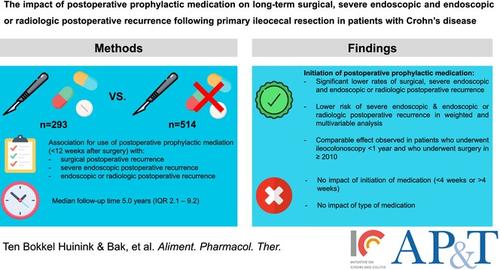
A retrospective cohort study was performed in patients with CD who underwent primary ICR between 2000-2020 in the Netherlands. Patients were divided into two groups: postoperative prophylactic medication [< 12 weeks following ICR] versus no postoperative prophylactic medication. Outcomes were surgical recurrence [re-resection for CD], severe endoscopic recurrence [modified Rutgeerts score (mRS) ≥ i3] and endoscopic or radiologic recurrence [mRS ≥ i2b or radiologic recurrence]. Inverse probability of treatment weighting [IPTW] method was used to adjust for confounding and selection bias. Survival and association between postoperative prophylactic medication and outcomes were assessed with Kaplan-Meier analyses and Cox proportional hazard models.

Results

807 patients underwent ICR (median follow-up 5.0 years); 36% received postoperative prophylactic medication. Surgical, severe endoscopic and endoscopic or radiologic recurrence rates were significantly lower in those who received prophylactic medication (p = 0.01; p < 0.01; p < 0.01). IPTW analysis showed a lower risk of severe endoscopic and endoscopic or radiologic recurrence in patients treated with postoperative prophylactic medication (aOR 0.64; 95% CI 0.43–0.97; aOR 0.65; 95% CI 0.47–0.91), which also was identified as a protective factor for severe endoscopic (aHR 0.5; 95% CI 0.4–0.6) and endoscopic or radiologic recurrence (aHR 0.6, 95% CI 0.5–0.7) in multivariable analysis after correction for confounding factors. A comparable protective effect of postoperative prophylactic medication was sustained in patients who underwent ileocolonoscopy <1 year postoperatively and who underwent surgery on or after 2010.

Conclusions

Prophylactic medication following primary ICR significantly reduces long-term recurrence rates in CD and was identified as a protective factor for severe endoscopic and endoscopic or radiologic recurrence.

Abstract Image

Abstract Image

查看原文
分享 分享
微信好友 朋友圈 QQ好友 复制链接
本刊更多论文
术后预防性用药对克罗恩病患者回盲切除术后长期手术、严重内镜及内镜或放射学复发的影响
回盲切除(ICR)后预防性用药对克罗恩病(CD)的影响值得进一步阐明。对于克罗恩病(CD)患者,特别是复发风险增加的患者,建议在回盲切除(ICR)后预防性用药,但对长期预后的影响需要进一步阐明。
本文章由计算机程序翻译,如有差异,请以英文原文为准。
求助全文
约1分钟内获得全文 去求助
来源期刊
CiteScore
15.60
自引率
7.90%
发文量
527
审稿时长
3-6 weeks
期刊介绍: Alimentary Pharmacology & Therapeutics is a global pharmacology journal focused on the impact of drugs on the human gastrointestinal and hepato-biliary systems. It covers a diverse range of topics, often with immediate clinical relevance to its readership.
期刊最新文献
Letter: Double PBC-Related Autoantibody Positivity-How Essential Is It for Diagnosis? Letter: Incremental Value and Stratified Interpretation of Dual Autoantibody Positivity in Primary Biliary Cholangitis. Dynamics of Circulatory HBcrAg and HBsAg After Nucleos(t)ide Analogue Cessation Using iTACT Assays to Predict Clinical Flares and HBsAg Loss. Review Article: TL1A Inhibitors in IBD - Mechanistic Rationale and Clinical Evidence. Review Article: An Update on Non-Invasive Tests for Steatotic Liver Disease - Insights From the ESSENCE Phase 3 Trial and Longitudinal Studies.
×
引用
GB/T 7714-2015
复制
MLA
复制
APA
复制
导出至
BibTeX EndNote RefMan NoteFirst NoteExpress
×
×
提示
您的信息不完整,为了账户安全,请先补充。
现在去补充
×
提示
您因"违规操作"
具体请查看互助需知
我知道了
×
提示
现在去查看 取消
×
提示
确定
0
微信
客服QQ
Book学术公众号 扫码关注我们
反馈
×
意见反馈
请填写您的意见或建议
请填写您的手机或邮箱
已复制链接
已复制链接
快去分享给好友吧!
我知道了
×
扫码分享
扫码分享
Book学术官方微信
Book学术文献互助
Book学术文献互助群
群 号:604180095
Book学术
文献互助 智能选刊 最新文献 互助须知 联系我们:info@booksci.cn
Book学术提供免费学术资源搜索服务,方便国内外学者检索中英文文献。致力于提供最便捷和优质的服务体验。
Copyright © 2023 Book学术 All rights reserved.
ghs 京公网安备 11010802042870号 京ICP备2023020795号-1