Haixia Chen, Zhixin Liu, Yunyun Xu, Xingyu Yu, Yinglei Tao, Yue Li, Xianli Huang, Jianping He and Tao Wang
{"title":"Targeted anchoring of Cu sites in imine-based covalent organic frameworks as catalytic centers for efficient Li–CO2 batteries†","authors":"Haixia Chen, Zhixin Liu, Yunyun Xu, Xingyu Yu, Yinglei Tao, Yue Li, Xianli Huang, Jianping He and Tao Wang","doi":"10.1039/D4SC07485H","DOIUrl":null,"url":null,"abstract":"<p >Lithium–carbon dioxide (Li–CO<small><sub>2</sub></small>) batteries have attracted much attention due to their high theoretical energy density and reversible CO<small><sub>2</sub></small> reduction/evolution process. However, the wide bandgap insulating discharge product Li<small><sub>2</sub></small>CO<small><sub>3</sub></small> is difficult to decompose, leading to large polarization or even death of the battery, thus seriously hindering the practical application of Li–CO<small><sub>2</sub></small> batteries. The properties of covalent organic framework (COF) materials, which can support the construction of multiphase catalytic systems, have great potential in the fields of CO<small><sub>2</sub></small> enrichment and electrocatalytic reduction. In this paper, the excellent redox properties of transition metal were utilized to introduce Cu metal into an imine-based COF to form Cu–O,N sites as the active sites for CO<small><sub>2</sub></small> oxidation and reduction. The electrochemical performance of the Cu sites in Li–CO<small><sub>2</sub></small> batteries was investigated, and the prepared batteries were able to cycle stably at a current density of 200 mA g<small><sup>−1</sup></small> for more than 1100 h. COF structural sites can be anchored by metal Cu sites to form Cu–O,N active centers for CO<small><sub>2</sub></small> oxidation and reduction processes. This study provides a new approach for the development of lithium CO<small><sub>2</sub></small> batteries towards more stable and stable.</p>","PeriodicalId":9909,"journal":{"name":"Chemical Science","volume":" 10","pages":" 4295-4302"},"PeriodicalIF":7.4000,"publicationDate":"2025-01-25","publicationTypes":"Journal Article","fieldsOfStudy":null,"isOpenAccess":false,"openAccessPdf":"https://pubs.rsc.org/en/content/articlepdf/2025/sc/d4sc07485h?page=search","citationCount":"0","resultStr":null,"platform":"Semanticscholar","paperid":null,"PeriodicalName":"Chemical Science","FirstCategoryId":"92","ListUrlMain":"https://pubs.rsc.org/en/content/articlelanding/2025/sc/d4sc07485h","RegionNum":1,"RegionCategory":"化学","ArticlePicture":[],"TitleCN":null,"AbstractTextCN":null,"PMCID":null,"EPubDate":"","PubModel":"","JCR":"Q1","JCRName":"CHEMISTRY, MULTIDISCIPLINARY","Score":null,"Total":0}
引用次数: 0
Abstract
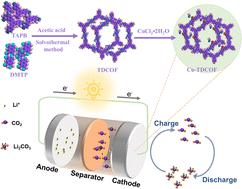
Lithium–carbon dioxide (Li–CO2) batteries have attracted much attention due to their high theoretical energy density and reversible CO2 reduction/evolution process. However, the wide bandgap insulating discharge product Li2CO3 is difficult to decompose, leading to large polarization or even death of the battery, thus seriously hindering the practical application of Li–CO2 batteries. The properties of covalent organic framework (COF) materials, which can support the construction of multiphase catalytic systems, have great potential in the fields of CO2 enrichment and electrocatalytic reduction. In this paper, the excellent redox properties of transition metal were utilized to introduce Cu metal into an imine-based COF to form Cu–O,N sites as the active sites for CO2 oxidation and reduction. The electrochemical performance of the Cu sites in Li–CO2 batteries was investigated, and the prepared batteries were able to cycle stably at a current density of 200 mA g−1 for more than 1100 h. COF structural sites can be anchored by metal Cu sites to form Cu–O,N active centers for CO2 oxidation and reduction processes. This study provides a new approach for the development of lithium CO2 batteries towards more stable and stable.
期刊介绍:
Chemical Science is a journal that encompasses various disciplines within the chemical sciences. Its scope includes publishing ground-breaking research with significant implications for its respective field, as well as appealing to a wider audience in related areas. To be considered for publication, articles must showcase innovative and original advances in their field of study and be presented in a manner that is understandable to scientists from diverse backgrounds. However, the journal generally does not publish highly specialized research.





 京公网安备 11010802042870号
京ICP备2023020795号-1
京公网安备 11010802042870号
京ICP备2023020795号-1

 分享
分享
 求助内容:
求助内容: 应助结果提醒方式:
 扫码关注我们
