Michel Aguilera, Sergio Pino-Alarcón, Francisco J Peña, Eugenio E Vogel, Natalia Cortés, Patricio Vargas
{"title":"Magnetocaloric Effect for a <i>Q</i>-Clock-Type System.","authors":"Michel Aguilera, Sergio Pino-Alarcón, Francisco J Peña, Eugenio E Vogel, Natalia Cortés, Patricio Vargas","doi":"10.3390/e27010011","DOIUrl":null,"url":null,"abstract":"<p><p>In this work, we study the magnetocaloric effect (MCE) in a working substance corresponding to a square lattice of spins with <i>Q</i> possible orientations, known as the \"<i>Q</i>-state clock model\". When the <i>Q</i>-state clock model has Q≥5 possible configurations, it presents the famous Berezinskii-Kosterlitz-Thouless (BKT) phase associated with vortex states. We calculate the thermodynamic quantities using Monte Carlo simulations for even <i>Q</i> numbers, ranging from Q=2 to Q=8 spin orientations per site in a lattice. We use lattices of different sizes with N=L×L=82,162,322,642,and1282 sites, considering free boundary conditions and an external magnetic field varying between B=0 and B=1.0 in natural units of the system. By obtaining the entropy, it is possible to quantify the MCE through an isothermal process in which the external magnetic field on the spin system is varied. In particular, we find the values of <i>Q</i> that maximize the MCE depending on the lattice size and the magnetic phase transitions linked with the process. Given the broader relevance of the <i>Q</i>-state clock model in areas such as percolation theory, neural networks, and biological systems, where multi-state interactions are essential, our study provides a robust framework in applied quantum mechanics, statistical physics, and related fields.</p>","PeriodicalId":11694,"journal":{"name":"Entropy","volume":"27 1","pages":""},"PeriodicalIF":2.0000,"publicationDate":"2024-12-27","publicationTypes":"Journal Article","fieldsOfStudy":null,"isOpenAccess":false,"openAccessPdf":"https://www.ncbi.nlm.nih.gov/pmc/articles/PMC11765250/pdf/","citationCount":"0","resultStr":null,"platform":"Semanticscholar","paperid":null,"PeriodicalName":"Entropy","FirstCategoryId":"101","ListUrlMain":"https://doi.org/10.3390/e27010011","RegionNum":3,"RegionCategory":"物理与天体物理","ArticlePicture":[],"TitleCN":null,"AbstractTextCN":null,"PMCID":null,"EPubDate":"","PubModel":"","JCR":"Q2","JCRName":"PHYSICS, MULTIDISCIPLINARY","Score":null,"Total":0}
引用次数: 0
Abstract
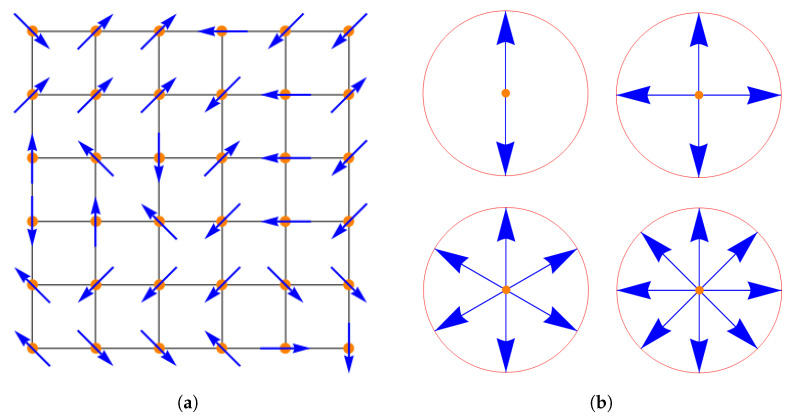
In this work, we study the magnetocaloric effect (MCE) in a working substance corresponding to a square lattice of spins with Q possible orientations, known as the "Q-state clock model". When the Q-state clock model has Q≥5 possible configurations, it presents the famous Berezinskii-Kosterlitz-Thouless (BKT) phase associated with vortex states. We calculate the thermodynamic quantities using Monte Carlo simulations for even Q numbers, ranging from Q=2 to Q=8 spin orientations per site in a lattice. We use lattices of different sizes with N=L×L=82,162,322,642,and1282 sites, considering free boundary conditions and an external magnetic field varying between B=0 and B=1.0 in natural units of the system. By obtaining the entropy, it is possible to quantify the MCE through an isothermal process in which the external magnetic field on the spin system is varied. In particular, we find the values of Q that maximize the MCE depending on the lattice size and the magnetic phase transitions linked with the process. Given the broader relevance of the Q-state clock model in areas such as percolation theory, neural networks, and biological systems, where multi-state interactions are essential, our study provides a robust framework in applied quantum mechanics, statistical physics, and related fields.
期刊介绍:
Entropy (ISSN 1099-4300), an international and interdisciplinary journal of entropy and information studies, publishes reviews, regular research papers and short notes. Our aim is to encourage scientists to publish as much as possible their theoretical and experimental details. There is no restriction on the length of the papers. If there are computation and the experiment, the details must be provided so that the results can be reproduced.





 京公网安备 11010802042870号
京ICP备2023020795号-1
京公网安备 11010802042870号
京ICP备2023020795号-1

 分享
分享
 求助内容:
求助内容: 应助结果提醒方式:
 扫码关注我们
