{"title":"Digital Mindfulness Training for Burnout Reduction in Physicians: Clinician-Driven Approach.","authors":"Lia Antico, Judson Brewer","doi":"10.2196/63197","DOIUrl":null,"url":null,"abstract":"<p><strong>Background: </strong>Physician burnout is widespread in health care systems, with harmful consequences on physicians, patients, and health care organizations. Mindfulness training (MT) has proven effective in reducing burnout; however, its time-consuming requirements often pose challenges for physicians who are already struggling with their busy schedules.</p><p><strong>Objective: </strong>This study aimed to design a short and pragmatic digital MT program with input from clinicians specifically to address burnout and to test its efficacy in physicians.</p><p><strong>Methods: </strong>Two separate nonrandomized pilot studies were conducted. In the first study, 27 physicians received the digital MT in a podcast format, while in the second study, 29 physicians and nurse practitioners accessed the same training through a free app-based platform. The main outcome measure was cynicism, one dimension of burnout. The secondary outcome measures were emotional exhaustion (the second dimension of burnout), anxiety, depression, intolerance of uncertainty, empathy (personal distress, perspective taking, and empathic concern subscales), self-compassion, and mindfulness (nonreactivity and nonjudgment subscales). In the second study, worry, sleep disturbances, and difficulties in emotion regulation were also measured. Changes in outcomes were assessed using self-report questionnaires administered before and after the treatment and 1 month later as follow-up.</p><p><strong>Results: </strong>Both studies showed that MT decreased cynicism (posttreatment: 33% reduction; P≤.04; r≥0.41 and follow-up: 33% reduction; P≤.04; r≥0.45), while improvements in emotional exhaustion were observed solely in the first study (25% reduction, P=.02, r=.50 at posttreatment; 25% reduction, P=.008, r=.62 at follow-up). There were also significant reductions in anxiety (P≤.01, r≥0.49 at posttreatment; P≤.01, r≥0.54 at follow-up), intolerance of uncertainty (P≤.03, r≥.57 at posttreatment; P<.001, r≥0.66 at follow-up), and personal distress (P=.03, r=0.43 at posttreatment; P=.03, r=0.46 at follow-up), while increases in self-compassion (P≤.02, r≥0.50 at posttreatment; P≤.006, r≥0.59 at follow-up) and mindfulness (nonreactivity: P≤.001, r≥0.69 at posttreatment; P≤.004, r≥0.58 at follow-up; nonjudgment: P≤.009, r≥0.50 at posttreatment; P≤.03, r≥0.60 at follow-up). In addition, the second study reported significant decreases in worry (P=.04, r=0.40 at posttreatment; P=.006, r=0.58 at follow-up), sleep disturbances (P=.04, r=0.42 at posttreatment; P=.01, r=0.53 at follow-up), and difficulties in emotion regulation (P=.005, r=0.54 at posttreatment; P<.001, r=0.70 at follow-up). However, no changes were observed over time for depression or perspective taking and empathic concern. Finally, both studies revealed significant positive correlations between burnout and anxiety (cynicism: r≥0.38; P≤.04; emotional exhaustion: r≥0.58; P≤.001).</p><p><strong>Conclusions: </strong>To our knowledge, this research is the first where clinicians were involved in designing an intervention targeting burnout. These findings suggest that this digital MT serves as a viable and effective tool for alleviating burnout and anxiety among physicians.</p><p><strong>Trial registration: </strong>ClinicalTrials.gov NCT06145425; https://clinicaltrials.gov/study/NCT06145425.</p>","PeriodicalId":14841,"journal":{"name":"JMIR Formative Research","volume":"9 ","pages":"e63197"},"PeriodicalIF":2.0000,"publicationDate":"2025-01-24","publicationTypes":"Journal Article","fieldsOfStudy":null,"isOpenAccess":false,"openAccessPdf":"https://www.ncbi.nlm.nih.gov/pmc/articles/PMC11806274/pdf/","citationCount":"0","resultStr":null,"platform":"Semanticscholar","paperid":null,"PeriodicalName":"JMIR Formative Research","FirstCategoryId":"1085","ListUrlMain":"https://doi.org/10.2196/63197","RegionNum":0,"RegionCategory":null,"ArticlePicture":[],"TitleCN":null,"AbstractTextCN":null,"PMCID":null,"EPubDate":"","PubModel":"","JCR":"Q3","JCRName":"HEALTH CARE SCIENCES & SERVICES","Score":null,"Total":0}
引用次数: 0
Abstract
Background: Physician burnout is widespread in health care systems, with harmful consequences on physicians, patients, and health care organizations. Mindfulness training (MT) has proven effective in reducing burnout; however, its time-consuming requirements often pose challenges for physicians who are already struggling with their busy schedules.
Objective: This study aimed to design a short and pragmatic digital MT program with input from clinicians specifically to address burnout and to test its efficacy in physicians.
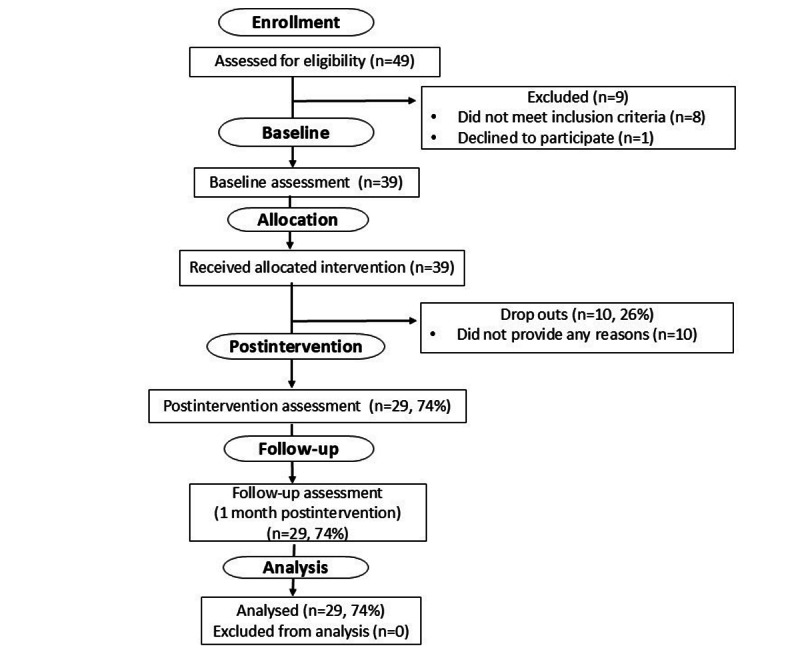
Methods: Two separate nonrandomized pilot studies were conducted. In the first study, 27 physicians received the digital MT in a podcast format, while in the second study, 29 physicians and nurse practitioners accessed the same training through a free app-based platform. The main outcome measure was cynicism, one dimension of burnout. The secondary outcome measures were emotional exhaustion (the second dimension of burnout), anxiety, depression, intolerance of uncertainty, empathy (personal distress, perspective taking, and empathic concern subscales), self-compassion, and mindfulness (nonreactivity and nonjudgment subscales). In the second study, worry, sleep disturbances, and difficulties in emotion regulation were also measured. Changes in outcomes were assessed using self-report questionnaires administered before and after the treatment and 1 month later as follow-up.
Results: Both studies showed that MT decreased cynicism (posttreatment: 33% reduction; P≤.04; r≥0.41 and follow-up: 33% reduction; P≤.04; r≥0.45), while improvements in emotional exhaustion were observed solely in the first study (25% reduction, P=.02, r=.50 at posttreatment; 25% reduction, P=.008, r=.62 at follow-up). There were also significant reductions in anxiety (P≤.01, r≥0.49 at posttreatment; P≤.01, r≥0.54 at follow-up), intolerance of uncertainty (P≤.03, r≥.57 at posttreatment; P<.001, r≥0.66 at follow-up), and personal distress (P=.03, r=0.43 at posttreatment; P=.03, r=0.46 at follow-up), while increases in self-compassion (P≤.02, r≥0.50 at posttreatment; P≤.006, r≥0.59 at follow-up) and mindfulness (nonreactivity: P≤.001, r≥0.69 at posttreatment; P≤.004, r≥0.58 at follow-up; nonjudgment: P≤.009, r≥0.50 at posttreatment; P≤.03, r≥0.60 at follow-up). In addition, the second study reported significant decreases in worry (P=.04, r=0.40 at posttreatment; P=.006, r=0.58 at follow-up), sleep disturbances (P=.04, r=0.42 at posttreatment; P=.01, r=0.53 at follow-up), and difficulties in emotion regulation (P=.005, r=0.54 at posttreatment; P<.001, r=0.70 at follow-up). However, no changes were observed over time for depression or perspective taking and empathic concern. Finally, both studies revealed significant positive correlations between burnout and anxiety (cynicism: r≥0.38; P≤.04; emotional exhaustion: r≥0.58; P≤.001).
Conclusions: To our knowledge, this research is the first where clinicians were involved in designing an intervention targeting burnout. These findings suggest that this digital MT serves as a viable and effective tool for alleviating burnout and anxiety among physicians.






 京公网安备 11010802042870号
京ICP备2023020795号-1
京公网安备 11010802042870号
京ICP备2023020795号-1

 分享
分享
 求助内容:
求助内容: 应助结果提醒方式:
 扫码关注我们
