Mohamad Ayoub, Salma Fayjaloun, Rabih Roufayel, Dany El Obeid, Ziad Fajloun, Mohamad Rima, Marc Karam
{"title":"Influence of <i>Apis mellifera syriaca</i> Bee Venom on Nociception and Inflammatory Cytokine Profiles in Experimental Hyperalgesia.","authors":"Mohamad Ayoub, Salma Fayjaloun, Rabih Roufayel, Dany El Obeid, Ziad Fajloun, Mohamad Rima, Marc Karam","doi":"10.3390/toxins17010018","DOIUrl":null,"url":null,"abstract":"<p><p>Hyperalgesia is a condition marked by an abnormal increase in pain sensitivity, often occurring in response to tissue injury, inflammation, or prolonged exposure to certain medications. Inflammatory mediators, such as cytokines IL-1β, IL-6, and TNF-α, play a central role in this process, amplifying pain perception. Developing effective treatments that address the underlying mechanisms of hyperalgesia is an active field of research. <i>Apis mellifera syriaca</i> venom demonstrated potential immunomodulatory activity associated with cytokine release in vivo. Therefore, the aim of this study is to evaluate the effect of <i>Apis mellifera syriaca</i> bee venom (<i>Ams</i>BV) on pain sensitivity in a formalin-induced hyperalgesia mice model and to evaluate the potential role of cytokines associated with the nociception of pain. The hotplate test, used to measure pain latency, showed that hypersensitivity to pain was induced in formalin-injected male mice only, with no changes in females, suggesting a sex-based response to formalin. When applied, <i>Ams</i>BV reduced pain sensitivity in males, suggesting pain relief potential. At the molecular level, <i>Ams</i>BV was able to reduce pro-inflammatory interleukin IL-4 and cytokine IFN-γ, emphasizing its immunomodulatory potential. Interestingly, the venom restored anti-inflammatory IL-10 levels that were significantly decreased in hyperalgesia males. Together, these findings highlight the therapeutic potential for <i>Ams</i>BV in managing inflammation and reducing pain, particularly hyperalgesia.</p>","PeriodicalId":23119,"journal":{"name":"Toxins","volume":"17 1","pages":""},"PeriodicalIF":4.0000,"publicationDate":"2025-01-01","publicationTypes":"Journal Article","fieldsOfStudy":null,"isOpenAccess":false,"openAccessPdf":"https://www.ncbi.nlm.nih.gov/pmc/articles/PMC11769041/pdf/","citationCount":"0","resultStr":null,"platform":"Semanticscholar","paperid":null,"PeriodicalName":"Toxins","FirstCategoryId":"3","ListUrlMain":"https://doi.org/10.3390/toxins17010018","RegionNum":3,"RegionCategory":"医学","ArticlePicture":[],"TitleCN":null,"AbstractTextCN":null,"PMCID":null,"EPubDate":"","PubModel":"","JCR":"Q2","JCRName":"FOOD SCIENCE & TECHNOLOGY","Score":null,"Total":0}
引用次数: 0
Abstract
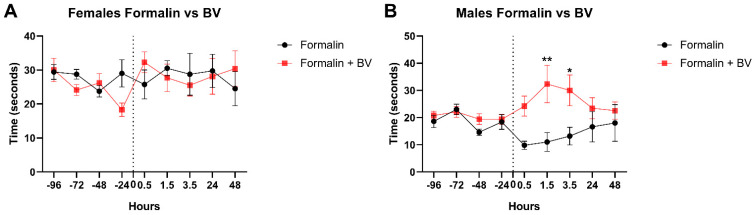
Hyperalgesia is a condition marked by an abnormal increase in pain sensitivity, often occurring in response to tissue injury, inflammation, or prolonged exposure to certain medications. Inflammatory mediators, such as cytokines IL-1β, IL-6, and TNF-α, play a central role in this process, amplifying pain perception. Developing effective treatments that address the underlying mechanisms of hyperalgesia is an active field of research. Apis mellifera syriaca venom demonstrated potential immunomodulatory activity associated with cytokine release in vivo. Therefore, the aim of this study is to evaluate the effect of Apis mellifera syriaca bee venom (AmsBV) on pain sensitivity in a formalin-induced hyperalgesia mice model and to evaluate the potential role of cytokines associated with the nociception of pain. The hotplate test, used to measure pain latency, showed that hypersensitivity to pain was induced in formalin-injected male mice only, with no changes in females, suggesting a sex-based response to formalin. When applied, AmsBV reduced pain sensitivity in males, suggesting pain relief potential. At the molecular level, AmsBV was able to reduce pro-inflammatory interleukin IL-4 and cytokine IFN-γ, emphasizing its immunomodulatory potential. Interestingly, the venom restored anti-inflammatory IL-10 levels that were significantly decreased in hyperalgesia males. Together, these findings highlight the therapeutic potential for AmsBV in managing inflammation and reducing pain, particularly hyperalgesia.
期刊介绍:
Toxins (ISSN 2072-6651) is an international, peer-reviewed open access journal which provides an advanced forum for studies related to toxins and toxinology. It publishes reviews, regular research papers and short communications. Our aim is to encourage scientists to publish their experimental and theoretical results in as much detail as possible. There is no restriction on the length of the papers. The full experimental details must be provided so that the results can be reproduced.





 京公网安备 11010802042870号
京ICP备2023020795号-1
京公网安备 11010802042870号
京ICP备2023020795号-1

 分享
分享
 求助内容:
求助内容: 应助结果提醒方式:
 扫码关注我们
