Robert J Turesky, Clarence Jones, Jingshu Guo, Kari Cammerrer, Laura A Maertens, Emmanuel S Antonarakis, Zhanni Lu, Logan G Spector
{"title":"Biomonitoring PhIP, a Potential Prostatic Carcinogen, in the Hair of Healthy Men of African and European Ancestry.","authors":"Robert J Turesky, Clarence Jones, Jingshu Guo, Kari Cammerrer, Laura A Maertens, Emmanuel S Antonarakis, Zhanni Lu, Logan G Spector","doi":"10.3390/toxics13010042","DOIUrl":null,"url":null,"abstract":"<p><p>Heterocyclic aromatic amines (HAAs), formed during the cooking of meat, are potential human carcinogens, underscoring the need for long-lived biomarkers to assess exposure and cancer risk. Frequent consumption of well-done meats containing 2-amino-1-methyl-6-phenylimidazo[4,5-<i>b</i>]pyridine (PhIP), a prevalent HAA that is a prostatic carcinogen in rodents and DNA-damaging agent in human prostate cells, has been linked to aggressive prostate cancer (PC) pathology. African American (AA) men face nearly twice the risk for developing and dying from PC compared to White men. We previously demonstrated that scalp hair is a reliable biospecimen for measuring PhIP intake using liquid chromatography-mass spectrometry. This study aimed to determine whether PhIP dietary intake is higher in AA men, potentially contributing to this health disparity. Healthy AA men were found to have a significantly higher mean hair PhIP level (2.12-fold) than White men on free-choice diets. However, this difference was not statistically significant after adjusting for melanin content. Further research is needed to understand how hair pigmentation, follicular density, and other morphological features of hair influence PhIP accumulation. These insights can improve the accuracy of using hair PhIP levels as a biomarker for exposure and its potential associations with cancer risk.</p>","PeriodicalId":23195,"journal":{"name":"Toxics","volume":"13 1","pages":""},"PeriodicalIF":4.1000,"publicationDate":"2025-01-08","publicationTypes":"Journal Article","fieldsOfStudy":null,"isOpenAccess":false,"openAccessPdf":"https://www.ncbi.nlm.nih.gov/pmc/articles/PMC11769170/pdf/","citationCount":"0","resultStr":null,"platform":"Semanticscholar","paperid":null,"PeriodicalName":"Toxics","FirstCategoryId":"93","ListUrlMain":"https://doi.org/10.3390/toxics13010042","RegionNum":3,"RegionCategory":"环境科学与生态学","ArticlePicture":[],"TitleCN":null,"AbstractTextCN":null,"PMCID":null,"EPubDate":"","PubModel":"","JCR":"Q2","JCRName":"ENVIRONMENTAL SCIENCES","Score":null,"Total":0}
引用次数: 0
Abstract
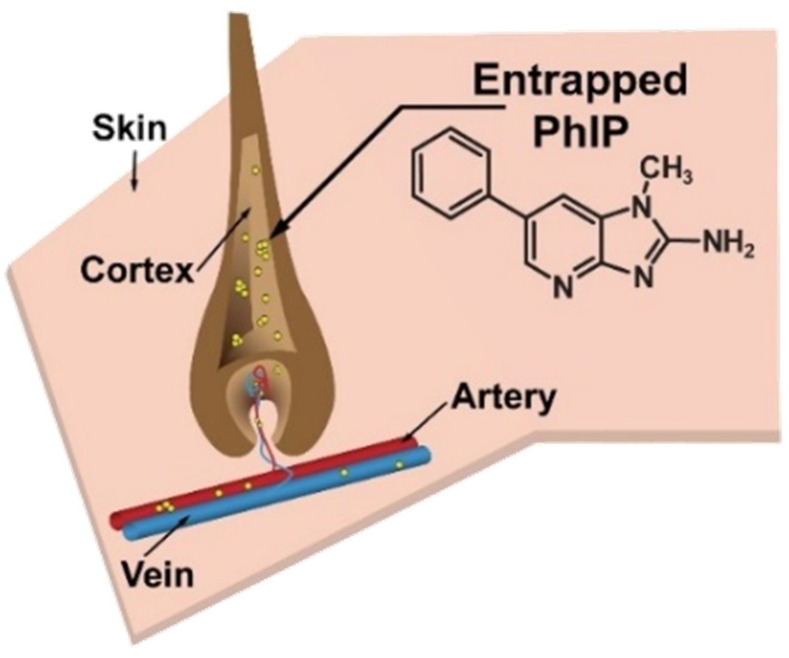
Heterocyclic aromatic amines (HAAs), formed during the cooking of meat, are potential human carcinogens, underscoring the need for long-lived biomarkers to assess exposure and cancer risk. Frequent consumption of well-done meats containing 2-amino-1-methyl-6-phenylimidazo[4,5-b]pyridine (PhIP), a prevalent HAA that is a prostatic carcinogen in rodents and DNA-damaging agent in human prostate cells, has been linked to aggressive prostate cancer (PC) pathology. African American (AA) men face nearly twice the risk for developing and dying from PC compared to White men. We previously demonstrated that scalp hair is a reliable biospecimen for measuring PhIP intake using liquid chromatography-mass spectrometry. This study aimed to determine whether PhIP dietary intake is higher in AA men, potentially contributing to this health disparity. Healthy AA men were found to have a significantly higher mean hair PhIP level (2.12-fold) than White men on free-choice diets. However, this difference was not statistically significant after adjusting for melanin content. Further research is needed to understand how hair pigmentation, follicular density, and other morphological features of hair influence PhIP accumulation. These insights can improve the accuracy of using hair PhIP levels as a biomarker for exposure and its potential associations with cancer risk.
ToxicsChemical Engineering-Chemical Health and Safety
CiteScore
4.50
自引率
10.90%
发文量
681
审稿时长
6 weeks
期刊介绍:
Toxics (ISSN 2305-6304) is an international, peer-reviewed, open access journal which provides an advanced forum for studies related to all aspects of toxic chemicals and materials. It publishes reviews, regular research papers, and short communications. Our aim is to encourage scientists to publish their experimental and theoretical results in detail. There is, therefore, no restriction on the maximum length of the papers, although authors should write their papers in a clear and concise way. The full experimental details must be provided so that the results can be reproduced. Electronic files or software regarding the full details of calculations and experimental procedure can be deposited as supplementary material, if it is not possible to publish them along with the text.





 京公网安备 11010802042870号
京ICP备2023020795号-1
京公网安备 11010802042870号
京ICP备2023020795号-1

 分享
分享
 求助内容:
求助内容: 应助结果提醒方式:
 扫码关注我们
