Yuhan Yang , Fu Zhao , Zhao Zhang , Yanan Liu , Zongmei Li , Xiaocui Wei , Tingyuan Wang , Chunyang Fan , Zhongyi Jiang
{"title":"Electrostatic interaction enhanced surface segregation towards heterogeneous antifouling membrane for oil/water separation","authors":"Yuhan Yang , Fu Zhao , Zhao Zhang , Yanan Liu , Zongmei Li , Xiaocui Wei , Tingyuan Wang , Chunyang Fan , Zhongyi Jiang","doi":"10.1016/j.ces.2025.121283","DOIUrl":null,"url":null,"abstract":"<div><div>The surface segregation method, as an in-situ surface modification method, has been increasingly used to construct heterogeneous membrane surfaces with hydrophilic microdomains and low surface energy microdomains. Herein, we constructed a heterogeneous antifouling membrane surface using electrostatic interaction enhanced surface segregation method with negatively charged perfluorosulfonic acid (PFSA) as surface segregation agents in casting solution and positively charged polyethyleneimine (PEI) as crosslinker in coagulation bath. The electrostatic interaction between PFSA and PEI enhanced the driving force of surface segregation, intensifying surface segregation of PFSA and residence stability of PFSA and PEI to construct low surface energy microdomains and hydrophilic microdomains, respectively. The resulting membrane exhibited super-oleophobicity and super-low oil adhesion underwater. Meanwhile, the addition of PFSA facilitated the phase inversion to enhance membrane permeability. Accordingly, our membrane exhibited water permeation flux of 367 L m<sup>−2</sup>h<sup>−1</sup> with a water flux recovery ratio of more than 95 % when separating various surfactant-stabilized oil-in-water emulsions. Moreover, after three-cycle filtration experiment, the water flux recovery ratio maintained above 90 %. Our study may provide a facile method to construct heterogeneous antifouling membrane through controlling surface segregation process using commercially available chemicals</div></div>","PeriodicalId":271,"journal":{"name":"Chemical Engineering Science","volume":"306 ","pages":"Article 121283"},"PeriodicalIF":4.3000,"publicationDate":"2025-03-01","publicationTypes":"Journal Article","fieldsOfStudy":null,"isOpenAccess":false,"openAccessPdf":"","citationCount":"0","resultStr":null,"platform":"Semanticscholar","paperid":null,"PeriodicalName":"Chemical Engineering Science","FirstCategoryId":"5","ListUrlMain":"https://www.sciencedirect.com/science/article/pii/S000925092500106X","RegionNum":2,"RegionCategory":"工程技术","ArticlePicture":[],"TitleCN":null,"AbstractTextCN":null,"PMCID":null,"EPubDate":"2025/1/26 0:00:00","PubModel":"Epub","JCR":"Q2","JCRName":"ENGINEERING, CHEMICAL","Score":null,"Total":0}
引用次数: 0
Abstract
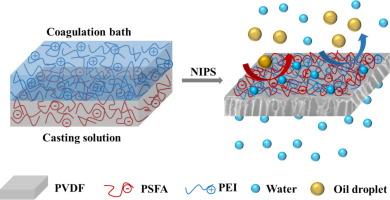
The surface segregation method, as an in-situ surface modification method, has been increasingly used to construct heterogeneous membrane surfaces with hydrophilic microdomains and low surface energy microdomains. Herein, we constructed a heterogeneous antifouling membrane surface using electrostatic interaction enhanced surface segregation method with negatively charged perfluorosulfonic acid (PFSA) as surface segregation agents in casting solution and positively charged polyethyleneimine (PEI) as crosslinker in coagulation bath. The electrostatic interaction between PFSA and PEI enhanced the driving force of surface segregation, intensifying surface segregation of PFSA and residence stability of PFSA and PEI to construct low surface energy microdomains and hydrophilic microdomains, respectively. The resulting membrane exhibited super-oleophobicity and super-low oil adhesion underwater. Meanwhile, the addition of PFSA facilitated the phase inversion to enhance membrane permeability. Accordingly, our membrane exhibited water permeation flux of 367 L m−2h−1 with a water flux recovery ratio of more than 95 % when separating various surfactant-stabilized oil-in-water emulsions. Moreover, after three-cycle filtration experiment, the water flux recovery ratio maintained above 90 %. Our study may provide a facile method to construct heterogeneous antifouling membrane through controlling surface segregation process using commercially available chemicals
表面偏析法作为一种原位表面修饰方法,被越来越多地用于构建具有亲水性微域和低表面能微域的非均相膜表面。本研究以带负电荷的全氟磺酸(PSFA)为表面偏析剂,带正电荷的聚亚胺(PEI)为交联剂,采用静电相互作用增强的表面偏析方法,在铸膜液中构建了非均相防污膜表面。PSFA与PEI之间的静电相互作用增强了表面偏析的驱动力,增强了PSFA的表面偏析和PSFA与PEI的驻留稳定性,分别构建了低表面能微域和亲水性微域。所得膜在水下表现出超疏油性和超低的油附着力。同时,PSFA的加入促进了相转化,增强了膜的通透性。因此,我们的膜在分离各种表面活性剂稳定的水包油乳液时,水通量回收率超过95 %,水通量通量为367 L m−2h−1。经过三次循环过滤实验,水通量回收率保持在90% %以上。我们的研究可能提供一种简单的方法,通过使用市售化学品控制表面分离过程来构建非均相防污膜
期刊介绍:
Chemical engineering enables the transformation of natural resources and energy into useful products for society. It draws on and applies natural sciences, mathematics and economics, and has developed fundamental engineering science that underpins the discipline.
Chemical Engineering Science (CES) has been publishing papers on the fundamentals of chemical engineering since 1951. CES is the platform where the most significant advances in the discipline have ever since been published. Chemical Engineering Science has accompanied and sustained chemical engineering through its development into the vibrant and broad scientific discipline it is today.





 京公网安备 11010802042870号
京ICP备2023020795号-1
京公网安备 11010802042870号
京ICP备2023020795号-1

 分享
分享
 求助内容:
求助内容: 应助结果提醒方式:
 扫码关注我们
