{"title":"Computed tomography-based nomogram for estimating progression-free survival probability in bladder cancer patients undergoing partial cystectomy","authors":"Ting Cao, Xiaolin Zhu, Chuanchao Guo, Hui Zhang, Lihua Chen, Tianran Zhang, Simeng Jiang, Xudong Gao, Ximing Wang, Wen Shen","doi":"10.1007/s00261-024-04747-1","DOIUrl":null,"url":null,"abstract":"<div><h3>Purpose</h3><p>To establish a prognostic model to estimate progression-free survival (PFS) probability in bladder cancer (BCa) patients undergoing partial cystectomy.</p><h3>Material and Methods</h3><p>Consecutive patients who underwent partial cystectomy between August 2012 and April 2021 were enrolled. The primary endpoint was PFS during the follow-up. The following features were assessed: tumor location, amount, size, tortuous blood vessels around or within the lesions, perivesical fat stranding, stalk, computed tomography (CT) enhancement, calcification, cystic degeneration, CT reported lymph nodes status, and presence of hydronephrosis. Univariate Cox regression and LASSO regression, followed by backward stepwise multivariable Cox, were used to construct the nomogram.</p><h3>Results</h3><p>A total of 106 patients were enrolled. Gender, histology, tortuous blood vessels, and perivesical fat stranding were used to fit the nomogram. The overall Harrell’s concordance index (C-index) was 0.752. The area under the receiver operator characteristic curves (AUC) at 1-year, 2-year and 3-year were 0.733, 0.789 and 0.833, respectively. The calibration curves showed remarkable consistency.</p><h3>Conclusion</h3><p>A nomogram model constructed based on the CT features and clinical risk factors is potentially feasible for predicting the PFS within 3 years after PC for BCa, which can assist in the choice of treatment and follow-up scheduling.</p></div>","PeriodicalId":7126,"journal":{"name":"Abdominal Radiology","volume":"50 8","pages":"3560 - 3571"},"PeriodicalIF":2.2000,"publicationDate":"2025-01-25","publicationTypes":"Journal Article","fieldsOfStudy":null,"isOpenAccess":false,"openAccessPdf":"https://www.ncbi.nlm.nih.gov/pmc/articles/PMC12267374/pdf/","citationCount":"0","resultStr":null,"platform":"Semanticscholar","paperid":null,"PeriodicalName":"Abdominal Radiology","FirstCategoryId":"3","ListUrlMain":"https://link.springer.com/article/10.1007/s00261-024-04747-1","RegionNum":3,"RegionCategory":"医学","ArticlePicture":[],"TitleCN":null,"AbstractTextCN":null,"PMCID":null,"EPubDate":"","PubModel":"","JCR":"Q2","JCRName":"RADIOLOGY, NUCLEAR MEDICINE & MEDICAL IMAGING","Score":null,"Total":0}
引用次数: 0
Abstract
Purpose
To establish a prognostic model to estimate progression-free survival (PFS) probability in bladder cancer (BCa) patients undergoing partial cystectomy.
Material and Methods
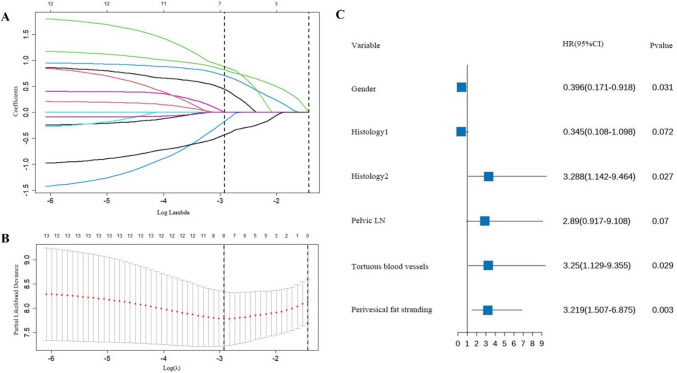
Consecutive patients who underwent partial cystectomy between August 2012 and April 2021 were enrolled. The primary endpoint was PFS during the follow-up. The following features were assessed: tumor location, amount, size, tortuous blood vessels around or within the lesions, perivesical fat stranding, stalk, computed tomography (CT) enhancement, calcification, cystic degeneration, CT reported lymph nodes status, and presence of hydronephrosis. Univariate Cox regression and LASSO regression, followed by backward stepwise multivariable Cox, were used to construct the nomogram.
Results
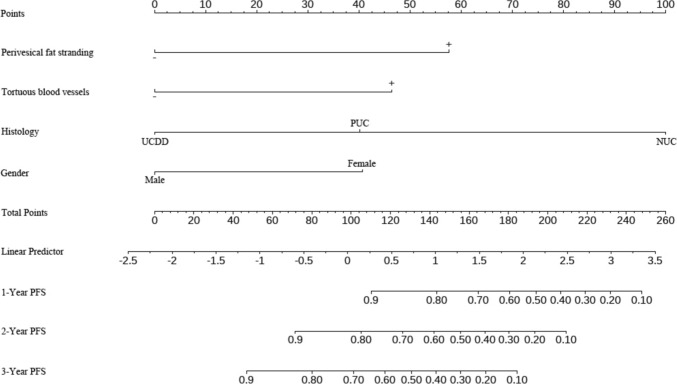
A total of 106 patients were enrolled. Gender, histology, tortuous blood vessels, and perivesical fat stranding were used to fit the nomogram. The overall Harrell’s concordance index (C-index) was 0.752. The area under the receiver operator characteristic curves (AUC) at 1-year, 2-year and 3-year were 0.733, 0.789 and 0.833, respectively. The calibration curves showed remarkable consistency.
Conclusion
A nomogram model constructed based on the CT features and clinical risk factors is potentially feasible for predicting the PFS within 3 years after PC for BCa, which can assist in the choice of treatment and follow-up scheduling.
目的:建立一个预测膀胱癌(BCa)部分膀胱切除术患者无进展生存(PFS)概率的预后模型。材料和方法:纳入2012年8月至2021年4月期间接受部分膀胱切除术的连续患者。主要终点为随访期间的PFS。评估以下特征:肿瘤的位置、数量、大小、病变周围或内部的血管扭曲、膀胱周围脂肪搁浅、茎、计算机断层扫描(CT)增强、钙化、囊性变性、CT报告的淋巴结状态和肾积水的存在。采用单变量Cox回归和LASSO回归,然后采用后向逐步多变量Cox回归构建正态图。结果:共纳入106例患者。性别,组织学,血管弯曲和膀胱周围脂肪搁浅被用来拟合nomogram。总体Harrell’s concordance index (C-index)为0.752。1年、2年和3年的接收算子特征曲线下面积(AUC)分别为0.733、0.789和0.833。标定曲线具有较好的一致性。结论:基于CT特征和临床危险因素构建的形态图模型预测BCa术后3年内PFS具有潜在的可行性,有助于选择治疗方案和随访计划。
期刊介绍:
Abdominal Radiology seeks to meet the professional needs of the abdominal radiologist by publishing clinically pertinent original, review and practice related articles on the gastrointestinal and genitourinary tracts and abdominal interventional and radiologic procedures. Case reports are generally not accepted unless they are the first report of a new disease or condition, or part of a special solicited section.
Reasons to Publish Your Article in Abdominal Radiology:
· Official journal of the Society of Abdominal Radiology (SAR)
· Published in Cooperation with:
European Society of Gastrointestinal and Abdominal Radiology (ESGAR)
European Society of Urogenital Radiology (ESUR)
Asian Society of Abdominal Radiology (ASAR)
· Efficient handling and Expeditious review
· Author feedback is provided in a mentoring style
· Global readership
· Readers can earn CME credits




 京公网安备 11010802042870号
京ICP备2023020795号-1
京公网安备 11010802042870号
京ICP备2023020795号-1

 分享
分享
 求助内容:
求助内容: 应助结果提醒方式:
 扫码关注我们
