Sean Tomlinson , Mark V. Lomolino , Jamie R. Wood , Atholl Anderson , George L.W. Perry , Janet M. Wilmshurst , Jeremy J. Austin , Damien A. Fordham
{"title":"Was extinction of New Zealand's avian megafauna an unavoidable consequence of human arrival?","authors":"Sean Tomlinson , Mark V. Lomolino , Jamie R. Wood , Atholl Anderson , George L.W. Perry , Janet M. Wilmshurst , Jeremy J. Austin , Damien A. Fordham","doi":"10.1016/j.scitotenv.2025.178471","DOIUrl":null,"url":null,"abstract":"<div><div>Human overexploitation contributed strongly to the loss of hundreds of bird species across Oceania, including nine giant, flightless birds called moa. The inevitability of anthropogenic moa extinctions in New Zealand has been fiercely debated. However, we can now rigorously evaluate their extinction drivers using spatially explicit demographic models capturing species-specific interactions between moa, natural climates and landscapes, and human colonists. By modelling the spatial abundance and extinction dynamics of six species of moa, validated against demographic and distributional inferences from the fossil record, we test whether their extinctions could have been avoided if human colonists moderated their hunting behaviours. We show that harvest rates of both moa birds (adults and subadults) and eggs are likely to have been low, varying between 4.0–6.0 % for birds and 2.5–12.0 % for eggs, annually. Our modelling, however, indicates that extinctions of moa could only have been avoided if Polynesian colonists maintained unrealistically expansive no-take zones (covering at least half of New Zealand's land area) and held their annual harvest rates to implausible levels (just 1 % of bird populations per annum). Although too late for moa, these insights provide valuable lessons and new computational approaches for conserving today's endangered megafauna.</div></div>","PeriodicalId":422,"journal":{"name":"Science of the Total Environment","volume":"964 ","pages":"Article 178471"},"PeriodicalIF":8.0000,"publicationDate":"2025-02-10","publicationTypes":"Journal Article","fieldsOfStudy":null,"isOpenAccess":false,"openAccessPdf":"","citationCount":"0","resultStr":null,"platform":"Semanticscholar","paperid":null,"PeriodicalName":"Science of the Total Environment","FirstCategoryId":"93","ListUrlMain":"https://www.sciencedirect.com/science/article/pii/S0048969725001056","RegionNum":1,"RegionCategory":"环境科学与生态学","ArticlePicture":[],"TitleCN":null,"AbstractTextCN":null,"PMCID":null,"EPubDate":"2025/1/24 0:00:00","PubModel":"Epub","JCR":"Q1","JCRName":"ENVIRONMENTAL SCIENCES","Score":null,"Total":0}
引用次数: 0
Abstract
Human overexploitation contributed strongly to the loss of hundreds of bird species across Oceania, including nine giant, flightless birds called moa. The inevitability of anthropogenic moa extinctions in New Zealand has been fiercely debated. However, we can now rigorously evaluate their extinction drivers using spatially explicit demographic models capturing species-specific interactions between moa, natural climates and landscapes, and human colonists. By modelling the spatial abundance and extinction dynamics of six species of moa, validated against demographic and distributional inferences from the fossil record, we test whether their extinctions could have been avoided if human colonists moderated their hunting behaviours. We show that harvest rates of both moa birds (adults and subadults) and eggs are likely to have been low, varying between 4.0–6.0 % for birds and 2.5–12.0 % for eggs, annually. Our modelling, however, indicates that extinctions of moa could only have been avoided if Polynesian colonists maintained unrealistically expansive no-take zones (covering at least half of New Zealand's land area) and held their annual harvest rates to implausible levels (just 1 % of bird populations per annum). Although too late for moa, these insights provide valuable lessons and new computational approaches for conserving today's endangered megafauna.
期刊介绍:
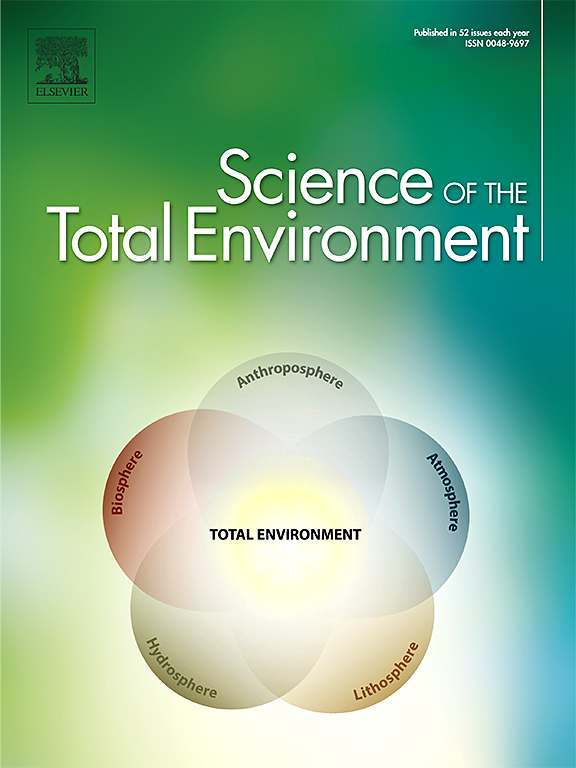
The Science of the Total Environment is an international journal dedicated to scientific research on the environment and its interaction with humanity. It covers a wide range of disciplines and seeks to publish innovative, hypothesis-driven, and impactful research that explores the entire environment, including the atmosphere, lithosphere, hydrosphere, biosphere, and anthroposphere.
The journal's updated Aims & Scope emphasizes the importance of interdisciplinary environmental research with broad impact. Priority is given to studies that advance fundamental understanding and explore the interconnectedness of multiple environmental spheres. Field studies are preferred, while laboratory experiments must demonstrate significant methodological advancements or mechanistic insights with direct relevance to the environment.





 京公网安备 11010802042870号
京ICP备2023020795号-1
京公网安备 11010802042870号
京ICP备2023020795号-1

 分享
分享
 求助内容:
求助内容: 应助结果提醒方式:
 扫码关注我们
