Assessing Facial Thermal Nociceptive Response in Female Dogs After Elective Ovariohysterectomy Anesthetized with Isoflurane and Treated with Cannabidiol and Meloxicam Analgesia.
Alejandro Casas-Alvarado, Patricia Mora-Medina, Ismael Hernández-Avalos, Julio Martínez-Burnes, Agatha Miranda-Cortes, Adriana Domínguez-Oliva, Daniel Mota-Rojas
{"title":"Assessing Facial Thermal Nociceptive Response in Female Dogs After Elective Ovariohysterectomy Anesthetized with Isoflurane and Treated with Cannabidiol and Meloxicam Analgesia.","authors":"Alejandro Casas-Alvarado, Patricia Mora-Medina, Ismael Hernández-Avalos, Julio Martínez-Burnes, Agatha Miranda-Cortes, Adriana Domínguez-Oliva, Daniel Mota-Rojas","doi":"10.3390/ani15020227","DOIUrl":null,"url":null,"abstract":"<p><p>Pain management requires the identification of certain indicators to recognize pain. Various tools have been suggested to achieve an objective evaluation, including infrared thermography (IRT). The objective of this study was to assess the facial thermal nociceptive response produced by the use of cannabidiol (CBD) alone and in combination with meloxicam in female dogs undergoing elective ovariohysterectomy anesthetized with isoflurane. Sixty-four female dogs of different breeds were randomly distributed into four study groups according to the treatment received. G1: Placebo group (<i>n =</i> 16); G2: Group receiving intravenous meloxicam as premedication (0.2 mg Kg<sup>-1</sup>) and every 24 h postoperatively 0.1 mg Kg<sup>-1</sup> (<i>n =</i> 16); G3: Group treated with CBD (<i>n =</i> 16) at a dose of 2 mg kg<sup>-1</sup> orally every 12 h; and G4: Group medicated with the combination of both treatments (<i>n =</i> 16). All treatments were administered for 48 h postoperatively. After the anesthetic surgical procedure, radiometric images were captured using IRT and physiological parameters during the events E<sub>Basal</sub>, E<sub>30min</sub>, E<sub>1h</sub>, E<sub>2h</sub>, E<sub>3h</sub>, E<sub>4h</sub>, E<sub>8h</sub>, E<sub>12h</sub>, E<sub>24h</sub> and E<sub>48h</sub>. Overall, it was found that the high, medium and low temperatures of the thermal windows of the eye, upper eyelid and lower eyelid, as well as the average temperature of the lacrimal gland in G1 between events, were significantly lower at E<sub>30min</sub>, E<sub>1h</sub> and E<sub>2h</sub> compared to E<sub>Basal</sub> (<i>p =</i> 0.01). Among treatments, a significantly higher temperature was observed in groups G2, G3 and G4 compared to G1 (<i>p =</i> 0.001) in the thermal windows of the upper eyelid, lower eyelid, lacrimal gland and ocular areas. Regarding physiological parameters, heart rate (HR) was higher in G1 compared to the animals in G2, G3 and G4 (<i>p =</i> 0.03). The respiratory rate (RR) was significantly lower in all four study groups during the postoperative events compared to their respective E<sub>Basal</sub> (<i>p <</i> 0.05), while among treatments, G2, G3 and G4 had a lower RR compared to G1 (<i>p =</i> 0.03). Mild hypothermia was observed in all study groups at E<sub>30min</sub> and E<sub>1h</sub> compared to E<sub>Basal</sub> (<i>p =</i> 0.001). No significant correlation was found between the temperatures of the assessed thermal regions and the physiological traits. In conclusion, CBD, whether administered alone or in combination with meloxicam, demonstrated comparable analgesic efficacy, which could control nociceptive cardiorespiratory and hemodynamic autonomic responses, as there were no significant changes in the facial thermal response between treatments G2, G3 and G4.</p>","PeriodicalId":7955,"journal":{"name":"Animals","volume":"15 2","pages":""},"PeriodicalIF":2.7000,"publicationDate":"2025-01-15","publicationTypes":"Journal Article","fieldsOfStudy":null,"isOpenAccess":false,"openAccessPdf":"https://www.ncbi.nlm.nih.gov/pmc/articles/PMC11758305/pdf/","citationCount":"0","resultStr":null,"platform":"Semanticscholar","paperid":null,"PeriodicalName":"Animals","FirstCategoryId":"97","ListUrlMain":"https://doi.org/10.3390/ani15020227","RegionNum":2,"RegionCategory":"农林科学","ArticlePicture":[],"TitleCN":null,"AbstractTextCN":null,"PMCID":null,"EPubDate":"","PubModel":"","JCR":"Q1","JCRName":"AGRICULTURE, DAIRY & ANIMAL SCIENCE","Score":null,"Total":0}
引用次数: 0
Abstract
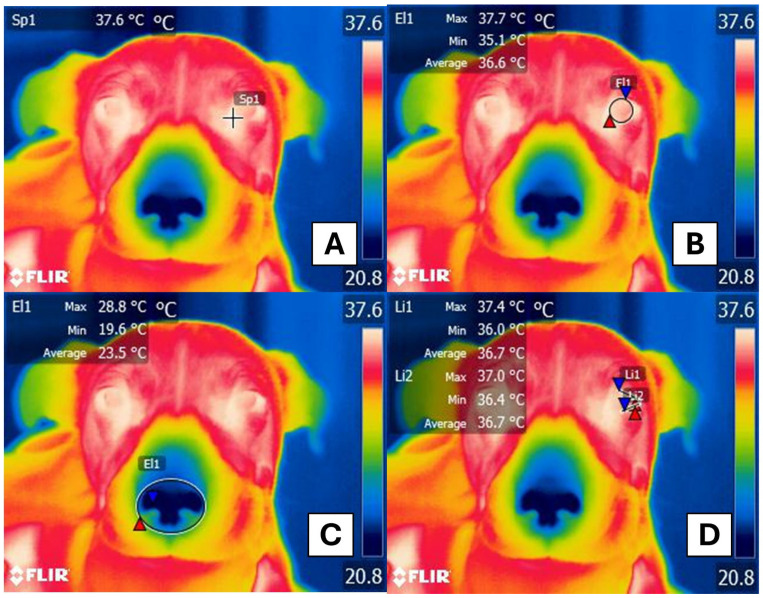
Pain management requires the identification of certain indicators to recognize pain. Various tools have been suggested to achieve an objective evaluation, including infrared thermography (IRT). The objective of this study was to assess the facial thermal nociceptive response produced by the use of cannabidiol (CBD) alone and in combination with meloxicam in female dogs undergoing elective ovariohysterectomy anesthetized with isoflurane. Sixty-four female dogs of different breeds were randomly distributed into four study groups according to the treatment received. G1: Placebo group (n = 16); G2: Group receiving intravenous meloxicam as premedication (0.2 mg Kg-1) and every 24 h postoperatively 0.1 mg Kg-1 (n = 16); G3: Group treated with CBD (n = 16) at a dose of 2 mg kg-1 orally every 12 h; and G4: Group medicated with the combination of both treatments (n = 16). All treatments were administered for 48 h postoperatively. After the anesthetic surgical procedure, radiometric images were captured using IRT and physiological parameters during the events EBasal, E30min, E1h, E2h, E3h, E4h, E8h, E12h, E24h and E48h. Overall, it was found that the high, medium and low temperatures of the thermal windows of the eye, upper eyelid and lower eyelid, as well as the average temperature of the lacrimal gland in G1 between events, were significantly lower at E30min, E1h and E2h compared to EBasal (p = 0.01). Among treatments, a significantly higher temperature was observed in groups G2, G3 and G4 compared to G1 (p = 0.001) in the thermal windows of the upper eyelid, lower eyelid, lacrimal gland and ocular areas. Regarding physiological parameters, heart rate (HR) was higher in G1 compared to the animals in G2, G3 and G4 (p = 0.03). The respiratory rate (RR) was significantly lower in all four study groups during the postoperative events compared to their respective EBasal (p < 0.05), while among treatments, G2, G3 and G4 had a lower RR compared to G1 (p = 0.03). Mild hypothermia was observed in all study groups at E30min and E1h compared to EBasal (p = 0.001). No significant correlation was found between the temperatures of the assessed thermal regions and the physiological traits. In conclusion, CBD, whether administered alone or in combination with meloxicam, demonstrated comparable analgesic efficacy, which could control nociceptive cardiorespiratory and hemodynamic autonomic responses, as there were no significant changes in the facial thermal response between treatments G2, G3 and G4.
AnimalsAgricultural and Biological Sciences-Animal Science and Zoology
CiteScore
4.90
自引率
16.70%
发文量
3015
审稿时长
20.52 days
期刊介绍:
Animals (ISSN 2076-2615) is an international and interdisciplinary scholarly open access journal. It publishes original research articles, reviews, communications, and short notes that are relevant to any field of study that involves animals, including zoology, ethnozoology, animal science, animal ethics and animal welfare. However, preference will be given to those articles that provide an understanding of animals within a larger context (i.e., the animals'' interactions with the outside world, including humans). There is no restriction on the length of the papers. Our aim is to encourage scientists to publish their experimental and theoretical research in as much detail as possible. Full experimental details and/or method of study, must be provided for research articles. Articles submitted that involve subjecting animals to unnecessary pain or suffering will not be accepted, and all articles must be submitted with the necessary ethical approval (please refer to the Ethical Guidelines for more information).




 京公网安备 11010802042870号
京ICP备2023020795号-1
京公网安备 11010802042870号
京ICP备2023020795号-1

 分享
分享
 求助内容:
求助内容: 应助结果提醒方式:
 扫码关注我们
