Muhammad Younas , Kifayatullah Khan , Maria Zeb , Muhammad Yaseen , Noor Samad Shah , Hassan Alshemmari , Yasar N. Kavil , Saeed Saad Alelyani , Mohamed Hussien , Sidra Zeb , Di Du
{"title":"A global review on perfluoroalkyl acids (PFAAs) in the riverine systems: Environmental behaviours and risks implications","authors":"Muhammad Younas , Kifayatullah Khan , Maria Zeb , Muhammad Yaseen , Noor Samad Shah , Hassan Alshemmari , Yasar N. Kavil , Saeed Saad Alelyani , Mohamed Hussien , Sidra Zeb , Di Du","doi":"10.1016/j.scitotenv.2025.178596","DOIUrl":null,"url":null,"abstract":"<div><div>This review provides a comprehensive global overview of the occurrences, distribution, emissions, and associated risks of perfluoroalkyl acids (PFAAs) in riverine systems across both developed and developing countries including the United States (US), Spain, France, Netherlands, Germany, Pakistan, China, Korea, Vietnam, Italy, and Japan. Data for this review were systematically gathered through a comprehensive and structured search process using various databases, search engines, and academic repositories to identify relevant literature and studies. Human health risks were assessed using recommended United States Environmental Protection Agency (USEPA) models, including estimated daily intake (EDI), hazard risk (HR), and hazard index (HI) for each reported PFAA compound in the studied countries. The overall results revealed significant variability in PFAAs contamination from the 1950s to 2023, reflecting extensive industrial usage and increasing environmental concerns, with levels often exceeding the permissible limits set by environmental quality standards established by national or international regulatory authorities, agencies, and organizations. Among the studied countries, Italy exhibited the highest average sum of PFAA compounds (∑PFAAs) concentration in riverine water, ranging from 4.07 to 140.61 ng/L, with an average of 41.37 ng/L, followed by the Netherlands, China, Japan, the US, Pakistan, Spain, France, Germany, Korea, and Vietnam. Similarly, Germany showed the highest average ∑PFAAs concentration in riverine sediments, ranging from 40.25 to 213.00 ng/g, with an average of 126.63 ng/g, followed by China, Spain, the US, Pakistan, Vietnam, and Korea. Whereas, in riverine fish, Spain had the highest average ∑PFAAs concentration, ranging from 0.05 to 144.97 ng/g, with a mean of 15.94 ng/g, followed by Korea, Vietnam, and the US. From a human risk perspective, the highest average EDI of ∑PFAAs via riverine water consumption was observed in the dependent population of Italy (2.02 × 10<sup>−3</sup> ng/L/day), followed by the Netherlands (8.24 × 10<sup>−4</sup> ng/L/day), the US (5.56 × 10<sup>−4</sup> ng/L/day), Pakistan (3.99 × 10<sup>−4</sup> ng/L/day), Japan (3.69 × 10<sup>−4</sup> ng/L/day), France (3.42 × 10<sup>−4</sup> ng/L/day), China (2.58 × 10<sup>−4</sup> ng/L/day), Spain (2.43 × 10<sup>−4</sup> ng/L/day), Germany (1.17 × 10<sup>−4</sup> ng/L/day), Korea (6.01 × 10<sup>−5</sup> ng/L/day), and Vietnam (1.28 × 10<sup>−5</sup> ng/L/day). For fish consumption, Spain recorded the highest average EDI of ∑PFAAs (9.92 × 10<sup>0</sup> ng/g/day) in its dependent population, followed by the US (3.44 × 10<sup>0</sup> ng/g/day), Korea (8.13 × 10<sup>−1</sup> ng/g/day), and Vietnam (4.99 × 10<sup>−1</sup> ng/g/day). The non-carcinogenic HR values for individual PFAA compounds via riverine water intake in the dependent populations of both developed and developing countries were within acceptable limits (<1). However, the HI values for ∑PFAAs intake via riverine fish consumption in the dependent population exceeded the threshold (>1) in the developed countries, the US and Spain, indicating higher potential risks associated with fish consumption in these countries. Given the inadequate wastewater treatment facilities in many regions, coupled with untreated runoff from urban areas and agricultural fields draining directly into rivers, this study underscores the urgent need for integrated prevention and control measures to mitigate PFAAs contamination in riverine systems and reduce associated risks. Ultimately, stricter regulations, improved monitoring, and enhanced water treatment technologies are crucial to reducing PFAAs contamination and safeguarding public health.</div></div>","PeriodicalId":422,"journal":{"name":"Science of the Total Environment","volume":"964 ","pages":"Article 178596"},"PeriodicalIF":8.0000,"publicationDate":"2025-01-23","publicationTypes":"Journal Article","fieldsOfStudy":null,"isOpenAccess":false,"openAccessPdf":"","citationCount":"0","resultStr":null,"platform":"Semanticscholar","paperid":null,"PeriodicalName":"Science of the Total Environment","FirstCategoryId":"93","ListUrlMain":"https://www.sciencedirect.com/science/article/pii/S004896972500230X","RegionNum":1,"RegionCategory":"环境科学与生态学","ArticlePicture":[],"TitleCN":null,"AbstractTextCN":null,"PMCID":null,"EPubDate":"","PubModel":"","JCR":"Q1","JCRName":"ENVIRONMENTAL SCIENCES","Score":null,"Total":0}
引用次数: 0
Abstract
This review provides a comprehensive global overview of the occurrences, distribution, emissions, and associated risks of perfluoroalkyl acids (PFAAs) in riverine systems across both developed and developing countries including the United States (US), Spain, France, Netherlands, Germany, Pakistan, China, Korea, Vietnam, Italy, and Japan. Data for this review were systematically gathered through a comprehensive and structured search process using various databases, search engines, and academic repositories to identify relevant literature and studies. Human health risks were assessed using recommended United States Environmental Protection Agency (USEPA) models, including estimated daily intake (EDI), hazard risk (HR), and hazard index (HI) for each reported PFAA compound in the studied countries. The overall results revealed significant variability in PFAAs contamination from the 1950s to 2023, reflecting extensive industrial usage and increasing environmental concerns, with levels often exceeding the permissible limits set by environmental quality standards established by national or international regulatory authorities, agencies, and organizations. Among the studied countries, Italy exhibited the highest average sum of PFAA compounds (∑PFAAs) concentration in riverine water, ranging from 4.07 to 140.61 ng/L, with an average of 41.37 ng/L, followed by the Netherlands, China, Japan, the US, Pakistan, Spain, France, Germany, Korea, and Vietnam. Similarly, Germany showed the highest average ∑PFAAs concentration in riverine sediments, ranging from 40.25 to 213.00 ng/g, with an average of 126.63 ng/g, followed by China, Spain, the US, Pakistan, Vietnam, and Korea. Whereas, in riverine fish, Spain had the highest average ∑PFAAs concentration, ranging from 0.05 to 144.97 ng/g, with a mean of 15.94 ng/g, followed by Korea, Vietnam, and the US. From a human risk perspective, the highest average EDI of ∑PFAAs via riverine water consumption was observed in the dependent population of Italy (2.02 × 10⁻³ ng/L/day), followed by the Netherlands (8.24 × 10⁻⁴ ng/L/day), the US (5.56 × 10⁻⁴ ng/L/day), Pakistan (3.99 × 10⁻⁴ ng/L/day), Japan (3.69 × 10⁻⁴ ng/L/day), France (3.42 × 10⁻⁴ ng/L/day), China (2.58 × 10⁻⁴ ng/L/day), Spain (2.43 × 10⁻⁴ ng/L/day), Germany (1.17 × 10⁻⁴ ng/L/day), Korea (6.01 × 10⁻⁵ ng/L/day), and Vietnam (1.28 × 10⁻⁵ ng/L/day). For fish consumption, Spain recorded the highest average EDI of ∑PFAAs (9.92 × 100 ng/g/day) in its dependent population, followed by the US (3.44 × 100 ng/g/day), Korea (8.13 × 10⁻¹ ng/g/day), and Vietnam (4.99 × 10⁻¹ ng/g/day). The non-carcinogenic HR values for individual PFAA compounds via riverine water intake in the dependent populations of both developed and developing countries were within acceptable limits (<1). However, the HI values for ∑PFAAs intake via riverine fish consumption in the dependent population exceeded the threshold (>1) in the developed countries, the US and Spain, indicating higher potential risks associated with fish consumption in these countries. Given the inadequate wastewater treatment facilities in many regions, coupled with untreated runoff from urban areas and agricultural fields draining directly into rivers, this study underscores the urgent need for integrated prevention and control measures to mitigate PFAAs contamination in riverine systems and reduce associated risks. Ultimately, stricter regulations, improved monitoring, and enhanced water treatment technologies are crucial to reducing PFAAs contamination and safeguarding public health.
期刊介绍:
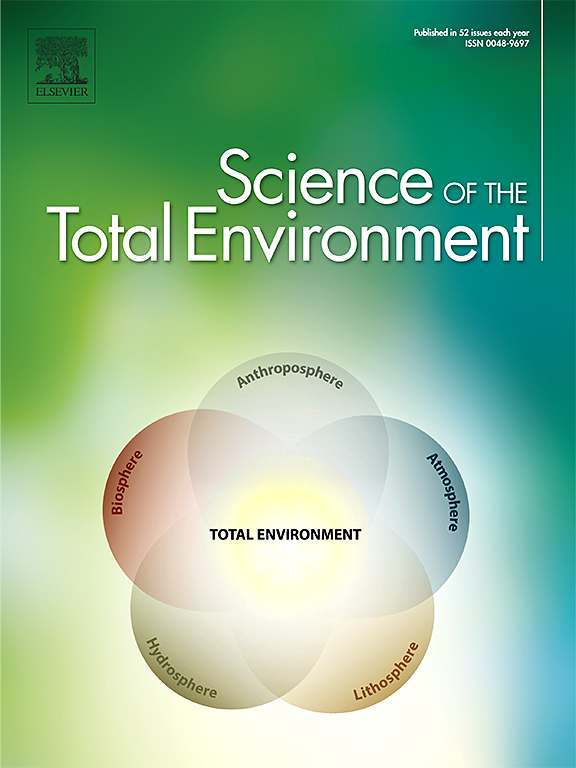
The Science of the Total Environment is an international journal dedicated to scientific research on the environment and its interaction with humanity. It covers a wide range of disciplines and seeks to publish innovative, hypothesis-driven, and impactful research that explores the entire environment, including the atmosphere, lithosphere, hydrosphere, biosphere, and anthroposphere.
The journal's updated Aims & Scope emphasizes the importance of interdisciplinary environmental research with broad impact. Priority is given to studies that advance fundamental understanding and explore the interconnectedness of multiple environmental spheres. Field studies are preferred, while laboratory experiments must demonstrate significant methodological advancements or mechanistic insights with direct relevance to the environment.




 京公网安备 11010802042870号
京ICP备2023020795号-1
京公网安备 11010802042870号
京ICP备2023020795号-1

 分享
分享
 求助内容:
求助内容: 应助结果提醒方式:
 扫码关注我们
