Tim Ludwig Tuengler, Christian Manuel Sterneder, Lyubomir Haralambiev, Friedrich Boettner
{"title":"What does the patients’ perception of alignment tell us about alignment targets in total knee arthroplasty?","authors":"Tim Ludwig Tuengler, Christian Manuel Sterneder, Lyubomir Haralambiev, Friedrich Boettner","doi":"10.1007/s00402-025-05765-4","DOIUrl":null,"url":null,"abstract":"<div><h3>Introduction</h3><p>Knee alignment significantly impacts the outcome of total knee arthroplasty (TKA). Understanding patient perceptions of their knee alignment in relation to objective measurements is essential to ensure optimal surgical outcomes and to meet patients’ expectations. This study reports patients’ perception of pre- and postoperative knee alignment in relation to radiographic alignment measurements.</p><h3>Materials and methods</h3><p>The study included 141 patients with primary osteoarthritis of the knee (mean age: 65.4 years, BMI: 30.8). Patients categorized their knee alignment before and after surgery using a picture-based rating scale: very bow-legged (> 10° varus), bow-legged (2.1–10° varus), straight (2° varus to 2° valgus), knock-kneed (2.1–10° valgus), and very knock-kneed (> 10° valgus). Hip-to-ankle films were performed to compared actual knee alignment with patients’ assessments retrospectively.</p><h3>Results</h3><p>Preoperatively, 15.1% of patients with severe varus, 55.6% with varus, and 86.7% with neutral alignment perceived their knees as straight. None of the patients with valgus or severe valgus alignment considered their knees as straight. Overall, 40.2% of patients with radiographic varus alignment classified their knees as straight, while nobody with valgus alignment did. Postoperatively patients with preoperative varus considered their knees as straight with an average of 1.8 ± 1.7 deg. mechanical varus alignment, while patients with preoperative valgus alignment considered their knees straight with an average of 0.4 ± 0.9 deg. mechanical valgus alignment.</p><h3>Conclusion</h3><p>Patients predominantly desire a straight knee postoperatively, however, most patients tend to perceive some varus alignment as straight. This is most common in patients with up to 5 degrees of varus deformity and suggests that a restricted or inverse kinematic alignment with up to 5 degrees of varus can meet the expectations of most patients. In contrast, patients with valgus deformity are sensitive to any remaining valgus deformity and leaving the knees in more than 2 deg. of valgus will unlikely satisfy the patients’ overall desire for a straight knee after surgery.</p></div>","PeriodicalId":8326,"journal":{"name":"Archives of Orthopaedic and Trauma Surgery","volume":"145 1","pages":""},"PeriodicalIF":2.1000,"publicationDate":"2025-01-25","publicationTypes":"Journal Article","fieldsOfStudy":null,"isOpenAccess":false,"openAccessPdf":"","citationCount":"0","resultStr":null,"platform":"Semanticscholar","paperid":null,"PeriodicalName":"Archives of Orthopaedic and Trauma Surgery","FirstCategoryId":"3","ListUrlMain":"https://link.springer.com/article/10.1007/s00402-025-05765-4","RegionNum":3,"RegionCategory":"医学","ArticlePicture":[],"TitleCN":null,"AbstractTextCN":null,"PMCID":null,"EPubDate":"","PubModel":"","JCR":"Q2","JCRName":"ORTHOPEDICS","Score":null,"Total":0}
引用次数: 0
Abstract
Introduction
Knee alignment significantly impacts the outcome of total knee arthroplasty (TKA). Understanding patient perceptions of their knee alignment in relation to objective measurements is essential to ensure optimal surgical outcomes and to meet patients’ expectations. This study reports patients’ perception of pre- and postoperative knee alignment in relation to radiographic alignment measurements.
Materials and methods
The study included 141 patients with primary osteoarthritis of the knee (mean age: 65.4 years, BMI: 30.8). Patients categorized their knee alignment before and after surgery using a picture-based rating scale: very bow-legged (> 10° varus), bow-legged (2.1–10° varus), straight (2° varus to 2° valgus), knock-kneed (2.1–10° valgus), and very knock-kneed (> 10° valgus). Hip-to-ankle films were performed to compared actual knee alignment with patients’ assessments retrospectively.
Results
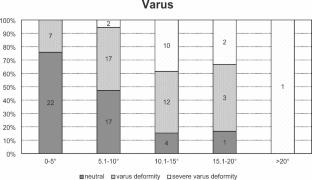
Preoperatively, 15.1% of patients with severe varus, 55.6% with varus, and 86.7% with neutral alignment perceived their knees as straight. None of the patients with valgus or severe valgus alignment considered their knees as straight. Overall, 40.2% of patients with radiographic varus alignment classified their knees as straight, while nobody with valgus alignment did. Postoperatively patients with preoperative varus considered their knees as straight with an average of 1.8 ± 1.7 deg. mechanical varus alignment, while patients with preoperative valgus alignment considered their knees straight with an average of 0.4 ± 0.9 deg. mechanical valgus alignment.
Conclusion
Patients predominantly desire a straight knee postoperatively, however, most patients tend to perceive some varus alignment as straight. This is most common in patients with up to 5 degrees of varus deformity and suggests that a restricted or inverse kinematic alignment with up to 5 degrees of varus can meet the expectations of most patients. In contrast, patients with valgus deformity are sensitive to any remaining valgus deformity and leaving the knees in more than 2 deg. of valgus will unlikely satisfy the patients’ overall desire for a straight knee after surgery.
期刊介绍:
"Archives of Orthopaedic and Trauma Surgery" is a rich source of instruction and information for physicians in clinical practice and research in the extensive field of orthopaedics and traumatology. The journal publishes papers that deal with diseases and injuries of the musculoskeletal system from all fields and aspects of medicine. The journal is particularly interested in papers that satisfy the information needs of orthopaedic clinicians and practitioners. The journal places special emphasis on clinical relevance.
"Archives of Orthopaedic and Trauma Surgery" is the official journal of the German Speaking Arthroscopy Association (AGA).



 京公网安备 11010802042870号
京ICP备2023020795号-1
京公网安备 11010802042870号
京ICP备2023020795号-1

 分享
分享
 求助内容:
求助内容: 应助结果提醒方式:
 扫码关注我们
