Jenny Kling, Robert Persson Asplund, Örjan Ekblom, Victoria Blom
{"title":"Psychological responses to acute exercise in patients with stress-induced exhaustion disorder: a cross-over randomized trial.","authors":"Jenny Kling, Robert Persson Asplund, Örjan Ekblom, Victoria Blom","doi":"10.1186/s12888-025-06484-1","DOIUrl":null,"url":null,"abstract":"<p><strong>Background: </strong>Understanding psychological responses to acute exercise, defined as a single bout of physical exercise, in clinical populations is essential for developing tailored interventions that account for the psychological benefits and challenges of exercise. Given its effectiveness in reducing symptoms in various psychological disorders, exercise should be further explored in Exhaustion Disorder ICD-10-SE: F43.8A (ED), characterized by persistent exhaustion following long-term psychosocial stress. Currently, no studies address the psychological responses to acute exercise in ED patients.</p><p><strong>Aims: </strong>This study aims to (1) compare the psychological responses to acute exercise between ED patients and healthy controls and (2) assess response differences between low and moderate exercise intensities.</p><p><strong>Methods: </strong>We conducted a two-armed cross-over trial comparing ED patients (n = 30) and healthy controls (n = 30). Participants completed a 22-min exercise at low or moderate intensity on a cycle ergometer, on separate occasions, in randomized order. The primary outcome was perceived fatigue (POMS); secondary outcomes included feelings of energy, anxiety, stress, exertion, and psychological discomfort, measured before, during, and up to 24 h post-exercise. Exercise effects were assessed using repeated measures analysis of variance.</p><p><strong>Results: </strong>ED patients reported higher levels of exertion, psychological discomfort, fatigue, anxiety, and stress but lower energy throughout the trial compared to controls. Unlike controls, the ED group showed significant fatigue and stress reductions post-exercise (p < 0.05). Additionally, ED patients showed a more elevated energy after moderate-intensity exercise compared to controls (p < 0.05). Both groups experienced anxiety reductions post-exercise, with no group interactions over time. No differences were observed between pre- and 6 or 24 h post-exercise in any variables. The only intensity effect (p < 0.05) in the ED patients was a more pronounced energy decline 30 min after moderate-intensity exercise.</p><p><strong>Conclusions: </strong>A 22-min exercise session was perceived as more strenuous by patients with exhaustion disorder (ED) and generated greater improvements in feelings of fatigue, energy, and stress compared to healthy individuals without delayed negative effects. These findings highlight the specific psychological responses in ED to exercise and can inform intervention design tailored specifically to this population.</p><p><strong>Trial registration: </strong>The study was retrospectively registered on 05/30/2024 at Clinical Trials.gov, with trial registration number 2022-04943-01.</p>","PeriodicalId":9029,"journal":{"name":"BMC Psychiatry","volume":"25 1","pages":"72"},"PeriodicalIF":3.4000,"publicationDate":"2025-01-24","publicationTypes":"Journal Article","fieldsOfStudy":null,"isOpenAccess":false,"openAccessPdf":"https://www.ncbi.nlm.nih.gov/pmc/articles/PMC11760732/pdf/","citationCount":"0","resultStr":null,"platform":"Semanticscholar","paperid":null,"PeriodicalName":"BMC Psychiatry","FirstCategoryId":"3","ListUrlMain":"https://doi.org/10.1186/s12888-025-06484-1","RegionNum":2,"RegionCategory":"医学","ArticlePicture":[],"TitleCN":null,"AbstractTextCN":null,"PMCID":null,"EPubDate":"","PubModel":"","JCR":"Q2","JCRName":"PSYCHIATRY","Score":null,"Total":0}
引用次数: 0
Abstract
Background: Understanding psychological responses to acute exercise, defined as a single bout of physical exercise, in clinical populations is essential for developing tailored interventions that account for the psychological benefits and challenges of exercise. Given its effectiveness in reducing symptoms in various psychological disorders, exercise should be further explored in Exhaustion Disorder ICD-10-SE: F43.8A (ED), characterized by persistent exhaustion following long-term psychosocial stress. Currently, no studies address the psychological responses to acute exercise in ED patients.
Aims: This study aims to (1) compare the psychological responses to acute exercise between ED patients and healthy controls and (2) assess response differences between low and moderate exercise intensities.
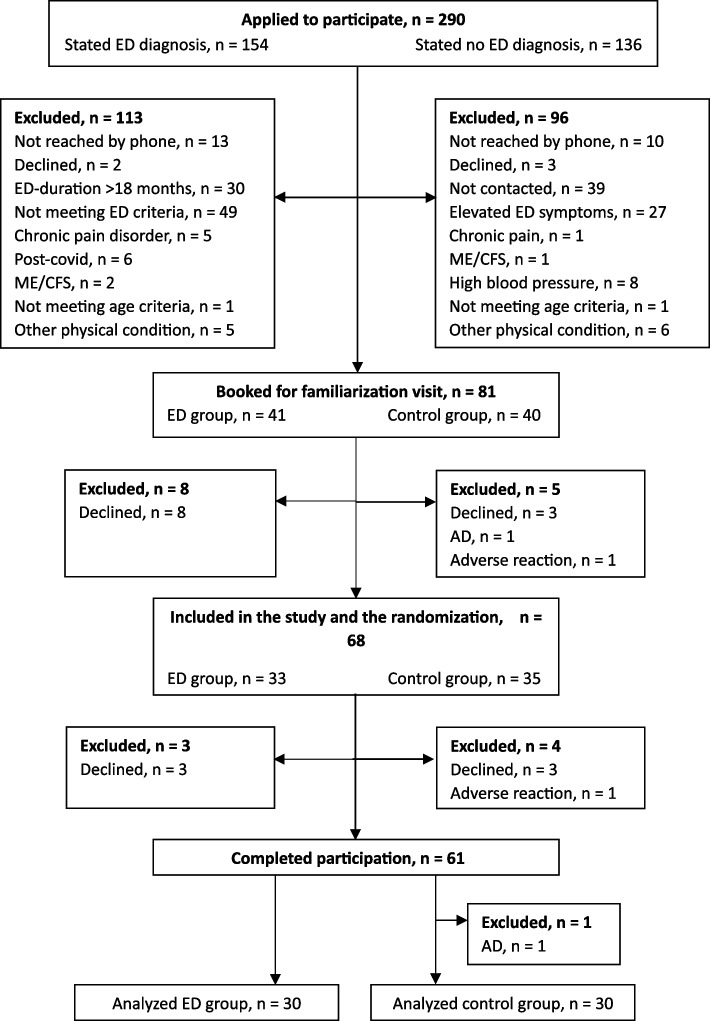
Methods: We conducted a two-armed cross-over trial comparing ED patients (n = 30) and healthy controls (n = 30). Participants completed a 22-min exercise at low or moderate intensity on a cycle ergometer, on separate occasions, in randomized order. The primary outcome was perceived fatigue (POMS); secondary outcomes included feelings of energy, anxiety, stress, exertion, and psychological discomfort, measured before, during, and up to 24 h post-exercise. Exercise effects were assessed using repeated measures analysis of variance.
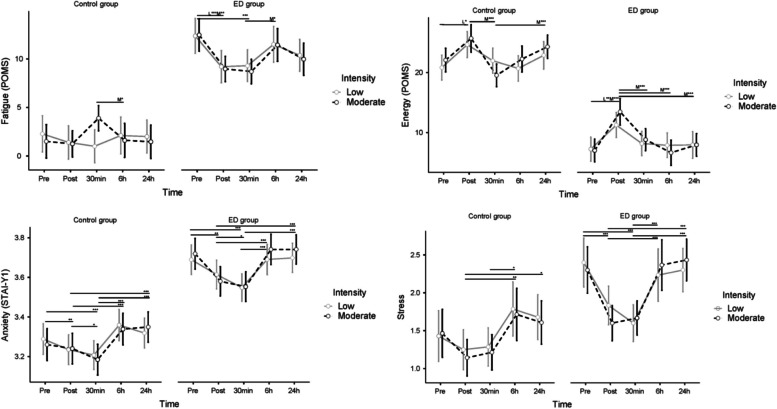
Results: ED patients reported higher levels of exertion, psychological discomfort, fatigue, anxiety, and stress but lower energy throughout the trial compared to controls. Unlike controls, the ED group showed significant fatigue and stress reductions post-exercise (p < 0.05). Additionally, ED patients showed a more elevated energy after moderate-intensity exercise compared to controls (p < 0.05). Both groups experienced anxiety reductions post-exercise, with no group interactions over time. No differences were observed between pre- and 6 or 24 h post-exercise in any variables. The only intensity effect (p < 0.05) in the ED patients was a more pronounced energy decline 30 min after moderate-intensity exercise.
Conclusions: A 22-min exercise session was perceived as more strenuous by patients with exhaustion disorder (ED) and generated greater improvements in feelings of fatigue, energy, and stress compared to healthy individuals without delayed negative effects. These findings highlight the specific psychological responses in ED to exercise and can inform intervention design tailored specifically to this population.
Trial registration: The study was retrospectively registered on 05/30/2024 at Clinical Trials.gov, with trial registration number 2022-04943-01.
期刊介绍:
BMC Psychiatry is an open access, peer-reviewed journal that considers articles on all aspects of the prevention, diagnosis and management of psychiatric disorders, as well as related molecular genetics, pathophysiology, and epidemiology.




 京公网安备 11010802042870号
京ICP备2023020795号-1
京公网安备 11010802042870号
京ICP备2023020795号-1

 分享
分享
 求助内容:
求助内容: 应助结果提醒方式:
 扫码关注我们
