{"title":"The prognostic value of systemic inflammation response index in digestive system carcinomas: a systematic review and meta-analysis.","authors":"Zuo-Hu Niu, Li Lin, Hong-Ye Peng, Xin-Zhuo Zheng, Mi-Yuan Wang, Feng-Xia Sun, Chun-Jun Xu","doi":"10.1186/s12876-025-03635-2","DOIUrl":null,"url":null,"abstract":"<p><strong>Background: </strong>Digestive system carcinomas (DSC) constitute a significant proportion of solid tumors, with incidence rates rising steadily each year. The systemic inflammation response index (SIRI) has been identified as a potential prognostic marker for survival in various types DSC. This meta-analysis aimed to evaluate the prognostic value of SIRI in patients with DSC.</p><p><strong>Methods: </strong>We conducted a comprehensive literature search of PubMed, Web of Science Core Collection, Embase, and Cochrane Library databases, searching for studies published from inception to May 30, 2023. Eligible studies included cohort studies that assessed the association between pre-treatment SIRI levels and DSC prognosis. We extracted and synthesized hazard ratios (HRs) and 95% confidence intervals (CIs) using STATA/SE 12.0, stratifying HRs based on univariable and multivariable analysis. Due to substantial heterogeneity, we applied a random-effect model for all pooled analyses. The primary outcome of interest was the overall survival (OS), while secondary outcomes included progression-free survival (PFS), disease-free survival (DFS), time to progression (TTP), and disease specific survival (DSS). Publication bias was evaluated using Begg's test and Egger's tests.</p><p><strong>Results: </strong>A total of 34 cohort studies encompassing 9628 participants were included in this meta-analysis. Notable heterogeneity was observedin the OS (I<sup>2</sup> = 76.5%, p < 0.001) and PFS (I<sup>2</sup> = 82.8%, p = 0.001) subgroups, whereas no significant heterogeneity was detected in the DFS, TTP, and DSS subgroups. Elevated SIRI was found to be significantly associated with shorter OS (HR = 1.98, 95% CI: 1.70-2.30, tau<sup>2</sup> = 0.0966) and poorer PFS (HR = 2.36, 95% CI: 1.58-3.53, tau<sup>2</sup> = 0.1319), DFS (HR = 1.80, 95% CI: 1.61-2.01, tau<sup>2</sup> < 0.0001), TTP (HR = 2.03, 95% CI: 1.47-2.81, tau<sup>2</sup> = 0.0232), and DSS (HR = 1.99, 95% CI: 1.46-2.72, tau<sup>2</sup> < 0.0001). Furthermore, an increase in SIRI following treatment was linked to reduced OS, TTP, and DFS, while a decrease in SIRI post-treatment corresponded with improved OS, TTP, and DFS compared to baseline levels.</p><p><strong>Conclusions: </strong>Elevated SIRI is associated with poorer clinical outcomes in patients with DSC. This index may serve as a valuable prognostic biomarker, offering a promising tool for predicting survival in DSC patients.</p><p><strong>Prospero: </strong>REGISTRATION NUMBER: CRD42023430962.</p>","PeriodicalId":9129,"journal":{"name":"BMC Gastroenterology","volume":"25 1","pages":"34"},"PeriodicalIF":2.5000,"publicationDate":"2025-01-24","publicationTypes":"Journal Article","fieldsOfStudy":null,"isOpenAccess":false,"openAccessPdf":"https://www.ncbi.nlm.nih.gov/pmc/articles/PMC11761727/pdf/","citationCount":"0","resultStr":null,"platform":"Semanticscholar","paperid":null,"PeriodicalName":"BMC Gastroenterology","FirstCategoryId":"3","ListUrlMain":"https://doi.org/10.1186/s12876-025-03635-2","RegionNum":3,"RegionCategory":"医学","ArticlePicture":[],"TitleCN":null,"AbstractTextCN":null,"PMCID":null,"EPubDate":"","PubModel":"","JCR":"Q2","JCRName":"GASTROENTEROLOGY & HEPATOLOGY","Score":null,"Total":0}
引用次数: 0
Abstract
Background: Digestive system carcinomas (DSC) constitute a significant proportion of solid tumors, with incidence rates rising steadily each year. The systemic inflammation response index (SIRI) has been identified as a potential prognostic marker for survival in various types DSC. This meta-analysis aimed to evaluate the prognostic value of SIRI in patients with DSC.
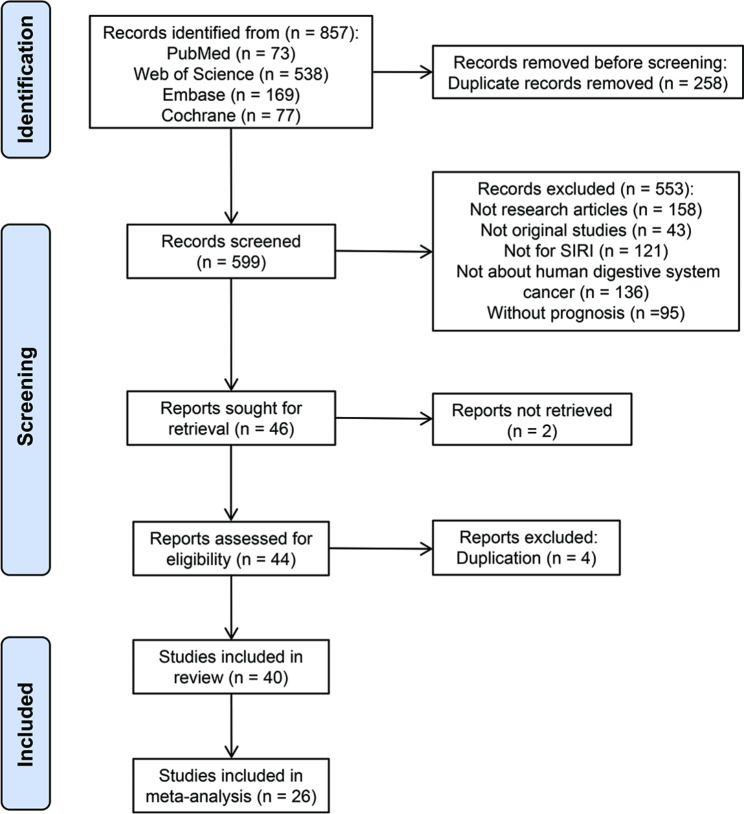
Methods: We conducted a comprehensive literature search of PubMed, Web of Science Core Collection, Embase, and Cochrane Library databases, searching for studies published from inception to May 30, 2023. Eligible studies included cohort studies that assessed the association between pre-treatment SIRI levels and DSC prognosis. We extracted and synthesized hazard ratios (HRs) and 95% confidence intervals (CIs) using STATA/SE 12.0, stratifying HRs based on univariable and multivariable analysis. Due to substantial heterogeneity, we applied a random-effect model for all pooled analyses. The primary outcome of interest was the overall survival (OS), while secondary outcomes included progression-free survival (PFS), disease-free survival (DFS), time to progression (TTP), and disease specific survival (DSS). Publication bias was evaluated using Begg's test and Egger's tests.
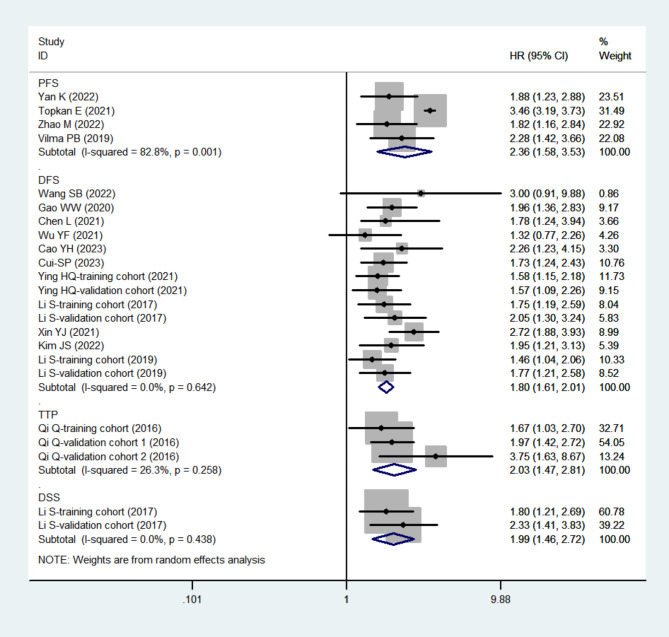
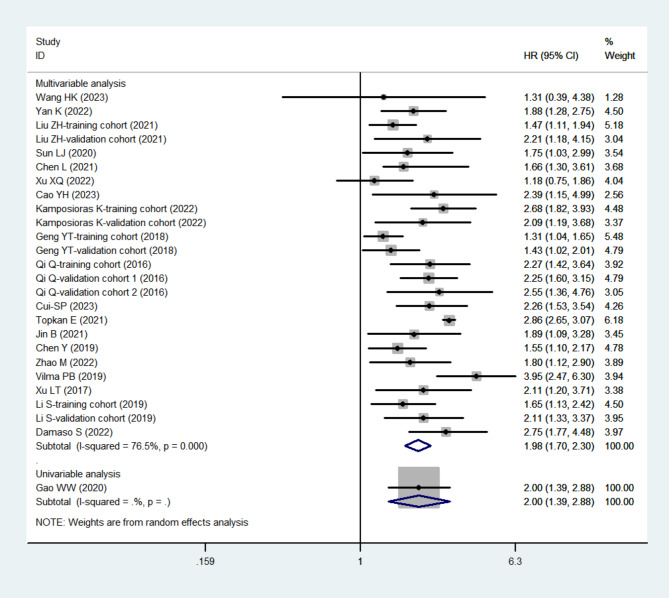
Results: A total of 34 cohort studies encompassing 9628 participants were included in this meta-analysis. Notable heterogeneity was observedin the OS (I2 = 76.5%, p < 0.001) and PFS (I2 = 82.8%, p = 0.001) subgroups, whereas no significant heterogeneity was detected in the DFS, TTP, and DSS subgroups. Elevated SIRI was found to be significantly associated with shorter OS (HR = 1.98, 95% CI: 1.70-2.30, tau2 = 0.0966) and poorer PFS (HR = 2.36, 95% CI: 1.58-3.53, tau2 = 0.1319), DFS (HR = 1.80, 95% CI: 1.61-2.01, tau2 < 0.0001), TTP (HR = 2.03, 95% CI: 1.47-2.81, tau2 = 0.0232), and DSS (HR = 1.99, 95% CI: 1.46-2.72, tau2 < 0.0001). Furthermore, an increase in SIRI following treatment was linked to reduced OS, TTP, and DFS, while a decrease in SIRI post-treatment corresponded with improved OS, TTP, and DFS compared to baseline levels.
Conclusions: Elevated SIRI is associated with poorer clinical outcomes in patients with DSC. This index may serve as a valuable prognostic biomarker, offering a promising tool for predicting survival in DSC patients.
期刊介绍:
BMC Gastroenterology is an open access, peer-reviewed journal that considers articles on all aspects of the prevention, diagnosis and management of gastrointestinal and hepatobiliary disorders, as well as related molecular genetics, pathophysiology, and epidemiology.



 京公网安备 11010802042870号
京ICP备2023020795号-1
京公网安备 11010802042870号
京ICP备2023020795号-1

 分享
分享
 求助内容:
求助内容: 应助结果提醒方式:
 扫码关注我们
