{"title":"An Efficient 3D Convolutional Neural Network for Dose Prediction in Cancer Radiotherapy from CT Images.","authors":"Lam Thanh Hien, Pham Trung Hieu, Do Nang Toan","doi":"10.3390/diagnostics15020177","DOIUrl":null,"url":null,"abstract":"<p><p><b>Introduction</b>: Cancer is a highly lethal disease with a significantly high mortality rate. One of the most commonly used methods for treatment is radiation therapy. However, cancer treatment using radiotherapy is a time-consuming process that requires significant manual work from planners and doctors. In radiation therapy treatment planning, determining the dose distribution for each of the regions of the patient's body is one of the most difficult and important tasks. Nowadays, artificial intelligence has shown promising results in improving the quality of disease treatment, particularly in cancer radiation therapy. <b>Objectives</b>: The main objective of this study is to build a high-performance deep learning model for predicting radiation therapy doses for cancer and to develop software to easily manipulate and use this model. <b>Materials and Methods</b>: In this paper, we propose a custom 3D convolutional neural network model with a U-Net-based architecture to automatically predict radiation doses during cancer radiation therapy from CT images. To ensure that the predicted doses do not have negative values, which are not valid for radiation doses, a rectified linear unit (ReLU) function is applied to the output to convert negative values to zero. Additionally, a proposed loss function based on a dose-volume histogram is used to train the model, ensuring that the predicted dose concentrations are highly meaningful in terms of radiation therapy. The model is developed using the OpenKBP challenge dataset, which consists of 200, 100, and 40 head and neck cancer patients for training, testing, and validation, respectively. Before the training phase, preprocessing and augmentation techniques, such as standardization, translation, and flipping, are applied to the training set. During the training phase, a cosine annealing scheduler is applied to update the learning rate. <b>Results and Conclusions</b>: Our model achieved strong performance, with a good DVH score (1.444 Gy) on the test dataset, compared to previous studies and state-of-the-art models. In addition, we developed software to display the dose maps predicted by the proposed model for each 2D slice in order to facilitate usage and observation. These results may help doctors in treating cancer with radiation therapy in terms of both time and effectiveness.</p>","PeriodicalId":11225,"journal":{"name":"Diagnostics","volume":"15 2","pages":""},"PeriodicalIF":3.3000,"publicationDate":"2025-01-14","publicationTypes":"Journal Article","fieldsOfStudy":null,"isOpenAccess":false,"openAccessPdf":"https://www.ncbi.nlm.nih.gov/pmc/articles/PMC11765056/pdf/","citationCount":"0","resultStr":null,"platform":"Semanticscholar","paperid":null,"PeriodicalName":"Diagnostics","FirstCategoryId":"3","ListUrlMain":"https://doi.org/10.3390/diagnostics15020177","RegionNum":3,"RegionCategory":"医学","ArticlePicture":[],"TitleCN":null,"AbstractTextCN":null,"PMCID":null,"EPubDate":"","PubModel":"","JCR":"Q1","JCRName":"MEDICINE, GENERAL & INTERNAL","Score":null,"Total":0}
引用次数: 0
Abstract
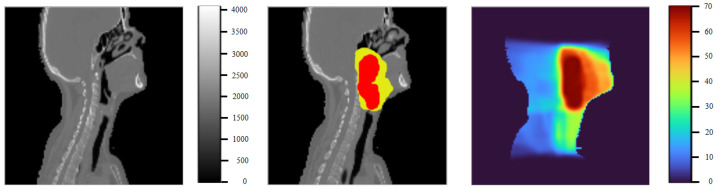
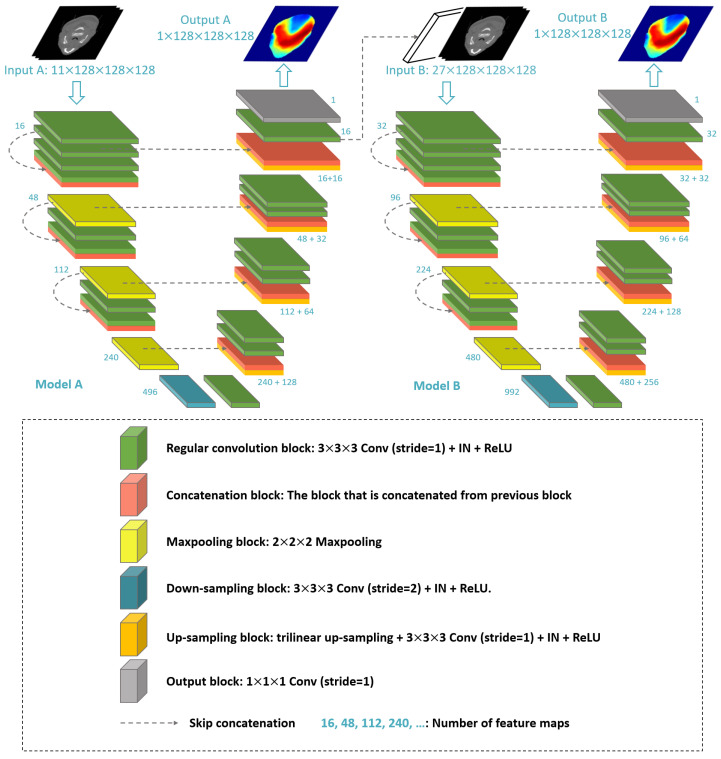
Introduction: Cancer is a highly lethal disease with a significantly high mortality rate. One of the most commonly used methods for treatment is radiation therapy. However, cancer treatment using radiotherapy is a time-consuming process that requires significant manual work from planners and doctors. In radiation therapy treatment planning, determining the dose distribution for each of the regions of the patient's body is one of the most difficult and important tasks. Nowadays, artificial intelligence has shown promising results in improving the quality of disease treatment, particularly in cancer radiation therapy. Objectives: The main objective of this study is to build a high-performance deep learning model for predicting radiation therapy doses for cancer and to develop software to easily manipulate and use this model. Materials and Methods: In this paper, we propose a custom 3D convolutional neural network model with a U-Net-based architecture to automatically predict radiation doses during cancer radiation therapy from CT images. To ensure that the predicted doses do not have negative values, which are not valid for radiation doses, a rectified linear unit (ReLU) function is applied to the output to convert negative values to zero. Additionally, a proposed loss function based on a dose-volume histogram is used to train the model, ensuring that the predicted dose concentrations are highly meaningful in terms of radiation therapy. The model is developed using the OpenKBP challenge dataset, which consists of 200, 100, and 40 head and neck cancer patients for training, testing, and validation, respectively. Before the training phase, preprocessing and augmentation techniques, such as standardization, translation, and flipping, are applied to the training set. During the training phase, a cosine annealing scheduler is applied to update the learning rate. Results and Conclusions: Our model achieved strong performance, with a good DVH score (1.444 Gy) on the test dataset, compared to previous studies and state-of-the-art models. In addition, we developed software to display the dose maps predicted by the proposed model for each 2D slice in order to facilitate usage and observation. These results may help doctors in treating cancer with radiation therapy in terms of both time and effectiveness.
DiagnosticsBiochemistry, Genetics and Molecular Biology-Clinical Biochemistry
CiteScore
4.70
自引率
8.30%
发文量
2699
审稿时长
19.64 days
期刊介绍:
Diagnostics (ISSN 2075-4418) is an international scholarly open access journal on medical diagnostics. It publishes original research articles, reviews, communications and short notes on the research and development of medical diagnostics. There is no restriction on the length of the papers. Our aim is to encourage scientists to publish their experimental and theoretical research in as much detail as possible. Full experimental and/or methodological details must be provided for research articles.




 京公网安备 11010802042870号
京ICP备2023020795号-1
京公网安备 11010802042870号
京ICP备2023020795号-1

 分享
分享
 求助内容:
求助内容: 应助结果提醒方式:
 扫码关注我们
