GABRIEL SAYER MD , MUSTAFA M. AHMED MD , MANDEEP R. MEHRA MD MSC , IGOR GOSEV MD , HIMABINDU VIDULA MD , ADAM D. DEVORE MD, MHS , DOUGLAS A. HORSTMANSHOF MD , JOSEPH C. CLEVELAND JR. MD , GARRICK C. STEWART MD , MARK S. SLAUGHTER MD , KAROL MUDY MD , AIJIA WANG MPH , NIR URIEL MD, MSc
{"title":"Implantable Cardioverter-Defibrillators and Cardiovascular Resynchronization Therapy with Left Ventricular Assist DevicesA MOMENTUM 3 Trial Analysis","authors":"GABRIEL SAYER MD , MUSTAFA M. AHMED MD , MANDEEP R. MEHRA MD MSC , IGOR GOSEV MD , HIMABINDU VIDULA MD , ADAM D. DEVORE MD, MHS , DOUGLAS A. HORSTMANSHOF MD , JOSEPH C. CLEVELAND JR. MD , GARRICK C. STEWART MD , MARK S. SLAUGHTER MD , KAROL MUDY MD , AIJIA WANG MPH , NIR URIEL MD, MSc","doi":"10.1016/j.cardfail.2024.12.011","DOIUrl":null,"url":null,"abstract":"<div><h3>Background</h3><div>The benefit of implantable cardioverter-defibrillators (ICDs) and cardiovascular resynchronization therapy defibrillators (CRT-Ds) in patients supported with a HeartMate 3 left ventricular assist device (LVAD) remains uncertain.</div></div><div><h3>Methods</h3><div>An analysis was done of the Multicenter Study of MAGLEV Technology in Patients Undergoing Mechanical Circulatory Support Therapy with HeartMate 3 (MOMENTUM 3) randomized clinical trial and the first 1000 patients in the Continued Access Protocol (CAP) trial. Patients were divided into 3 groups based on the presence of an ICD and/or CRT-D: No device (n = 153, 11%), ICD only (n = 699, 50.4%), and CRT-D (n = 535, 38.6%). We assessed the association of ICDs or CRT-Ds with overall mortality, ventricular arrhythmias (VAs), rehospitalization rates, quality of life, and the 6-minute walk test distance at 2 years’ follow-up.</div></div><div><h3>Results</h3><div>Patients with an ICD or CRT-D had similar survival to those without (hazard ratio [HR], 1.3; 95% CI 0.8–2.1, <em>P</em> = .36) with no differences in rehospitalizations, quality of life or 6-minute walk test distance. VA occurred more frequently in patients with an ICD or CRT-D (HR, 2.4; 95% CI 1.3-4.3, <em>P</em> = .006). Compared with an ICD alone, patients with a CRT-D demonstrated similar survival (HR, 1.1; 95% CI 0.9–1.5, <em>P</em> = .36). However, they had increased rates of VA (HR, 1.3; 95% CI 1.0–1.7, <em>P</em> = .03). There were no differences in rate of rehospitalization between those with an ICD or CRT-D and those without (<em>P</em> = .19) or between those with an ICD and those with a CRT-D (<em>P</em> = .32). A propensity-matched sensitivity analysis confirmed these findings.</div></div><div><h3>Conclusions</h3><div>In this post-hoc analysis of the MOMENTUM 3 trial, the presence of an ICD or CRT-D at the time of HM3 LVAD implantation was associated with an increased incidence of VA but was not associated with survival, quality of life, or functional capacity.</div></div><div><h3>Trial Registration</h3><div>Momentum 3 portfolio, NCT02224755 (Pivotal) and NCT02892955 (CAP)</div></div>","PeriodicalId":15204,"journal":{"name":"Journal of Cardiac Failure","volume":"31 10","pages":"Pages 1548-1557"},"PeriodicalIF":8.2000,"publicationDate":"2025-10-01","publicationTypes":"Journal Article","fieldsOfStudy":null,"isOpenAccess":false,"openAccessPdf":"","citationCount":"0","resultStr":null,"platform":"Semanticscholar","paperid":null,"PeriodicalName":"Journal of Cardiac Failure","FirstCategoryId":"3","ListUrlMain":"https://www.sciencedirect.com/science/article/pii/S1071916425000120","RegionNum":2,"RegionCategory":"医学","ArticlePicture":[],"TitleCN":null,"AbstractTextCN":null,"PMCID":null,"EPubDate":"2025/1/22 0:00:00","PubModel":"Epub","JCR":"Q1","JCRName":"CARDIAC & CARDIOVASCULAR SYSTEMS","Score":null,"Total":0}
引用次数: 0
Abstract
Background
The benefit of implantable cardioverter-defibrillators (ICDs) and cardiovascular resynchronization therapy defibrillators (CRT-Ds) in patients supported with a HeartMate 3 left ventricular assist device (LVAD) remains uncertain.
Methods
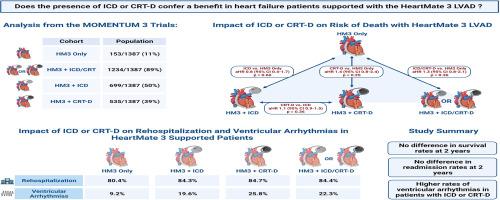
An analysis was done of the Multicenter Study of MAGLEV Technology in Patients Undergoing Mechanical Circulatory Support Therapy with HeartMate 3 (MOMENTUM 3) randomized clinical trial and the first 1000 patients in the Continued Access Protocol (CAP) trial. Patients were divided into 3 groups based on the presence of an ICD and/or CRT-D: No device (n = 153, 11%), ICD only (n = 699, 50.4%), and CRT-D (n = 535, 38.6%). We assessed the association of ICDs or CRT-Ds with overall mortality, ventricular arrhythmias (VAs), rehospitalization rates, quality of life, and the 6-minute walk test distance at 2 years’ follow-up.
Results
Patients with an ICD or CRT-D had similar survival to those without (hazard ratio [HR], 1.3; 95% CI 0.8–2.1, P = .36) with no differences in rehospitalizations, quality of life or 6-minute walk test distance. VA occurred more frequently in patients with an ICD or CRT-D (HR, 2.4; 95% CI 1.3-4.3, P = .006). Compared with an ICD alone, patients with a CRT-D demonstrated similar survival (HR, 1.1; 95% CI 0.9–1.5, P = .36). However, they had increased rates of VA (HR, 1.3; 95% CI 1.0–1.7, P = .03). There were no differences in rate of rehospitalization between those with an ICD or CRT-D and those without (P = .19) or between those with an ICD and those with a CRT-D (P = .32). A propensity-matched sensitivity analysis confirmed these findings.
Conclusions
In this post-hoc analysis of the MOMENTUM 3 trial, the presence of an ICD or CRT-D at the time of HM3 LVAD implantation was associated with an increased incidence of VA but was not associated with survival, quality of life, or functional capacity.
Trial Registration
Momentum 3 portfolio, NCT02224755 (Pivotal) and NCT02892955 (CAP)
期刊介绍:
Journal of Cardiac Failure publishes original, peer-reviewed communications of scientific excellence and review articles on clinical research, basic human studies, animal studies, and bench research with potential clinical applications to heart failure - pathogenesis, etiology, epidemiology, pathophysiological mechanisms, assessment, prevention, and treatment.



 京公网安备 11010802042870号
京ICP备2023020795号-1
京公网安备 11010802042870号
京ICP备2023020795号-1

 分享
分享
 求助内容:
求助内容: 应助结果提醒方式:
 扫码关注我们
