David Seixas Esteves, Amanda Melo, Sónia Alves, Nelson Durães, Maria C Paiva, Elsa W Sequeiros
{"title":"Magnetic Field-Assisted Orientation and Positioning of Magnetite for Flexible and Electrically Conductive Sensors.","authors":"David Seixas Esteves, Amanda Melo, Sónia Alves, Nelson Durães, Maria C Paiva, Elsa W Sequeiros","doi":"10.3390/mi16010068","DOIUrl":null,"url":null,"abstract":"<p><p>Magnetic field-assisted control of magnetite location is a promising strategy for developing flexible, electrically conductive sensors with enhanced performance and adjustable properties. This study investigates the effect of static magnetic fields applied on thermoplastic elastomer (TPE) composites with magnetite and multi-walled carbon nanotubes (MWCNT). The composites were prepared by compression moulding and the magnetic field was applied on the mould cavity during processing. Composites were prepared with a range of concentrations of magnetite (1, 3, and 6 wt.%) and MWCNT (1 and 3 wt.%). The effect of particle concentration on composite viscosity was investigated. Rheological analysis showed that MWCNTs significantly increased the composite viscosity while magnetite had minimal impact, ensuring stable processing and facilitating particle orientation under a static magnetic field. Particle orientation and electrical conductivity were evaluated for the composites prepared with different particle concentrations under different processing temperatures. Magnetic field application at 190 °C enhanced magnetite/MWCNT interactions, substantially reducing electrical resistivity while preserving thermal stability. The composites showed no degradation at 220 °C and above, demonstrating suitability for high-temperature applications requiring thermal resilience. Furthermore, magnetite's magnetic response facilitated precise sensor positioning and strong adhesion to polyimide substrates at 220 °C. These findings demonstrate a scalable and adaptable approach for enhancing sensor performance and positioning, with broad potential in flexible electronics.</p>","PeriodicalId":18508,"journal":{"name":"Micromachines","volume":"16 1","pages":""},"PeriodicalIF":3.0000,"publicationDate":"2025-01-08","publicationTypes":"Journal Article","fieldsOfStudy":null,"isOpenAccess":false,"openAccessPdf":"https://www.ncbi.nlm.nih.gov/pmc/articles/PMC11768084/pdf/","citationCount":"0","resultStr":null,"platform":"Semanticscholar","paperid":null,"PeriodicalName":"Micromachines","FirstCategoryId":"5","ListUrlMain":"https://doi.org/10.3390/mi16010068","RegionNum":3,"RegionCategory":"工程技术","ArticlePicture":[],"TitleCN":null,"AbstractTextCN":null,"PMCID":null,"EPubDate":"","PubModel":"","JCR":"Q2","JCRName":"CHEMISTRY, ANALYTICAL","Score":null,"Total":0}
引用次数: 0
Abstract
Magnetic field-assisted control of magnetite location is a promising strategy for developing flexible, electrically conductive sensors with enhanced performance and adjustable properties. This study investigates the effect of static magnetic fields applied on thermoplastic elastomer (TPE) composites with magnetite and multi-walled carbon nanotubes (MWCNT). The composites were prepared by compression moulding and the magnetic field was applied on the mould cavity during processing. Composites were prepared with a range of concentrations of magnetite (1, 3, and 6 wt.%) and MWCNT (1 and 3 wt.%). The effect of particle concentration on composite viscosity was investigated. Rheological analysis showed that MWCNTs significantly increased the composite viscosity while magnetite had minimal impact, ensuring stable processing and facilitating particle orientation under a static magnetic field. Particle orientation and electrical conductivity were evaluated for the composites prepared with different particle concentrations under different processing temperatures. Magnetic field application at 190 °C enhanced magnetite/MWCNT interactions, substantially reducing electrical resistivity while preserving thermal stability. The composites showed no degradation at 220 °C and above, demonstrating suitability for high-temperature applications requiring thermal resilience. Furthermore, magnetite's magnetic response facilitated precise sensor positioning and strong adhesion to polyimide substrates at 220 °C. These findings demonstrate a scalable and adaptable approach for enhancing sensor performance and positioning, with broad potential in flexible electronics.
期刊介绍:
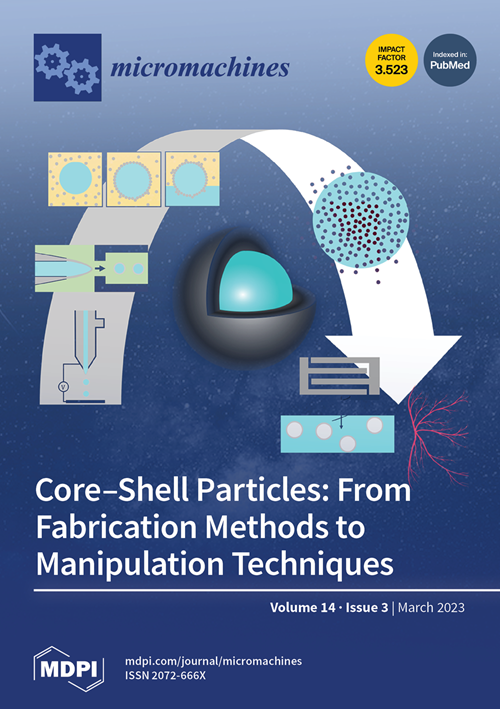
Micromachines (ISSN 2072-666X) is an international, peer-reviewed open access journal which provides an advanced forum for studies related to micro-scaled machines and micromachinery. It publishes reviews, regular research papers and short communications. Our aim is to encourage scientists to publish their experimental and theoretical results in as much detail as possible. There is no restriction on the length of the papers. The full experimental details must be provided so that the results can be reproduced.



 京公网安备 11010802042870号
京ICP备2023020795号-1
京公网安备 11010802042870号
京ICP备2023020795号-1

 分享
分享
 求助内容:
求助内容: 应助结果提醒方式:
 扫码关注我们
