Weston Bussler, Katelyn DeZego, Holli Chandler, Robert W Reid, Slavko Komarnytsky
{"title":"Nutrient-Nutrient Interactions Among Broccoli Glucosinolates and Their Implications for Breeding Cruciferous Crops to Enhance Human Health.","authors":"Weston Bussler, Katelyn DeZego, Holli Chandler, Robert W Reid, Slavko Komarnytsky","doi":"10.3390/nu17020344","DOIUrl":null,"url":null,"abstract":"<p><p>While a balanced diet can fulfill most nutritional needs, optimizing the composition of specific foods like broccoli can amplify their health benefits.</p><p><strong>Background/objectives: </strong>Broccoli (<i>Brassica oleracea</i> L. Italica group) is a widely consumed cruciferous vegetable valued for its gastrointestinal and immune health benefits. However, the individual contributions and interactions of broccoli glucosinolates, as they hydrolyze into bioactive isothiocyanates, remain poorly understood.</p><p><strong>Methods: </strong>This study investigated mixtures of four major aliphatic glucosinolates-glucoraphanin, gluconapin, progoitrin, and sinigrin-in individual and combinational models to assess their effects on human colorectal cell proliferation.</p><p><strong>Results: </strong>Combination index analysis revealed moderate to strong antagonistic interactions among these glucosinolates, with the most significant antagonism observed during enzymatic hydrolysis by myrosinase. Mixture analysis identified an optimal glucosinolate ratio including glucoraphanin (81-84%), gluconapin (9-19%), and others (0-7%) to maximize their antiproliferative effects (adjusted R<sup>2</sup> > 0.80). This optimal profile was achievable within the target broccoli mapping population. Testing the near-optimal VB067 isogenic broccoli line showed a 44% increase in antiproliferative activity compared to the initial breeding parent or an average sister line.</p><p><strong>Conclusions: </strong>This study highlights the potential of leveraging nutrient-nutrient interactions to guide molecular breeding and produce functional varieties of cruciferous vegetables with optimized health benefits.</p>","PeriodicalId":19486,"journal":{"name":"Nutrients","volume":"17 2","pages":""},"PeriodicalIF":5.0000,"publicationDate":"2025-01-18","publicationTypes":"Journal Article","fieldsOfStudy":null,"isOpenAccess":false,"openAccessPdf":"https://www.ncbi.nlm.nih.gov/pmc/articles/PMC11768351/pdf/","citationCount":"0","resultStr":null,"platform":"Semanticscholar","paperid":null,"PeriodicalName":"Nutrients","FirstCategoryId":"3","ListUrlMain":"https://doi.org/10.3390/nu17020344","RegionNum":2,"RegionCategory":"医学","ArticlePicture":[],"TitleCN":null,"AbstractTextCN":null,"PMCID":null,"EPubDate":"","PubModel":"","JCR":"Q1","JCRName":"NUTRITION & DIETETICS","Score":null,"Total":0}
引用次数: 0
Abstract
While a balanced diet can fulfill most nutritional needs, optimizing the composition of specific foods like broccoli can amplify their health benefits.
Background/objectives: Broccoli (Brassica oleracea L. Italica group) is a widely consumed cruciferous vegetable valued for its gastrointestinal and immune health benefits. However, the individual contributions and interactions of broccoli glucosinolates, as they hydrolyze into bioactive isothiocyanates, remain poorly understood.
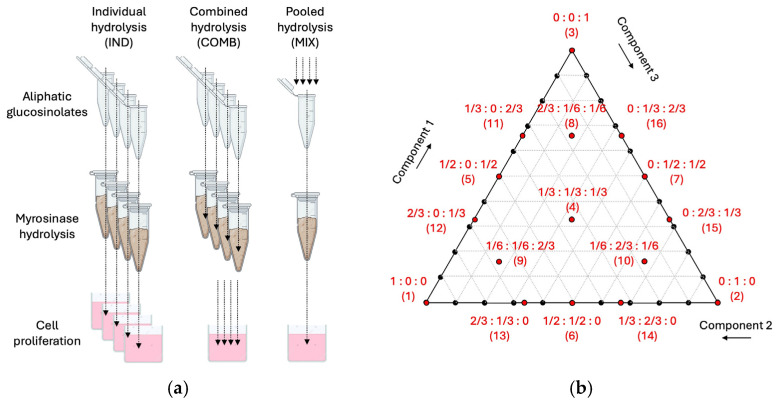
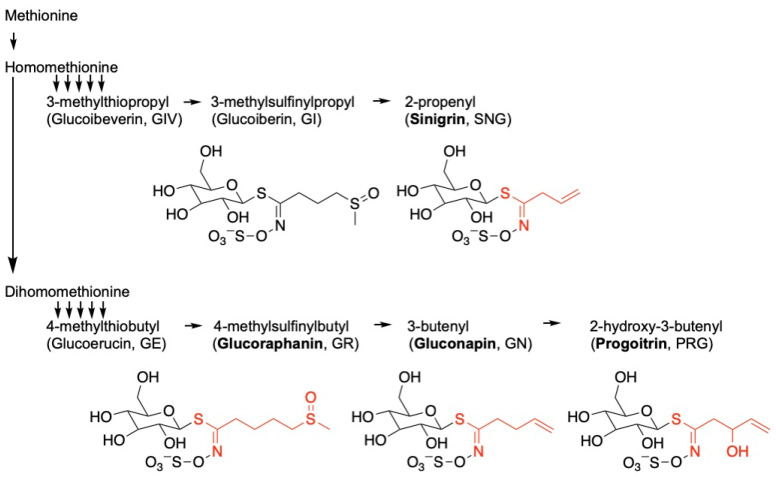
Methods: This study investigated mixtures of four major aliphatic glucosinolates-glucoraphanin, gluconapin, progoitrin, and sinigrin-in individual and combinational models to assess their effects on human colorectal cell proliferation.
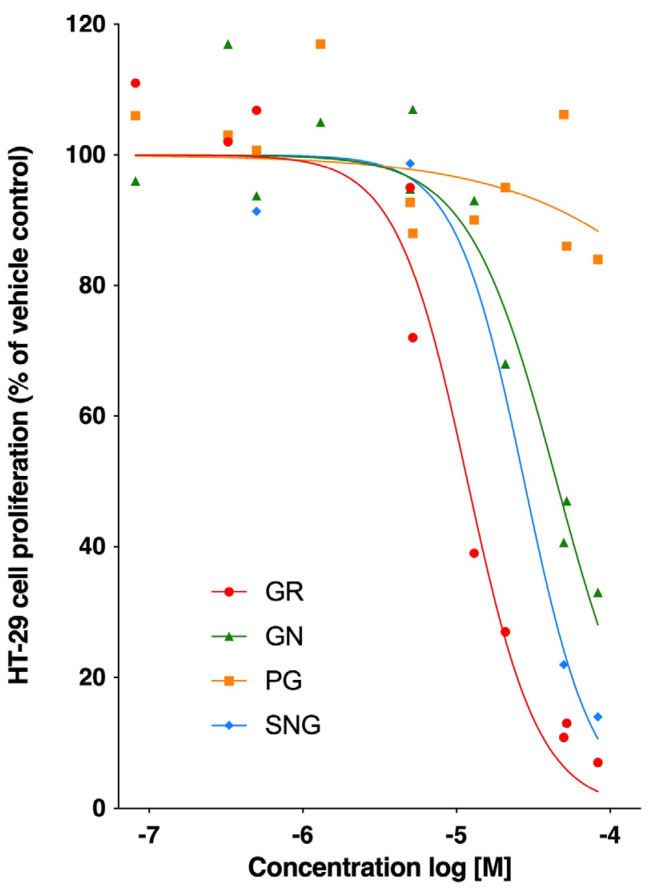
Results: Combination index analysis revealed moderate to strong antagonistic interactions among these glucosinolates, with the most significant antagonism observed during enzymatic hydrolysis by myrosinase. Mixture analysis identified an optimal glucosinolate ratio including glucoraphanin (81-84%), gluconapin (9-19%), and others (0-7%) to maximize their antiproliferative effects (adjusted R2 > 0.80). This optimal profile was achievable within the target broccoli mapping population. Testing the near-optimal VB067 isogenic broccoli line showed a 44% increase in antiproliferative activity compared to the initial breeding parent or an average sister line.
Conclusions: This study highlights the potential of leveraging nutrient-nutrient interactions to guide molecular breeding and produce functional varieties of cruciferous vegetables with optimized health benefits.
虽然均衡的饮食可以满足大多数营养需求,但优化特定食物的成分,如西兰花,可以放大它们对健康的益处。背景/目的:西兰花(Brassica oleracea L. Italica group)是一种广泛食用的十字花科蔬菜,因其对胃肠道和免疫健康的益处而受到重视。然而,当西兰花硫代葡萄糖苷水解成具有生物活性的异硫氰酸酯时,它们的个体贡献和相互作用仍然知之甚少。方法:本研究在单独和组合模型中研究了四种主要的脂肪族硫代葡萄糖苷-葡萄糖苷,葡萄糖苷,原高蛋白和紫红素-的混合物,以评估它们对人类结肠细胞增殖的影响。结果:联合指数分析显示,这些硫代葡萄糖苷之间存在中强拮抗作用,在黑子酶水解过程中观察到最显著的拮抗作用。混合分析确定了最佳硫代葡萄糖苷配比,包括葡萄糖苷(81-84%)、葡萄糖苷(9-19%)和其他(0-7%),以最大限度地发挥其抗增殖作用(调整R2 bb0 0.80)。在目标西兰花定位群体中可以实现这一最佳剖面。对接近最优的VB067等基因西兰花品系的测试表明,与初始育种亲本或普通姊妹品系相比,其抗增殖活性提高了44%。结论:本研究强调了利用营养-营养相互作用指导分子育种和培育具有最佳健康效益的十字花科蔬菜功能品种的潜力。
期刊介绍:
Nutrients (ISSN 2072-6643) is an international, peer-reviewed open access advanced forum for studies related to Human Nutrition. It publishes reviews, regular research papers and short communications. Our aim is to encourage scientists to publish their experimental and theoretical results in as much detail as possible. There is no restriction on the length of the papers. The full experimental details must be provided so that the results can be reproduced.




 京公网安备 11010802042870号
京ICP备2023020795号-1
京公网安备 11010802042870号
京ICP备2023020795号-1

 分享
分享
 求助内容:
求助内容: 应助结果提醒方式:
 扫码关注我们
